



Camp Hebron and Dimapur in Nagaland; Imphal, Senapati and Ukhrul in Manipur
In a wooden cupboard of a house in Imphal lies one of the most unusual relics of the Naga movement: an old pair of jeans.
The garment has been stitched together with patches of different colours and sizes. The knees have been repaired repeatedly. Threads hold the garment together almost as much as the denim itself. Some seams are so thick that the jeans seem weary of the weight of its own history.
Every seam can, perhaps, trace the journey of the man who wore them: Thuingaleng Muivah. The 92-year-old general secretary of the National Socialist Council of Nagaland (Isak-Muivah)—known as ‘Ato Kilonser (prime minister) of the Republic of Nagalim’ and affectionately called “uncle” by many Nagas—has endured as much as those jeans have.

For more than six decades, he has survived clandestine journeys through jungles, crossed international borders, and weathered factional splits, exile and political struggles. Muivah has been tested by time, much like the old jeans. It reached the cupboard in Imphal as a gift to his only sister, Longrungla, who died during his years of fighting. Together, the man and the garment have endured South Asia’s longest-running insurgency—the Naga political struggle.
The Naga struggle began before Indian independence, deepened after 1947 and survived military crackdowns, factional splits, ceasefires and endless negotiations. Born in 1934, Muivah has lived through every phase of it. He survived long enough to guide the movement towards the framework agreement signed in 2015 with then interlocutor R.N. Ravi in the presence of Prime Minister Narendra Modi. The agreement was expected to lead to a permanent solution to the Naga issue.
Today, however, Muivah stands at a crossroads. He may still bring lasting peace to the Nagas, or leave behind an insurgency that continues to simmer, thanks to cadres who have long operated from Myanmar and continue to move across the frontier with relative ease. With time running out and a final settlement remaining elusive, the stakes are becoming higher.
Ironically, one of the gravest injuries Muivah suffered during the insurgency years did not come at the hands of the Indian Army, but during an attack on a Burmese post at Taklang in 1976. Former Naga army commanders recall seeing Muivah badly wounded by grenade shrapnel. “Nearly 47 of them pierced his chest, jawbone and knee,” recalls a senior former Naga army officer. “Those were the most serious injuries of his revolutionary life.”
With no hospitals or medical facilities available in the jungle, he was initially treated in makeshift camps by close aide V.S Atem, a medically trained officer who received training from the Chinese. He would later become General Atem.
For months, Muivah remained fragile deep inside the forests. Eventually, he and a small group began a journey on foot towards China for treatment. Because his wounds were severe, the trek took more than three months. He underwent surgery in China’s Yunnan province.
Today, Muivah’s confidant and former Naga army chief Phunting Shimrang is believed to be in Yunnan after escaping from India in 2019. He is learnt to be supported by the NSCN(IM)’s national security adviser Pamshin Muivah, based in Myanmar. Together, they command considerable influence within the organisation.
Over the past few years, as peace talks with the Indian government stalled over contentious issues of a separate Naga flag and constitution, the NSCN(IM) has increasingly consolidated its presence in Myanmar. A new formation, called the Eastern Flank and led by former Naga army chief Hanshi Ramsan, has emerged. The group is believed to command around 250 cadres. Its support base has grown after Ikato Chishi Swu, son of late NSCN(IM) cofounder Isak Chishi Swu, joined hands with the group. The NSCN(IM) today appears divided into separate spheres of influence, with the Phunting-Pamshin group and Hanshi operating independently in different zones.
THE LAST OPPORTUNITY FOR PEACE
Any major crackdown on Hebron—the NSCN(IM)’s biggest camp in Nagaland—could produce two outcomes. The organisation could fragment and gradually shift its operational base to Myanmar. Or, hardline factions could regroup into smaller and potentially more lethal units.
Muivah appears to have prepared for both eventualities by repositioning leaders such as Phunting, Pamshin and Hanshi across the border. Yet his larger intent seems clear: he wants peace and places greater faith in negotiations than in prolonged conflict. Indian officials see the present moment as perhaps the last opportunity to stitch together a durable peace accord.
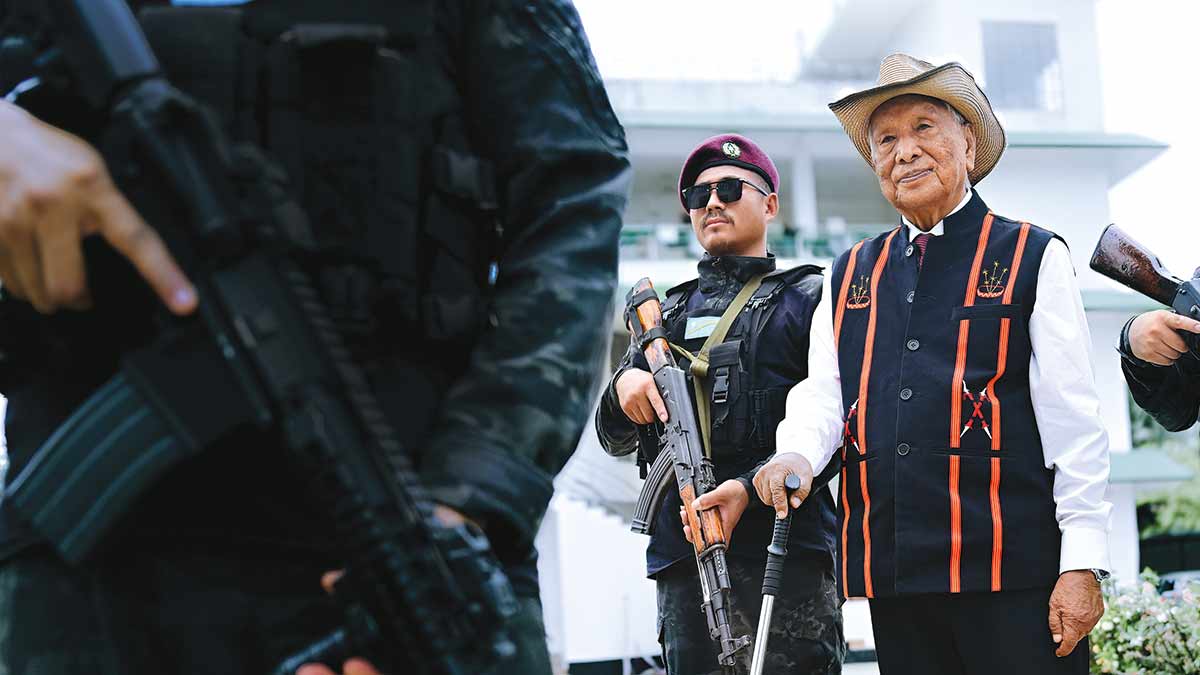
THE WEEK met Muivah at his residence in Dimapur, a two-hour drive from Hebron, an arrangement made necessary by his failing health. He lives here with his wife, Pakahao Muivah, following a strict routine of regular walks around the compound. Naga army commandos carrying sophisticated weapons guard him wherever he goes.
Muivah is both emotional and pragmatic. “When you come here with the intention to understand the Nagas sincerely, we value that very seriously,” he tells THE WEEK during an exclusive interaction. “We never expected many people from India to come and stay with us to understand our history.”
According to Muivah, the gap between the Nagas and Indians widened because of violence, killings and mistrust accumulated over decades. “But we are prepared to understand those who come with sincerity,” he says.
Today, Muivah is distraught as the ethnic conflict between the Meitei and Kuki-Zo communities in Manipur has slowly spread to areas where the Nagas live. The NSCN(IM) has been careful to avoid involvement, but recent months have exposed divisions not just between the valley and hill districts but also within hill areas inhabited by both the Kuki-Zo and Naga communities. Muivah accuses the Indian side of supporting the Kuki-Zo, an allegation that threatens to delay the peace process further. “Despite the framework agreement, they (the Indian government) are using force against us through the Kukis. It is an attempt to humiliate and crush us,” he says.
For Muivah, history must be understood in a realistic sense to find common ground. “If the history of the Nagas is not respected and honoured, there can be no real solution,” he says. Memories of how the Naga were treated when the Naga National Council raised its demand for self-determination run very deep in the Naga movement. But Muivah says he places humanity above politics. “If there is respect for human history and suffering,” he says, “solutions can be found.”
He emphasised his willingness to continue talks with New Delhi, because “problems should be resolved through understanding, not endless conflict”. For those outside the conflict who wonder why the movement has endured for so long, he has a straightforward explanation: “It concerns identity, history and the future of our people. If people genuinely try to understand the realities of the Nagas, they will also understand why this movement has endured for so long.”
THE UNCLE AND THE LEGEND
Muivah’s patchwork jeans is one of the last surviving artefacts of the Naga movement’s private history.
It arrived home in secrecy. At some point during his years underground, Muivah sent it home through a messenger as proof that he was alive. It eventually found its way into a wooden cupboard, where it remained for years before being rediscovered by his nephew Ningreingam Ruivah.
One day, Ruivah sat down with the worn fabric to meditate on his family history and the unfinished story of the Naga struggle. “For a long time it was kept in my mother’s cupboard,” Ruivah says. His connection with his uncle dates back to the year he was born in the mid-1960s. His mother often recalled one brief visit Muivah made after learning that she had given birth to a son. “He asked, ‘So it is a son?’ and was very happy,” Ruivah says. Only years later did the family understand the significance of that visit. “I think he came to say goodbye,” Ruivah says.
Muivah soon disappeared into the jungles, beginning the journey that would transform him into one of the most influential figures in Naga politics.
Long before he became a legend, though, Muivah existed in family stories as an energetic and stubborn boy. Longrungla was the eldest among five siblings. After her came brothers Shangreihan and James, followed by Muivah and the youngest, Asui. Today, only Muivah and Asui survive.
“My mother used to say many children in the village followed him while playing,” Ruivah says. “He always wanted to lead, and he was determined to complete tasks.”
Born in Somdal village in the Tangkhul hills of Manipur’s Ukhrul district, Muivah eventually rose to become one of the most prominent leaders at Hebron. His rise was remarkable because he was a Tangkhul Naga at the centre of a movement whose leadership was dominated by Nagas from present-day Nagaland. In 1980, when he became Ato Kilonser, a section of the Nagas questioned his meteoric rise. But Muivah carried the title with quiet authority.
After one of the NSCN’s founders, S.S. Khaplang, established his own faction based in Myanmar, the Isak-Muivah faction, led by Muivah and Isak Chishi Swu, gradually became the dominant force in the Naga movement. Run from Hebron, the NSCN(IM)’s parallel government has its own parliament, cabinet, courts and prisons. Deep inside Hebron is the army headquarters that claims to command 10,000 cadres, including men and women.
In 2015, Swu signed the framework agreement on his deathbed, leaving Muivah to shape the tenuous final accord. A decade later, in 2025, Muivah travelled by helicopter from Hebron to Somdal to celebrate his 92nd birthday. For many villagers, the visit carried deep symbolism. The elderly saw him as the last surviving pillar of a movement that had shaped generations.
His return also revived stories that have long circulated in Naga households. One such story dates back to 1973, when villagers had gathered at a newly built church in Somdal for a ceremony. Apparently, Muivah arrived in disguise and watched the proceedings from a nearby cave before slipping away.
In family homes, the stories are more personal. Ruivah remembers the tale of a gruelling journey through the jungles along the Myanmar border. Cadres travelling with Muivah were exhausted after months of difficult training. They reached a point where each person had only a single glucose biscuit left to eat. Most consumed theirs immediately, but Muivah broke his biscuit into smaller pieces and distributed it.
Stories like this make up Muivah the legend. The Nagas believe that the little boy from Somdal has waited long enough to bring peace to the land.
THE LOST HOME IN MYANMAR
If Ruivah’s story is about inheritance and belonging, the story of Pasheto Chishi Swu—son of Isak Chishi—is one of separation. Born in the Naga areas in eastern Myanmar, Pasheto was one year and eight months old when he was separated from his parents and sent to Nagaland to live with relatives. His other siblings, also born in Myanmar, were sent to different homes.
“I met my parents only in 1993, when I was 15,” Pasheto says. “It was in Nepal.” Factionalism had forced Isak to move to Nepal and go underground. Over the years, the family met in different countries. One of Pasheto’s best memories is of a reunion in the Philippines. “We were there as a family—each one of us,” he recalls. “We stayed together for a year.”
It was his first opportunity to know his father and siblings. At home, the legendary Naga leader was a man of few words. After completing his master’s degree, Pasheto formally joined the organisation and worked closely with his father at Hebron. Those were the years when Swu’s health began to fail. “He always seemed to be recovering,” Pasheto says. “Because of his long sufferings, he had many health complications. Every time he went for treatment, he would spend a month or two in hospital.”
Isak’s final years overlapped with one of the most significant moments in the history of the Naga peace process—the signing of the framework agreement in 2015. “It was special because it was the only agreement for the Nagas signed by top Indian leaders,” Pasheto says. “My father signed it.”
If insurgent families like Pasheto’s bore one kind of burden, the families of intermediaries in the peace process carried another.
For nearly two decades, from the signing of the ceasefire in 1997 until his death in 2016, Grinder Muivah moved quietly through the shadows of the long-running peace process. Son of Muivah’s elder brother Shangreihan and a trusted go-between, he helped sustain communication between the NSCN(IM) leadership and the Indian government.
Grinder worked in construction to support his family. His widow, Sonia, says the family paid a heavy price because of his involvement. “People thought that because he was the go-between, he must be receiving help either from the government or from the NSCN. He got nothing,” she says. According to her, the only support he received came in the form of travel arrangements and tickets when talks were held abroad.
The family’s most painful trial came in March 2000. Earlier that year, Muivah was arrested in Bangkok for allegedly having a meeting with the Pakistani intelligence establishment in Rawalpindi in which he was offered full support for ramping up the insurgency in the northeast. He was detained in Bangkok after foreign agencies were reportedly alerted of “a suspected North Korean terrorist” travelling on a South Korean passport.
Grinder travelled to Bangkok to meet Muivah, and soon found himself drawn into a controversy. On his return, he was detained at Kolkata airport, accused of plotting to hijack an aircraft to secure Muivah’s release. “It was all splashed in the newspapers that my husband was arrested,” Sonia says. “He was taken to Aizawl. That was a very difficult time for me because my children were in school.”
Nearly four months passed before Grinder was released. During that period, Sonia travelled between Delhi, Kolkata and Mizoram, trying to make sense of the situation and making legal arrangements.
“No help came from the government,” she says. “He had no identity card—nothing in writing saying he was the go-between.” Sonia is grateful for the help she got from his lawyer, Nandita Haksar. “If not for her, I don’t know what the situation might have been,” she says.
While Grinder was away, she ran the family’s Noida factory and raised four children. “I was the one looking after the children and the business.”
The couple had married in 1987. Sonia had graduated from Miranda House and was considering a career in the civil services. Grinder had studied at St Stephen’s College.
The highs and lows of their life mirrored the Naga struggle. When the 2015 framework agreement was signed, Grinder was jubilant. “He took the family out to the Claridges hotel in Delhi,” she says. Peace seemed within reach.
But less than a year later, in April 2016, Grinder passed away.
After his death, Sonia sought the help of interlocutor R.N. Ravi, but was told that there was no formal record of Grinder’s role in the negotiations. Disappointed but determined, Sonia chose not to allow the past to define her family’s future. Her children decided not to continue in their father’s footsteps, choosing to involve themselves in business rather than in politics.
“As a family,” she says, “we did not want to become involved because we were not sure how sincere the government of India was about the peace process.”
THE LAST CHAPTER OF THE FOUNDERS
Today, young Nagas are revisiting their history, trying to understand why decades of bloodshed has not brought about a final settlement. Some elders talk of missed opportunities, including during the Indira Gandhi era. Others recall delegations received at Hyderabad House, when the Naga issue was treated with seriousness.
Now, time weighs heavily on the Naga movement—Swu is gone, and Muivah is in his nineties. Questions of succession, unity and political transition remain unresolved.
The strife in Manipur has further complicated the situation, with many Tangkhul Nagas facing difficulties in travelling from Dimapur to the hill districts of Manipur. In regions where the Naga and Kuki-Zo communities have clashed in the past, land and territory issues continue to fester.
Back in Hebron, life continues much as it has for years. Hannah, a 29-year-old soldier in the Naga army, says she joined to serve her people. “My father is a farmer and all my siblings are doing different jobs,” she says. “But I am happy to be here.”
As the sun begins to set, young soldiers gather, carrying M16 and AK-47 rifles, rocket-propelled grenades, and drones. One drone flies smoothly over the Naga flag fluttering over the headquarters, revealing a sprawling landscape of green hills, training grounds and buildings, including a magnificent church. Beyond Hebron lie the jungles stretching into Myanmar, where generations of Naga soldiers were trained to fight.
For all his years of struggle, Muivah today appears ready to extend an olive branch to the Indian government. Those familiar with the talks say the Indian government is prepared to give substantial autonomy to the Nagas within the constitutional framework, while emphasising that there is no scope for secession.
A lot hinges on how the two sides plan to bridge the gap between aspirations and reality. Uncertainty may not be good: in the absence of a final peace agreement, a post-Muivah era could weaken the NSCN(IM)’s unity and authority. It could also diminish the influence of its moderate leadership that has for years kept sections of the Naga movement committed to dialogue. Without the weight and legitimacy of the NSCN(IM)’s founding generation, say some Indian officials, the younger and more hardline elements could steer the outfit back towards armed resistance.
“I am like a cat with nine lives,” Muivah once told Indian security officials.
The patchwork jeans he sent home from the jungles remain adequate proof of his resilience. Perhaps, the fabric can also serve as a fitting metaphor for the future of Naga movement itself: fractured, weakened and tested by time, it may still patch itself together for a long fight if Muivah departs without securing peace.
