


 Add as a preferred source on Google

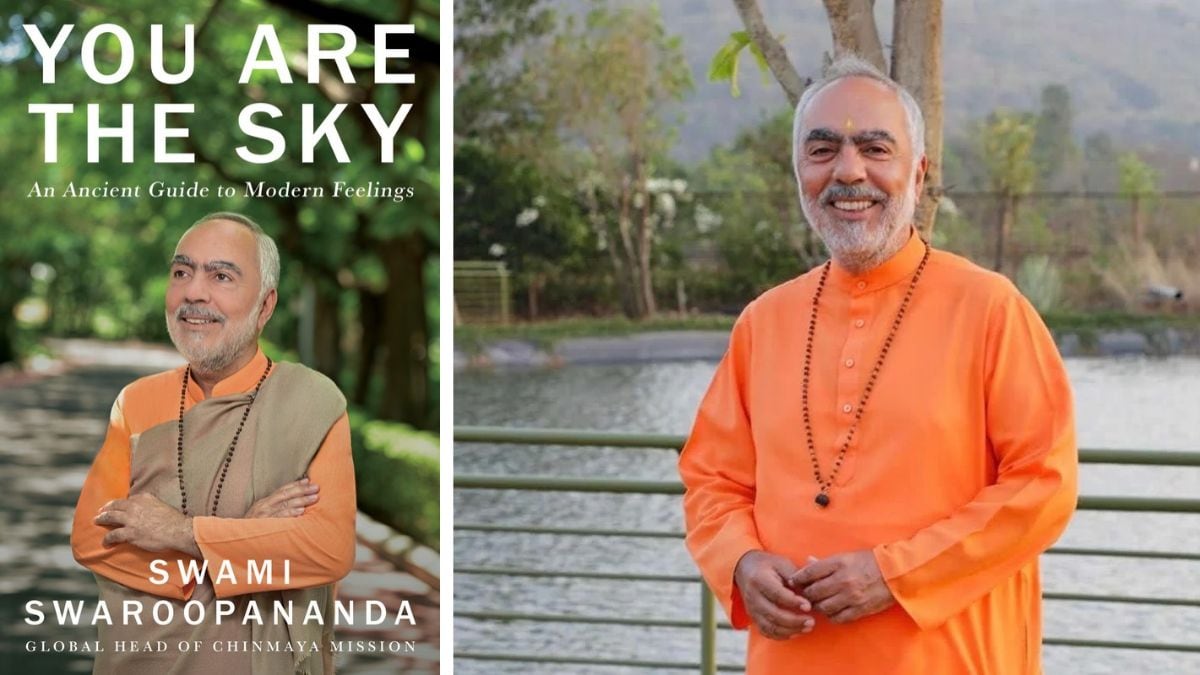
Swami Swaroopananda, global head of the Chinmaya Mission, recently released his new book, You Are The Sky: An Ancient Guide to Modern Feelings, published by Pan Macmillan India. Inspired by Vedantic philosophy and modern psychology, it examines how to experience emotions without letting them describe us.
Swami Swaroopananda has headed the Chinmaya Mission since January 2017, succeeding Swami Tejomayananda. He oversees more than 350 centres worldwide and serves as chancellor of Chinmaya Vishwa Vidyapeeth.
Born in Mumbai and raised in Hong Kong, he was inspired by Swami Chinmayananda’s commentary on the Bhagavad Gita, and was initiated into the monastic order in 1992 by Swami Chinmayananda.
In an interview with THE WEEK, he speaks about his new book, navigating modern emotions and the future of Chinmaya Mission. Excerpts:
Q/ Your book is titled ‘You Are The Sky’. What prompted you to choose this title?
A/ The sky is a beautiful metaphor for our true nature. Clouds may gather, storms may arise, and rain may pour, but none of these change the sky itself. Similarly, emotions come and go within us. We experience happiness, anger, jealousy, fear, guilt and sadness, sometimes with great intensity.
Yet, there is something within us that remains constant, beyond the changing nature of these experiences.
We often identify completely with what we feel. When we are angry, we say, "I am angry." When we are sad, we believe that sadness defines us. But our ancient wisdom invites us to look deeper. It teaches us that we are not merely the emotions we experience temporarily; we are the awareness that observes them.
The title, You Are The Sky, is an invitation to discover this deeper understanding of ourselves. It does not suggest that we should suppress our emotions or become indifferent to them. Rather, we must learn to experience them without allowing them to define or control us. When we recognise that we are the sky and not the passing clouds, we begin to develop a healthier and more peaceful relationship with our emotions.
Q/ Has modern technology made us more emotionally vulnerable?
A/ Technology, in itself, is neither good nor bad. It is a powerful instrument, and like any instrument, its impact depends on how we use it. However, the way we engage with technology today has certainly introduced new emotional challenges.
Social media constantly exposes us to carefully curated versions of other people's lives. We see their achievements, celebrations, travels and successes, and often begin comparing them with our own everyday experiences. This can create feelings of inadequacy, jealousy and dissatisfaction. The expectation of instant responses, immediate validation and constant connectivity can also make it difficult for us to be comfortable with ourselves.
But I would not say that technology has created these emotions. Jealousy, insecurity, fear and the desire for approval have always existed. What technology has done is provide these tendencies with more opportunities to express themselves, often at an unprecedented speed and scale.
The solution, therefore, is not to reject technology but to develop greater awareness in our relationship with it. We must learn to use technology without becoming psychologically dependent on it.
A little reflection, restraint and time away from constant stimulation can help us reconnect with ourselves. Ultimately, no amount of external validation can give us the inner fulfilment that comes from understanding who we truly are.
Q/ Can we truly separate ourselves from our emotions?
A/ I would say that we do not need to separate ourselves from our emotions; we need to understand what they are trying to tell us about ourselves and to adjust our relationship with them.
Emotions are a natural part of the human experience. They bring colour, depth and meaning to our relationships and experiences. Love, compassion, joy and empathy enrich our lives. Even emotions such as anger, fear and sadness can reveal something about our inner state and the way we respond to the world.
The difficulty arises when we start to completely identify with these emotions. When anger takes over, we may say or do things we later regret. When fear dominates us, we may miss opportunities. When sadness becomes our entire identity, we may lose sight of the many other dimensions of our existence.
Vedanta does not ask us to become emotionless. It teaches us to become aware of our emotions rather than be controlled by them.
There is a difference between experiencing anger and allowing anger to dictate our actions. There is a difference between feeling sad and believing that we are nothing but sadness.
This understanding gives us the freedom to respond rather than react. We can acknowledge what we feel, understand it and choose how to act. In fact, the more aware we become, the more genuinely human and compassionate our responses can be.
Q/ If you could change one thing about the way Indian society understands and deals with emotions, what would it be?
A/ I would like us to move away from treating emotional vulnerability as a weakness.
In many parts of our society, we are taught to celebrate success, strength and achievement, but we are not always equally comfortable discussing fear, disappointment, anxiety or sadness. Children are sometimes told not to cry, young people are expected to have everything figured out, and adults often feel that they must always appear strong. As a result, people learn to hide what they feel rather than understand it.
We must create an environment in which emotional conversations are not accompanied by judgement or shame.
This should begin at home and extend to our schools, colleges and workplaces. We must teach children not only how to succeed academically but also how to understand themselves, manage their emotions and develop healthy relationships.
There is an important distinction between acknowledging an emotion and allowing it to overwhelm us. Both aspects need to be understood. We should encourage people to express what they feel, but also equip them with the wisdom to navigate those feelings.
Our ancient Indian wisdom has a great deal to offer in this regard. Vedanta teaches us self-awareness, reflection and a deeper understanding of the mind. If we can bring these principles into everyday life, we can build a society that is not only more emotionally aware but also more compassionate and resilient.
Q/ Swami Chinmayananda took Vedanta beyond traditional ashrams and brought it to students, professionals and ordinary households. How do you assess his legacy 75 years after the Mission was founded?
A/ Pujya Swami Chinmayananda's greatest contribution was that he made the timeless wisdom of Vedanta accessible and relevant to ordinary people.
He recognised that spirituality was not something to be confined to ashrams or reserved for those who had renounced worldly responsibilities. It was equally relevant to students, professionals, homemakers, business leaders and anyone seeking to understand life better.
Through his discourses, study groups, publications and interactions with people across different sections of society, he brought the message of the Upanishads and the Bhagavad Gita into everyday conversations. He encouraged people to question, enquire and apply this knowledge in their own lives rather than merely accept it as tradition.
Above all, he believed deeply in selfless seva, dedicating his life to sharing this liberating knowledge and spreading true happiness across all walks of life.
75 years after the founding of the Chinmaya Mission in 1951, the relevance of his vision is perhaps greater than ever. Today, the Mission has grown to more than 350 centres worldwide, along with educational institutions, youth programmes and several initiatives serving different sections of society. Yet, the essence remains the same: to make people aware of their inherent potential and help them lead more meaningful lives.
For me, his legacy is not simply the institutions he established or the number of people he reached. It is the spirit of enquiry, transformation and self-discovery that he inspired in people. The real tribute to Pujya Gurudev is to continue making Vedanta relevant to every generation, while remaining faithful to its timeless message.
Q/ What is the vision for Chinmaya Mission over the next 25 years?
A/ Our vision for Chinmaya Mission over the next 25 years is to take the timeless wisdom of Vedanta to an even wider audience, particularly the younger generations, while remaining rooted in the vision and teachings of Pujya Gurudev Swami Chinmayananda.
The world is changing rapidly. Young people today are navigating a very different environment, shaped by technology, artificial intelligence, social media, changing career aspirations and evolving social relationships.
While the external circumstances may change, the fundamental questions of human life remain the same. Who am I? What gives my life meaning? How do I find lasting happiness? These are questions that Vedanta has addressed for centuries.
We must find relevant and engaging ways to bring this wisdom to contemporary audiences. Our youth initiatives, educational institutions, study groups and digital platforms will continue to play an important role in this endeavour. At the same time, we must strengthen our efforts in education, character development, community service and the holistic growth of individuals.
I also envision a Mission that continues to nurture capable teachers, dedicated volunteers and future leaders who can carry this knowledge forward with conviction and compassion. Our responsibility is not merely to expand our reach, but also to deepen our impact.
Ultimately, the guiding principle remains Gurudev's vision of ‘Maximum happiness for the maximum number of people for the maximum time’. If, over the next 25 years, we can help more individuals discover inner strength, live with greater awareness and contribute positively to society, we would have carried his legacy forward in the truest sense.
