



For most households, Dussehra immediately means family feasts, dancing, singing, fairs (melas), sweets, idol displays (bomma kolu) and Ramlila plays that culminate in the spectacular and fiery Ravana Dahan. The ten-day festival reaches its zenith with Ravana Dahan, the ceremonial burning of giant effigies of the ten-headed demon king Ravana, his brother Kumbhakarna and son Meghanada.
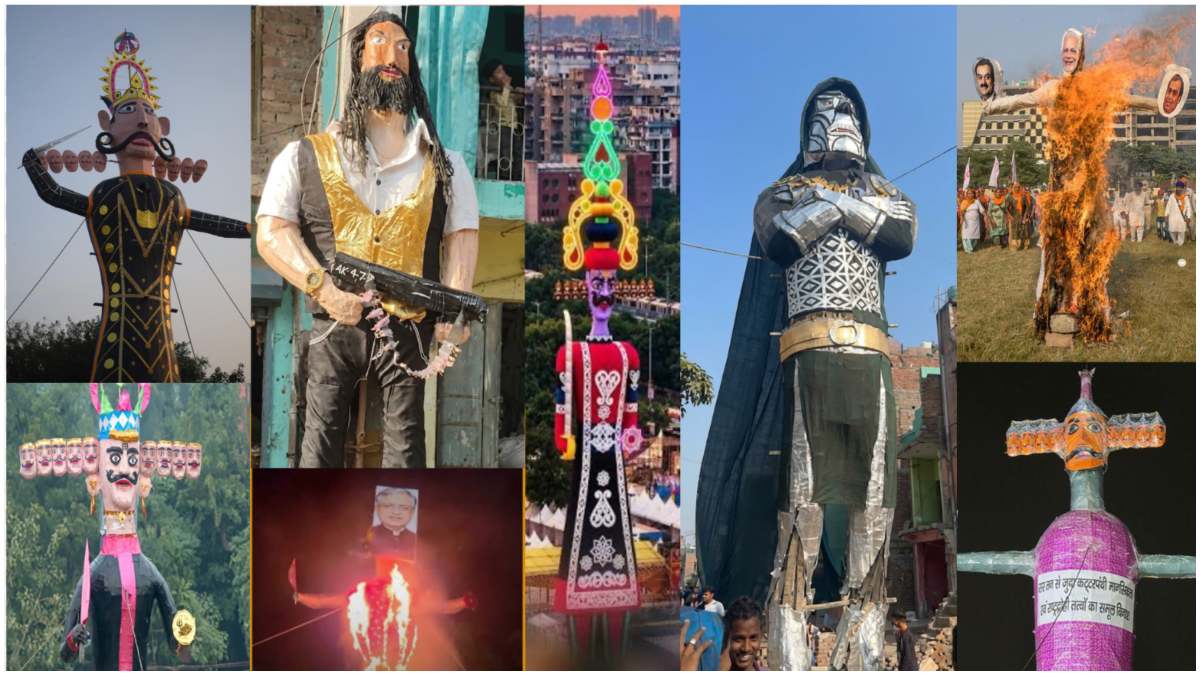
Anyone exposed to the Dussehra culture can resonate with the childhood familiarity of Ravana from the Ramayana as the unquestionable villain. This is changing as we grow up and enter a more political world. The idea of a villain becomes less straightforward as the story moves beyond mythology, into public life. In 2026, Dussehra rituals took on new targets, turning the choice of what to burn into a statement in itself. From a 22-storey-high Ravana to effigies of political figures and party symbols, this year’s Dussehra showcased heights of creative expression and artistry.
Tradition meets pageantry: Hey Ram!
Almost acclaiming the title of the World’s tallest Ravana, Delhi’s Dwarka Dussehra Mela was a crowd puller primarily for its enormous 221-feet-tall Ravana Effigy, approximately the height of a 22-storey building. This stands second to the tallest Ravana effigy, which was set up in Kota, Rajasthan, at a height of 221.5 feet. Another artistic feat was the effigy by the historic Luv Kush Ramlila in Delhi, which took a rather dramatic turn, adding a rotating sword, glowing eyes and a feature wherein the effigy uttered “Hey Ram!” when struck with the flaming arrow.
The cockroach in the political kitchen
The meteoric rise of the Cockroach Janta Party (CJP) is gaining both widespread support and criticism as a political movement. After successfully leading movements that got the Union education minister to resign, the CJP is actively fighting and exposing corrupt practices. This has caused political upheavals and a sense of hostility towards them from right-wing groups, media commentators, and law enforcement authorities, among others, resulting in the burning of cockroach effigies in some parts of the country, especially Delhi.
The election watchdog in Dussehra crosshairs
The Chief Election Commissioner of India, Gyanesh Kumar, has been facing severe criticism due to controversies and allegations surrounding mass voter deletions through SIR (Special Intensive Revision), partisan bias and internal ECI dissent. With opposition and youth demanding his resignation, the election watchdog CEC Kumar is caught in Dussehra crosshairs, with effigies of his face burnt all across the nation, notably in the protest by the Youth Congress.
Doomsday, Dussehra edition
On a lighter note, the Delhi effigies only get more interesting. This year, Dr. Doom Ravana, an Indian twist to the classic Marvel character Victor Von Doom, made his debut. Marvel's supreme monarch and Hindu mythology's ten–headed demon king are, in some sense, multiversal counterparts with their shared ambitions and interest in conquering and creating illusions. Even Hamza Ali Mazari, the character played by Ranveer Singh in the Bollywood blockbuster Dhurandhar, wasn’t spared, as masses created an effigy of him, donning an AK-47 rifle.
From Udta Punjab to Chardi Kala: Turning the tide on chitta
Chitta, a locally used term in Punjab for heroin, illegal drugs, narcotic and psychotropic substances, was the name of the effigy burnt at Daresi Ground in Ludhiana. The burning symbolises an aspiration for triumph over the drugs and chitta mafia that have plagued the state for generations. The event was attended by Union Home Minister Amit Shah.
The devil wears Littmann: Ravana’s eleventh headache
The Indraprastha Ramlila Committee conveyed a rather novel social problem through their effigy. They featured an effigy named ‘Aaj Ka Ravan’, intended to highlight alleged manipulation of generic medicine prices, trade in counterfeit medicines, black marketing of medicines, counterfeit and fake drugs, a growing problem in the nation. The effigy stood for the end of these evils and for better medical practices to come into play.
The 75-foot culture war: Burning questions, torching ideologies
A 75–foot Ravana effigy was designed and burnt in UP’s Lucknow. The effigy was meant to be representative of eliminating anti-national, anti-Sanatan, and dimagi naxalism influences and elements from the face of society.
Guilty until the effigy burns: Now with a full Parliamentary session
The Congress-affiliated National Students’ Union of India (NSUI) burnt a Ravana effigy bearing the faces of Narendra Modi, Amit Shah, Gyanesh Kumar, Gautam Adani, Mukesh Ambani and others. Their innovative protest used one mythological figure to represent several distinct political and economic grievances. The Union cited issues including alleged electoral irregularities, paper leaks, unemployment and the exploitation of resources as key reasons for their protest.
Anti-national casting call: Ravan Dahan’s guest list is out
A new political uprising, recognised as a countermove to the CJP, is a group that identifies itself as the Lal Hit Janta Party. Led by Ayan Bhatnagar, the party burnt effigies of Congress leader Rahul Gandhi, YouTuber Dhruv Rathee, actors Naseeruddin Shah and Prakash Raj, among other individuals, terming their targets as ‘anti-national’.
When Ravana is trampled, not burnt
Kota, Rajasthan, follows a rather distinct practice from the rest of the nation, which involves wrestlers trampling a clay effigy of Ravana under their feet.
Ravana, the revered
In Kanpur, devotees believe Ravana deserves to be remembered for his immense knowledge, scholarship and devotion to Lord Shiva, rather than being defined solely by his role as the Ramayana’s antagonist. As the rest of the country spends the holiday burning effigies, a historic tradition of worshipping Ravana continues at Kanpur’s Shivala Temple.
These effigies show us how one festival is used by various groups in the country to voice their concerns and express their identities. What these effigies reveal is not just who people are angry with, but who they want held accountable. The effigies are not just artistic pieces of creative expression, but are equally visually polemic, taking a strong stance on the message they aim to convey.
