



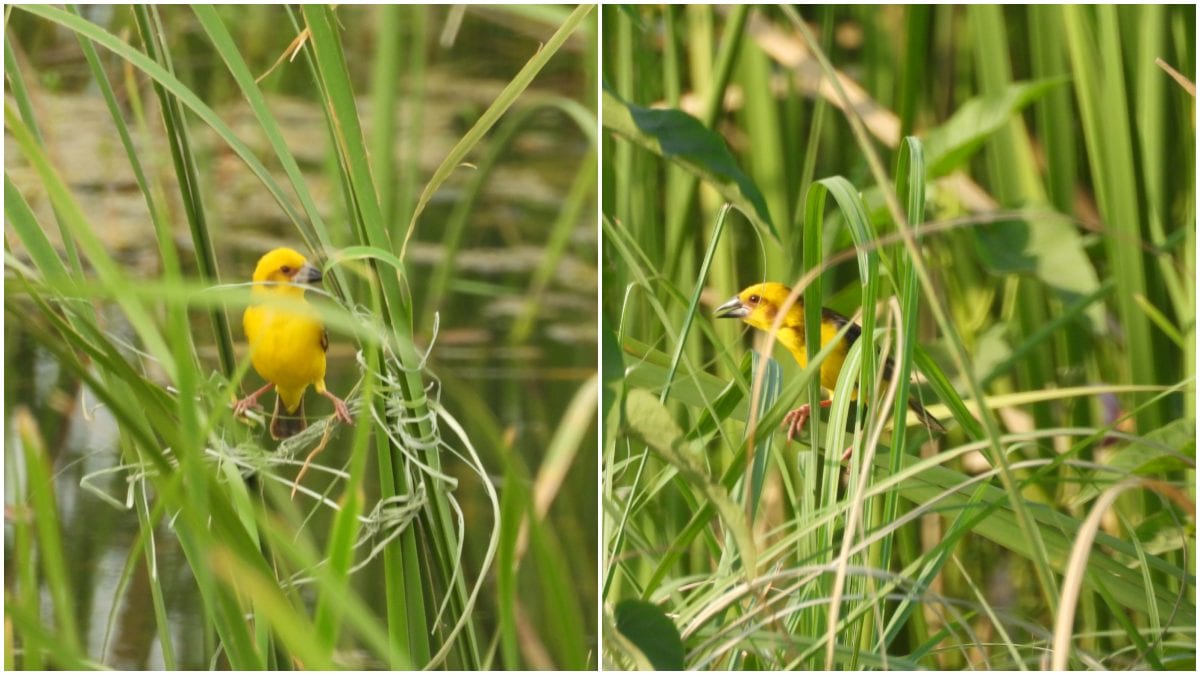
Early in the morning, before the sun becomes harsh over the Terai, the grasslands around Haripura Reservoir come alive with bird calls, buzzing insects and the rustling of tall grass. Somewhere inside this grass, the Finn’s Weaver, a highly endangered bird, builds a nest that hangs like a woven basket from a tall stem.
For Weaver birds such as the Finn’s, the grass is their home, offering food and space to build nests and raise their young. The Finn’s Weaver is a bigger cousin of the Baya Weaver. Even historically, the Finn’s Weaver was a rare bird, whose range was restricted to the foothill grassland ecosystems in lower Kumaon and Western Nepal (northern subspecies) and around Manas and adjoining areas in Assam (eastern subspecies). Especially in the last two decades, the northern subspecies of this bird has lost most of its breeding habitat in lower Kumaon to agricultural and industrial expansion. In 2020, a breeding colony of the Finn’s Weaver was discovered at Haripura Reservoir in Kumaon after nearly a decade of the northern subspecies not being observed anywhere.
The Finn’s Weaver shares space closely with humans at Haripura. But this coexistence is different from ‘commensal’ bird species such as House Sparrows, Crows, Black Kites and Mynas that thrive in human-made habitats around villages and cities. The Finn’s, which is a habitat specialist that needs tall grasslands to feed and breed, is literally hanging on to the last straw at Haripura. Its last remaining home, lying outside of protected forest boundaries in northern India, is at the mercy of the goodwill of local communities and their willingness to share space with this bird.
The Haripura Reservoir is home to more than 250 species of birds, and the survival of the Finn’s Weaver is tied to something that is often overlooked: the future of the grass itself. The tall grasses around Haripura are disappearing in several ways. For a person looking at the landscape from a distance, a small harvested patch, less than 10 sq. metres, may appear ordinary. For a Finn’s Weaver nesting colony, however, the timing of the grass harvest can be critical. The breeding season is a particularly sensitive period, starting from late May and stretching up to the end of September.
For generations, human communities have interacted with Terai grasslands and wetlands in lower Kumoan. In this land, where people celebrate Makar Sankranti as “Ghughuti Tyaar” by worshipping birds, economic pressures and changing land-use patterns have wiped out 98 per cent of the wetland-grassland habitats. This has led to a huge shift in relationships between birds and people in a land where traditional value systems still place great emphasis on birds and nature. The question, therefore, is not simply how to protect a patch of grassland for an endangered bird species. The more difficult question is whether people can continue to live with and benefit from this landscape while leaving enough space and resources for an endangered species to survive.
Three school students from villages around Haripura are beginning to ask this question in their own way. Ankit Bisht, a Class X student, Raghav Nayal, studying in Class IX, and Jatin Singh, a Class VI student, all study at G.K. Convent Inter College. Their involvement with Haripura began through nature education and birding with the Nature Science Initiative.
For Ankit, it started with a single workshop which led to him discovering a passion for observing birds and natural history. “I started birding with Nature Science Initiative. It was just a one-day workshop for me in the beginning. But after that I started observing birds on my own. Slowly I understood that this is something I really love doing,” Ankit says.
He kept returning to the landscape. At first, he was looking at birds. Then, gradually, the birds began teaching him about the place itself. “Earlier I used to see birds just as birds. But when I started observing them regularly, I started understanding the place where I belong. I realised that I am not the only one who lives here. There are so many other lives sharing the same space with us.”
For Ankit, this became an introduction to the idea of coexistence. The more he observed, the more he began to see connections between birds and the people around him. The Finn’s Weaver needs the grass for its survival. Local families need the same grass for their livelihoods and traditional uses. Farmers depend on the land. Communities depend on the wetland.
Ankit began to see that their struggles were not entirely separate. “I started understanding that the struggle of the Finn’s Weaver and the struggle of local people have many things in common. Both need this landscape. Both need resources from here. If the habitat disappears, it affects the bird, but it also affects people”.
That understanding has changed the way the students approach their work. They are not only counting birds. They are documenting nests and habitats, observing changes in the grasslands, speaking with local people and trying to bring different perspectives into the same conversation.
For Ankit’s father, who is a farmer, watching his son become involved in this work has been a source of pride. “When I see Ankit being appreciated for his work, I feel proud as a father,” he says. But his pride is also connected to something larger. “I see many children of his age falling into drugs and other kinds of addictions. My son and his friends are trying to do something meaningful.” His words point towards another dimension of the students’ work. Nature education is not only about creating future birdwatchers. It can also create a sense of belonging, responsibility and purpose among young people.
For Ankit, the wetland has become a classroom. And the lessons do not end when the binoculars are put away. “We have seen many birds, but we don’t know much about them”. The students’ work has also brought them into conversations with people who have lived around Haripura for years. One thing they heard repeatedly was that birds were not new to local residents.
“We have seen many birds, and they are wonderful, but we don’t know much about them,” one local resident told them. “We have seen a lot of cameramen who come here with big lens cameras, but we never understood what they do with them.” The observation is simple but revealing. The Finn’s Weaver and other rare birds at Haripura have long attracted birdwatchers, photographers and researchers. Yet the people living beside the wetland have often remained outside these conversations.
The students are trying to change that. Instead of only bringing outsiders into the landscape to document it, they are trying to build local understanding of what is already present. A bird becomes more than a photograph. A nest becomes more than a sighting. The grass becomes more than something to cut and sell. It becomes part of a shared landscape.
Jatin’s family brings another perspective to the conversation. Jatin’s mother belongs to the Buxa community, an Indigenous community with a long relationship with the grasslands and their resources. Grass has traditionally been used to make a range of handicrafts and household products. She remembers a time when grass was more abundant. “There used to be enough grass for everyone. People could use it and there was enough to share,” she explains. Increasing pressure on the wetland and the growing commercial sale of grass have reduced the availability of the resource. What was once readily available for local use is becoming harder to access. For her, the disappearance of grass is not only an ecological concern. It is also a cultural one. As traditional grass resources become scarce, the handicrafts associated with them also face the possibility of disappearing.
This creates an unexpected connection between the Finn’s Weaver and the Buxa community. Both are weaving populations that depend, in different ways, on the same grassland. The bird's survival depends on this grassland, so does a dying craft. While people may adapt to novel hobbies and crafts, the bird will not survive without empathetic responses from people to spare some grassland habitats for biodiversity. The question of coexistence therefore becomes much broader than protecting an endangered species. It becomes about keeping the landscape alive enough to support shared life and livelihoods.
With support from Nature Science Initiative, Ankit, Raghav and Jatin have continued observing Finn’s Weaver and its habitat. They have helped document nesting sites, monitor habitat conditions and speak with people around the wetland. Their work has also opened conversations with the Forest Department and other stakeholders. The students are slowly becoming a bridge between different worlds: between scientific observation and local knowledge, between young people and the administration, and between a critically endangered bird and the people who share its habitat.
There are no easy solutions at Haripura. Agriculture cannot simply disappear. Local communities cannot be asked to abandon resources they depend upon. At the same time, a habitat supporting an endangered bird cannot continue shrinking indefinitely. This is why the idea of coexistence matters. It does not mean asking people to stop using nature. It means asking how resources can be shared, how breeding habitats can be protected, how traditional livelihoods can survive and how communities can participate in decisions about the landscapes they call home.
The students are still learning. But perhaps that is precisely what makes their work important. They began by watching birds. They stayed to understand their home. And somewhere between the woven nest of a Finn’s Weaver, the hands of a grass craftsperson, the fields of a farmer and the questions of three schoolchildren, Haripura has become more than a wetland. It has become a lesson in living together.
The future of Haripura will not be decided by the Finn’s Weaver alone, nor by the people living around it. It will depend on whether both can continue to have space in the same landscape. The tall grass may look insignificant from a distance. But inside it hangs a nest. And around that nest is a much larger story — of land, livelihood, culture, biodiversity and young people trying to remind a landscape that it does not belong to one species alone. Perhaps coexistence begins there: by recognising that the same place can be a human home, a livelihood, a tradition and a nest — all at once.
Mukesh Kandpal & Soumya Prasad work with birds, cultures and children across Uttarakhand. Their quest is supported by Royal Enfield Social Mission and Coexistence Consortium.
