



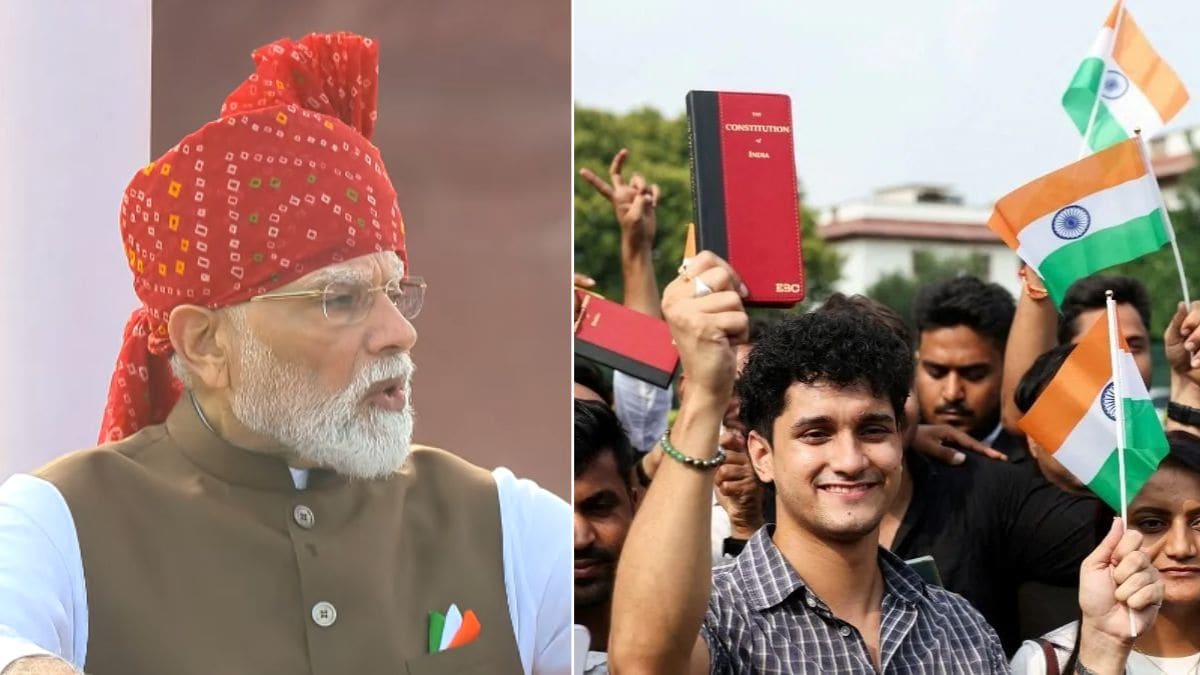
A phrase used from the Red Fort in August 2026—Dimagi Naxal—offers an intriguing window into India’s political and psychological transformation. The expression no longer evokes the armed insurgent moving through a forest. It relocates Naxalism from geography to cognition, describing instead an educated, urban person, whose criticism of the state is presumed to carry the ideological residue of an older revolution.
Whether the description is fair to those against whom it is directed, belongs to everyday political debate. The more revealing question is how a peasant uprising produced an urban cultural archetype, how cinema helped that archetype acquire prestige, and why the figure once celebrated as a hero has gradually become the Other against whom an aspirational India defines itself.
The Naxalite movement began in 1967 in Naxalbari, within the agrarian realities of north Bengal. Its original protagonists were peasants and sharecroppers confronting questions of land, crop and local power. Its immediate adversary was the jotedar, or landlord, rather than the metropolitan industrialist. Charu Majumdar’s Historic Eight Documents placed this struggle within a revolutionary framework: the Indian state could not be reformed through parliamentary participation but had to be overthrown through protracted rural warfare.
The movement spread to Srikakulam, Midnapore, Bhojpur and, eventually, the forests of central and southern India. Yet as the conflict travelled, something curious occurred within urban culture. The peasant who began the uprising gradually disappeared from public view, while the educated young man who interpreted it, moved to the centre of the frame.
Satyajit Ray’s Pratidwandi captured this transition with remarkable subtlety. Siddhartha, forced to abandon medical college and search for employment, tells an interview panel that the courage of the Vietnamese people—not the moon landing—was the most important event of the decade, and fails to secure the job. He is neither revolutionary nor conformist, but an educated young man unable to accept the establishment on its own terms. Ray gave the political discontent of the period an introspective and recognisably urban face.
By the time this anger reached Bombay cinema in Zanjeer, the agrarian programme had disappeared. What remained was moral permission for the hero to be angry. The adversary was now the smuggler, the corrupt businessman or the wealthy man who could purchase the law. Popular cinema retained the temper of Naxalbari while replacing its political theory with a more accessible struggle between the ordinary citizen and the unscrupulous rich.
In Varumayin Niram Sivappu, Tamil cinema offered its own version of the alienated graduate: educated, unemployed and unwilling to lie for a position within the licence-permit order. The title itself—“the colour of poverty is red”—made the association explicit. Across three film industries, the same cultural substitution had occurred. The peasant was off-screen, the graduate had become the hero, and the affluent “fat cat” had become the psychological Other.
Every society needs such an Other—not simply someone with whom it disagrees, but a figure through whom it recognises what it does not wish to be. In the cinema of the 1970s and 1980s, prosperity was morally suspect until proven clean. When the angry hero dented the rich man’s car, audiences were invited to feel that the metal deserved to give way. Ask yourself, how many times have you witnessed the hero act against the wealthy and corrupt and receive adulation and applause?
Economic liberalisation gradually altered this moral geometry. The middle class was offered another imagination of the future: employment, consumption, travel, a home and greater opportunity for its children. The hero of Dilwale Dulhania Le Jayenge did not wish to smash the car; he imagined a good life that included one.
This was not merely a cinematic shift. It reflected a profound transformation in public aspiration. Once acquisition came to represent possibility rather than moral compromise, chosen austerity no longer automatically signified integrity. The jholawala—the educated dissenter with khadi clothing and a cloth bag—could now be regarded less as the custodian of conscience and more as someone refusing progress on behalf of others.
Meanwhile, both the armed movement and the parliamentary Left contracted. Maoist influence receded geographically, while the Left’s electoral presence diminished from its considerable strength in the early 2000s. What survived most visibly was not a mass constituency but a vocabulary, a style of argument and a recognisable cultural type.
Here the psychological reversal becomes complete. The wealthy man has not become a saint, nor has inequality ceased to matter. He has simply ceased to be indispensable as India’s defining foil. For a public organising its life around examinations, employment, monthly repayments and the future of its children, habitual protest may appear less like courageous dissent and more like interruption.
The language of politics followed this reversal. Andolan jeevi recoded protest as a vocation; Dimagi Naxal moved the description from conduct into the mind. Once the insurgent had largely disappeared from the forest, the ideology was said to survive in the urban critic.
Our tasks as detached observers is neither to endorse this labelling nor to dismiss dissent as obstruction. It is to recognise the deeper cultural transformation: cinema once placed the graduate’s face upon a peasant rebellion and invited educated India to admire him. Today, a country aspiring to a life that includes the car, no longer instinctively identifies with the hero who dents it.
The fat cat and the man with the cloth bag have not disappeared. They have simply exchanged places as India’s psychological Other.
The author is a neuropsychiatrist and podcaster.
The opinions expressed in this article are those of the author and do not purport to reflect the opinions or views of THE WEEK.
