



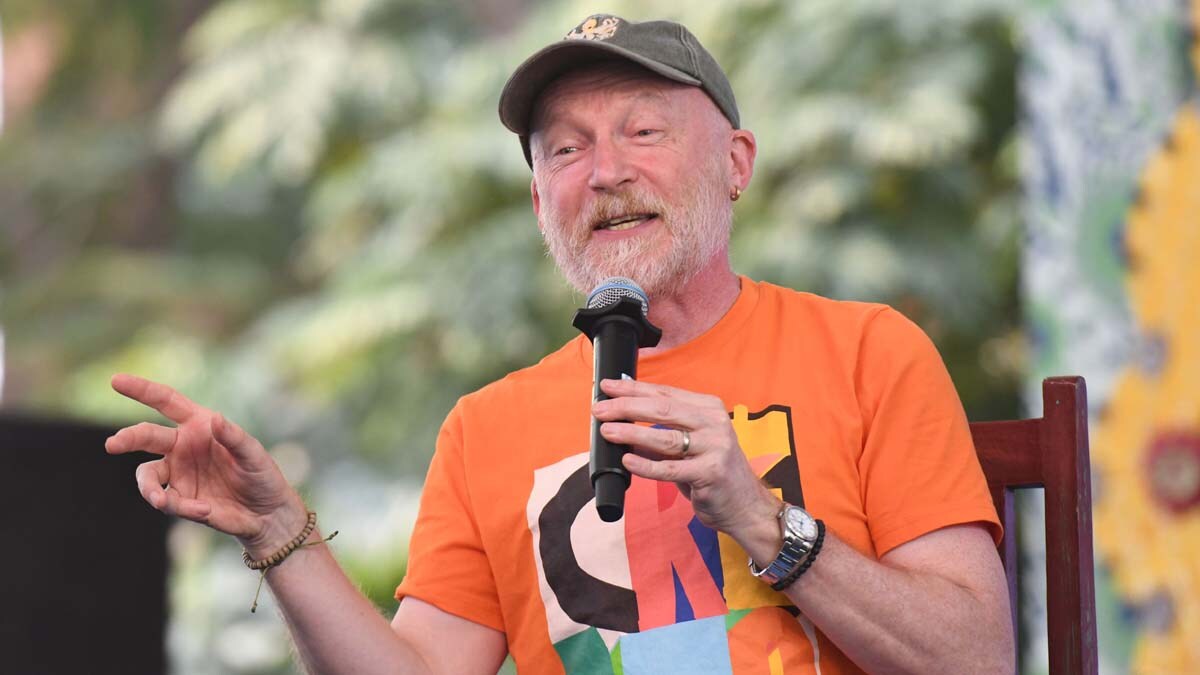
The question sounded almost playful when British mathematician Marcus du Sautoy asked the audience at the Jaipur Literature Festival in 2026: “1, 2, 3, 5, 8, 13. What comes next?”
“21,” came the answer.
“You probably know these as the Fibonacci numbers, named after the Italian mathematician from the 12th-13th century who realised that these numbers lie at the heart of nature. But really, they shouldn’t be named after Fibonacci, because he wasn’t the first to discover them. So who was? Indian poets and musicians,” he says, setting the tone for what’s ahead.
Of numbers & imagination
The sharp divide between mathematics and the arts is a relatively recent phenomenon. The former is seen as cold, while the latter is seen as emotional; yet, for centuries, the two have complemented and informed each other. In fact, many of history’s greatest creative minds have played with mathematics—an idea du Sautoy explored in his Jaipur Literature Festival session and in his 2025 book, Blueprints: How Mathematics Shapes Creativity.
“The book is about how creative artists are deeply interested in structure, and mathematics is, at its core, the study of structure,” he said.
Of Shakespeare & Taj Mahal
While British playwright William Shakespeare and one of the seven wonders—the Taj Mahal—don’t have anything in common apart from: structure.
Again, mathematics comes into play here, du Sautoy argued.
For example, we know Shakespeare as a great wordsmith, but he was also obsessed with numbers. “Take iambic pentameter: ten beats, five pairs of short–long rhythms. Shakespeare uses it constantly, but he also disrupts it deliberately.”
For example, the iconic line in Hamlet: “To be or not to be, that is the question.” “That line has eleven syllables, not ten. Why? Because eleven is a prime number—indivisible. Shakespeare breaks the rhythm to wake you up,” the mathematician said.
Similarly, a line in Macbeth reads: “Is this a dagger that I see before me?”
“That extra 'that' disrupts the rhythm, forcing attention.” Among all forms of art, architecture is probably the strongest fusion of mathematics and art. There’s science, so the building stands, and then there’s the aesthetics, where the art comes into play.
“Fractal is another powerful structure: a pattern that repeats itself at different scales. You see this in Indian architecture: octagonal rooms transitioning into domes through intricate, honeycomb-like forms that repeat at smaller and smaller levels,” he explained.
“The Taj Mahal is a perfect example. Remarkably, even the layout of Agra shows fractal structure,” he added.
Math in nature
Here, du Sautoy made an interesting observation on why this feels harmonious. “It’s because nature itself is fractal. Trees branch, then branch again, then again. Our brains recognise these patterns.”
For example: “Cut an apple horizontally and you’ll see a five-pointed star. A banana reveals three points. A persimmon shows eight.” Again, Fibonacci numbers.
Le Corbusier’s mathematics
The same Fibonacci numbers, du Sautoy said, are seen in the buildings designed by French-Swiss architect Le Corbusier. "Though his buildings were called brutalist, his interiors are deeply human. Families have lived in his buildings for generations because the proportions feel right."
Not only the arts, human body itself is mathematical. For example, symmetry communicates health and fitness.
“Our brains evolved to detect mathematical structure. That’s why we’re all, in some sense, mathematicians at heart,” said du Sautoy.
