



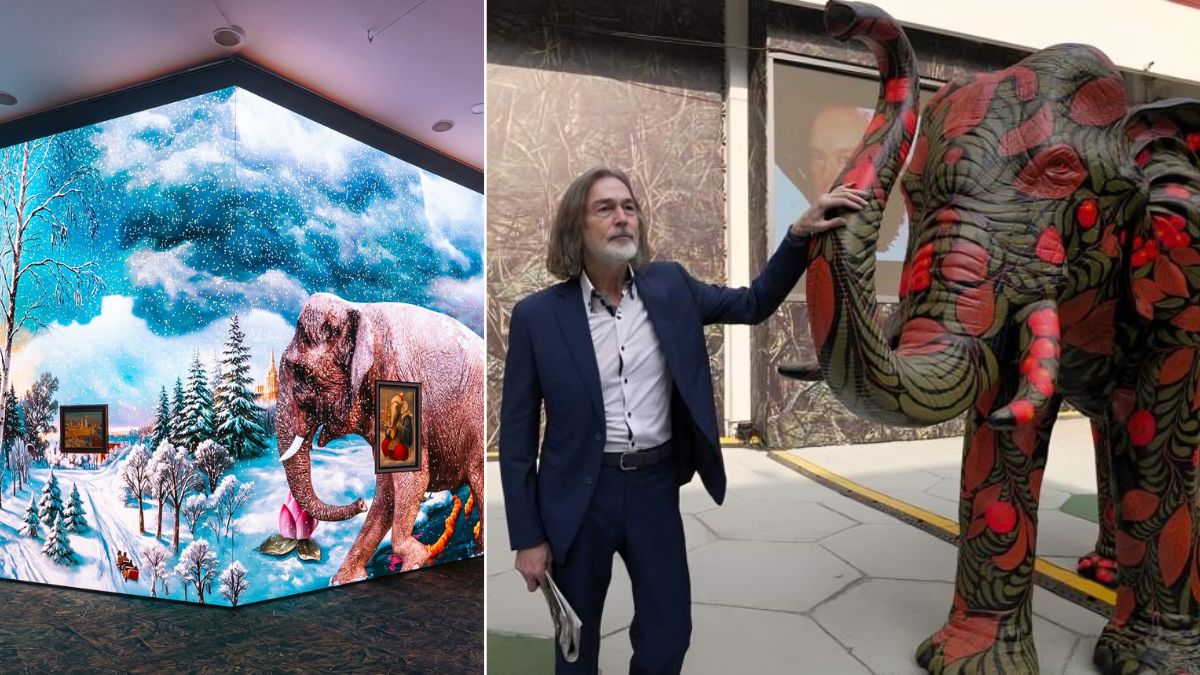
This December, Lalit Kala Akademi transforms Delhi into a realm of imagination, where tradition whispers to technology, surreal visions intertwine with symbolism, and a Russian master sketches India's soul with unstoppable fervour.
Nikas Safronov’s 'Dream Vision: India' is not just an exhibition; it’s a full-blown cultural handshake across continents. And like any meaningful handshake, it lingers. Spread across the Akademi’s galleries, the show assembles nearly a hundred artworks, each pulling you into Safronov’s hybrid aesthetic-part Renaissance disciples, part dream-logic, part tech-alchemy. It’s the kind of visual universe where a calm Buddha might share wall space with a hyper-real portrait, and the two seem to be in the middle of a long, philosophical eye-contact session.
At first glance, the exhibition feels deceptively glossy. But stay a little longer, Delhi teaches patience and the emotional undercurrent begins to reveal itself. Safronov’s India is not a cliché of colours and chaos. It is a mood board of spiritual recall, mythic texture, and the quiet violence of nostalgia. His works blend traditional techniques with multimedia elements so subtly that you catch yourself leaning in, unsure if a glow is paint, projection, or your own imagination doing overtime.
In 2025, when India’s cultural diplomacy is expanding and India-Russia relations are undergoing a careful recalibration amid shifting global power equations, an exhibition like “Dream Vision: India” at the Lalit Kala Akademi lands with unusual relevance. As India positions itself as a global cultural hub, hosting record numbers of international shows and collaborations, the Akademi's role as the country’s oldest national arts institution (founded in 1954) becomes even more crucial.
Safronov’s exhibition, supported by the Russian Cultural Centre, arrives at a moment when traditional diplomacy is strained, yet cultural exchange remains one of the few channels still capable of softening geopolitical noise. It reminds us that art is still one of the few arenas where nuance survives, where dialogue between nations can unfold without diplomats clearing their throats, and where technology and tradition can coexist without trying to cancel each other. At a moment when geopolitical tensions run high, attention spans run low, and identity is endlessly politicised, a show that invites viewers to slow down, think, feel, and cross borders-intellectually and emotionally becomes more than a cultural event; it becomes a quiet act of repair.
In an era where the global art scene grapples with AI, questions of authenticity, and the push-and-pull between tradition and innovation, this exhibition-blending classical portraiture with multimedia and tech-driven works, actively engages with the conversations defining contemporary art. In today's polarised, attention-scarce, and algorithm-shaped world, a show that encourages viewers to pause, embrace complexity, and explore cross-cultural imagination feels less like a gallery visit and more like a societal imperative.
Diplomacy, of course, is the exhibition’s elegant subtext. Co-hosted at the Lalit Kala Akademi with participation from the Russian Cultural Centre, the show becomes a soft-power postcard. It is proof that cultural dialogue can still be more disarming than any press conference. Even Sonia Gandhi walked through the exhibition recently, studying canvases with the focus of someone decoding an encrypted message.
And the viewers? A delight. Delhi’s gallery-goers oscillate between academic seriousness and phone-camera frenzy. You overhear everything, from “This reminds me of Klimt” to “Bro, is this Al?” And yet the art work remains steadfast amidst the city’s signature intellectual whirlwind. The best part is the accessibility: entry is free, the doors stay open from 11 am to 7 pm, and the Akademi is a two-minute walk from Mandi House Metro, which means there are absolutely no excuses left to miss it.
Nikas Safronov is one of Russia’s most celebrated contemporary painters, a People’s Artist of the Russian Federation, Academician of the Russian Academy of Arts, and a professor whose work has been shown around the world. Born in Ulyanovsk in 1956, he trained at prestigious institutions including the Moscow Surikov State Academic Art Institute and went on to forge his own artistic language, Dream Vision, a fusion of classical technique, symbolism and surreal layering that blurs the line between reality and imagination.
Over the last decade alone, he has held over 320 exhibitions globally, drawing large audiences and high-profile recognition–from museum collections in the Hermitage and Tretyakov Gallery to his recent audience with Pope Francis at the Vatican in 2025.
His portraits of world figures and immersive multimedia work continue to spark conversation about art’s role in cultural connection–making his presence in Lalit Kala Akademi a truly global cultural moment.
The Akademi has long functioned as India’s most elegant cultural import machine minus the tariffs. With a mandate sharper than its marble floors, the Akademi routinely airlifts international artists, ideas, and avant-garde experiments into the Indian public sphere, turning its galleries into a crash course in global aesthetics. It doesn’t just exhibit art; it cross-pollinates imaginations, ensuring that Delhi audiences can meet a Berlin installation artist or a Seoul minimalist without ever renewing their passports. The Akademi keeps India plugged into the world’s creative voltage-and does it with disarming, democratic flair.
Over the decades, that voltage has been delivered through a surprisingly eclectic itinerary: from the Akademi’s early showcases of Canadian paintings, Chinese handicrafts and Hungarian folk art in the 1950s, to landmark exhibitions like Who Was Rembrandt, a Dutch-backed tour that carried the Old Master’s legacy across Indian cities-and the sweeping Portrait of Mexico, which brought 3,000 years of Mexican visual culture to Indian audiences. Add to that a steady parade of Polish graphic art, Romanian architecture, Australian painting, and even Van Gogh photographic retrospectives, and the pattern becomes clear: Lalit Kala Akademi hasn’t merely hosted international art, it has curated India’s window to the world, one meticulously chosen exhibition at a time.
“Dream Vision: India” ultimately succeeds because it doesn’t merely present art, it provokes you to see India, and maybe yourself, as something layered, unfinished, and beautifully contradictory. And for an institution founded in 1954 to safeguard and celebrate India’s artistic nerve, this is exactly the kind of dream worth hosting.
'Dream Vision: India' at Lalit Kala Akademi
Where: Lalit Kala Akademi Galleries, Rabindra Bhavan, Ferozeshah Road, Mandi House, New Delhi, 110001.
When: December 7 to 21, 2025
Timing: Typically late morning to early evening (galleries usually open around 11 am and close by 7 pm).
Entry: Free for all visitors. No booking needed.
How to Get There:
Metro: The closest station is Mandi House (Blue & Violet Lines) - a short walk from the venue.
By Road: Well-connected by buses, cabs, and autos from across Delhi.
Tip: Weekday mornings and early afternoons are usually quieter for a more reflective viewing experience.
