



A nation’s progress often rests on the shoulders of migrant workers, people who construct its skylines, power its industries, and keep its economy moving, even when their own presence stays largely unnoticed. They give more than they receive, enduring exhausting work, modest pay, cultural isolation, and the daily struggle to claim dignity in societies that rely on them but seldom recognise their worth.
Talking about migrating to foreign countries for work, India often tops the charts today, but the phenomenon is hardly new. A century before Gulf visas and global IT corridors, the Panama Canal quietly absorbed a massive wave of migrant labour from around the world, including thousands from undivided India. Their contribution remained largely invisible—until one story resurfaced.
Among the roughly 1,50,000 Indians who braved perilous seas to reach Panama was Bhag Singh of Rumi, near Ludhiana. Born on August 13, 1881, he remains a ghost in the archives, his childhood undocumented, his journey unrecorded. What we do know: he owned farmland, had a wife and four children, and in 1903 he left it all behind to seek work on one of the most ambitious engineering projects of the age.
For over 50 years, his story lay buried in family memory—until August 2024, when his grandson, Darshan Singh Deol, began piecing it together from the scraps preserved by his mother, bringing one forgotten migrant back into the global narrative he helped build.

Darshan Singh Deol only has a patched-together map of his grandfather's odyssey from a small Punjabi village to the heart of one of the greatest engineering projects in modern history. How exactly Bhag Singh was recruited remains unknown, but the historical pattern is unmistakable: the British colonial government routinely funnelled Indian labour into overseas projects, and the Panama Canal was no exception.
What is known is the improbable route. Bhag Singh travelled from Jagraon to Kolkata, then onwards to Shanghai, and finally to Panama—most likely by train to Kolkata and then by steamship across unforgiving waters. Contemporary records of similar voyages reveal the brutality of the passage: of the nearly 1,50,000 Indians who attempted the journey, about 50,000 died before even reaching Panama. Their bodies were lowered into the sea—quiet burials performed not for dignity but for sanitary necessity.
Bhag Singh's journey from Jagraon to Kolkata, from there to Shanghai, and finally to Panama places him squarely among the thousands of colonial-era labourers who were funnelled into the Canal workforce through British-linked recruitment networks (see Shipton 2014; Lal 2006 on Indian indenture routes). If he reached Panama during the final decades of Canal construction, he would have entered a world where immigrant labourers bore the harshest burdens: malaria and yellow fever still stalked work camps, though partly controlled after 1905 (McCullough, The Path Between the Seas, 1977); workers on the "silver roll"—mostly West Indian, Black, and Asian migrants—lived in overcrowded barracks, low pay, racial segregation, and dangerous shifts of dynamite blasting and landslide-prone excavation (Greene 2009; Conniff 2012).

The Canal Zone was a landscape of sweat, disease, and hierarchy, where survival often depended on luck as much as strength. Linking his route with these records, Bhag Singh was likely one of the many "invisible men" who crossed oceans for wages that barely covered their passage, yet whose labour carved the Culebra Cut and powered the greatest engineering feat of the century. His presence is not documented directly, but the migration pattern, the timing, and the colonial recruitment networks make his story fit the broader historical evidence of Asian labourers who helped build the Canal under brutal conditions.
When Bhag Singh left Rumi in 1903, he had a wife, four young children, and land that would later be redistributed for Rs 10—a loss that symbolised how migration often empties not only households but entire histories. He arrived in Panama, a turban-clad Sikh among Hindus, Muslims, and Christians from India—labourers absorbed into a system that categorised workers with industrial coldness: Gold Roll for skilled, Silver Roll for unskilled. The distinction governed pay, housing, sanitation, and even survival.
The conditions were appalling. Mosquitoes infested the camps; malaria and yellow fever ravaged the workforce. Only when Chief Sanitary Officer Col. William C. Gorgas forced through sanitation reforms—against the stubborn scepticism of the Isthmian Canal Commission—did the death toll begin to fall.
Through all this, Bhag Singh never managed to send a letter home. No telegraph, no note, not a line. His wife, when asked where he had gone, simply said she did not know whether he was alive or dead. A palm reader once told her she wasn't a widow—that he would return. It was the only thread she had.
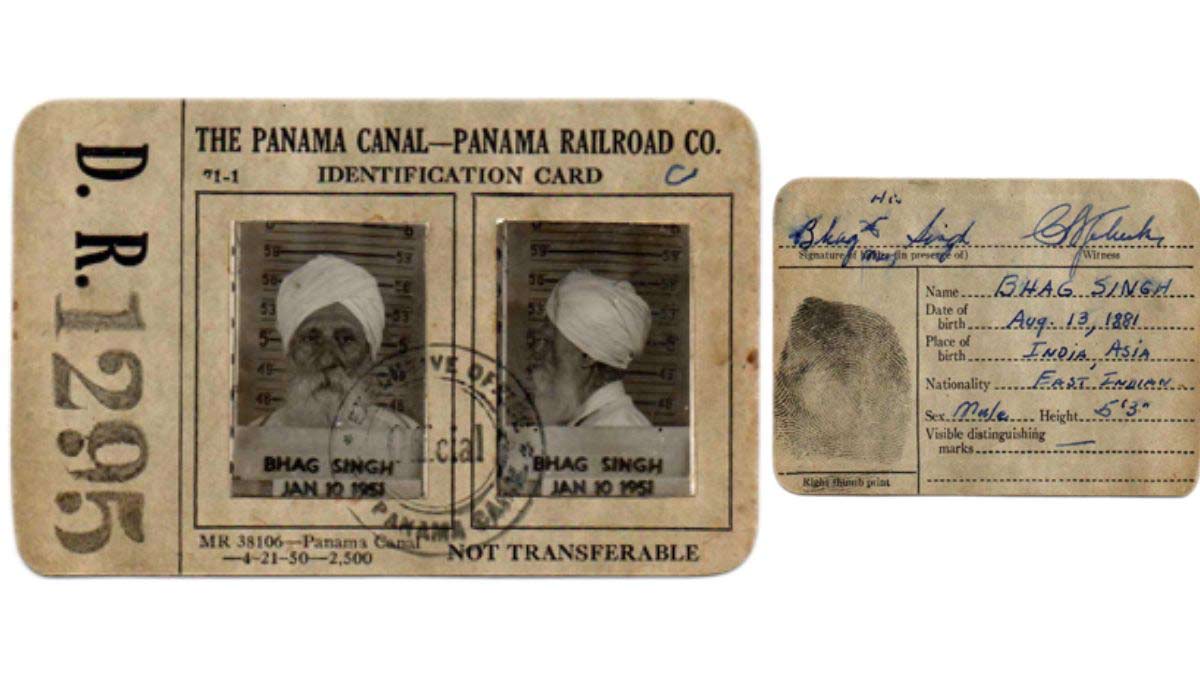
When the Canal finally opened in August 1914, Bhag Singh stayed on as a watchman. The details of his work remain blurry, but an identity card from the 1950s offers a glimpse of him decades later—aged, dignified, still working the Canal he once helped build. Then tragedy struck: an accident crippled his legs, and the company declared him unfit for duty. They offered him three choices—relocation to America for medical care, settlement in Britain as a Commonwealth citizen, or a passage back to India. After fifty years abroad, he chose home without hesitation.
A letter arrived in Rumi announcing his return. On July 7, 1951, Bhag Singh left Panama accompanied by two company agents; his Panama Canal-issued British passport is the only surviving proof of his journey. He reached Bombay on August 21, 1951, then travelled to Jagraon by train, where the agents left him.
He cut a striking figure when he arrived—pant-coat, turban, suitcase—almost gentlemanly in a village that had long declared him dead. A man named Golu recognised him instantly as "Bhagta", the legend who had vanished for half a century. He placed Bhag Singh's luggage onto a tonga, helped him aboard, and began the last stretch to Rumi. At one steep canal crossing, the horse couldn't pull the weight; the two men got down and pushed the tonga together—a symbolic return: the migrant and the villager hauling the past back home.
Back in the village, he met his four-year-old grandson—Darshan Singh Deol, who would one day become the keeper of his legacy. Among the few belongings Bhag brought from Panama was a Panj Granthi published in the 1930s, believed to have travelled from Punjab to Los Angeles and then to Panama, a testament to the quiet religious networks Sikhs built wherever they went.

As he resettled, Bhag Singh received a lifetime pension of USD 11 per month from the Panama Canal/Railroad Company, beginning October 1, 1950. He would ride a tonga with young Darshan to the Punjab National Bank in Jagraon to collect it; their mornings together remain Darshan's most vivid memories. He recalls, “The bank manager would always joke that my grandfather’s pension was more than his own salary.” The land that had once slipped away for a mere Rs 10 found its way back the moment Bhag Singh walked home. He did not bargain or plead; he arrived with the gravity of someone who had dug through Panama's rock and malaria to survive. And when a man returns from that kind of life, even the land remembers who it belongs to.
Bhag Singh lived until 1968—alive long enough to see his grandson marry, but too infirm to attend the wedding. Darshan remembers him as gentle, slow-spoken, and full of stories about Panama. He says about his grandfather, “He was a very kind person; he used to read books very slowly. He used to buy clothes and sweets for me, as I was the only son left; my brother and sister were gone.”
Today, Darshan Singh is in his seventies, living in Stockholm. He is the only surviving child from the family line that Bhag Singh returned to. As age dulls the memories his grandfather entrusted him with, Darshan has become determined to recover the history he inherited in fragments.
So, in August 2024, he began. Armed with the brittle documents his mother guarded all her life, he says, "I could only begin this work because my mother preserved my grandfather's passport, pension slip, and ID card in her sandook right up until her last day."
Darshan travelled to Panama. The Panama Canal and Railroad Company told him their archives held nothing. At the Panama Sikh Gurdwara, he learnt of the Indian workers—tall, strong, resilient—who had toiled there. The Gurudwara directed him to the Central Library, where a librarian helped him uncover Bhag Singh's pay slips and the harsh realities workers faced: dense forests, deadly wildlife, brutal terrain.
Darshan met Panama's former Indian Ambassador and urged recognition for the thousands of Indian labourers, especially Sikh migrants, who built the Canal but went unmentioned in its official history.

On his way back, he stayed briefly in Vancouver, where the Komagata Maru tragedy left another historical scar. At the Gurdwara there, he learnt about the ship's passengers—Sikhs, Hindus, Muslims—denied entry under racially exclusionary laws, then fired upon by colonial police in India. On the Komagata Maru Martyr Memorial, Darshan found a name: Bhag Singh. No evidence yet proves it was the same man, but the ambiguity captures the essence of his story: a life lived across oceans but barely captured on paper.
Much of Panama's archival record vanished from public reach when the US handed the Canal to Panama in 1999 and moved key documents to Los Angeles, out of Darshan's financial reach. “Alone I cannot do much; maybe I can do something at the village level, but with the help of the government, I can bring this story to the world. It is a part of our Sikh history too,” says Darshan.
Despite the gaps, he continues his mission. He has formally requested the Panama government to honour Indian labourers with a statue and a postal stamp and to allow an Akhand Path at the Gurudwara Sahib in memory of the thousands buried at sea before ever touching Panama's shore. Darshan has also taken his quest to the diplomatic doorstep. He met Dr Sumit Seth, the current Indian Ambassador to Panama, and received an encouraging response—one of the first official acknowledgements that the story of Bhag Singh, and of thousands like him, deserves to return to the historical record rather than remain trapped in family memory.
He has also launched a website, The Indian Roots in Panama, to ensure that the names erased by time are finally written back into history. Darshan Singh is not pursuing this mission alone. Two of his school friends—Sukhdev S. Gill and Desh Raj Malhotra—have become his anchors, helping him sift through documents, chase archives across continents, and piece together the story that history never bothered to record. With their support, Darshan has even published a concise booklet titled Construction and Development of the Panama Canal: A Story of Participation of Bhag Singh and Other Indians, his first attempt to give public shape to a narrative buried for more than a century.
