



In his iconic 1899 painting ‘Hansa Damyanthi’ (Damyanthi and the swan), Raja Ravi Varma paints a poised Damyanthi in an attentive conversation with a swan, her body tilted slightly, her chin rested on her left hand. Damayanti, the Mahabharata heroine known for her romance with Nala, is dressed in luxurious pink silk with a golden border, adorned with a pearl necklace, earrings, bangles and anklets, her hair neatly tied in a bun and set with a pink flower.
With her sari neatly draped, Damayanti appears composed and in control. ‘Mohini’, the female incarnation of Vishnu, by contrast, is more carefree. Varma depicts her on a swing, hair left loose, dressed in a white, almost translucent sari with a golden border. Her jewellery is minimal, while the garment falls in soft, fluid folds rather than clean, rigid lines.
Meanwhile, ‘Padmini, The Lotus Lady’ is far more dramatic in its sartorial expression. Clad in flowing pink, draped loosely, Padmini’s pallu rises in an arc around her head before falling, highlighting her form.
Though celebrated for visualising Hindu mythology, Varma was just as attentive to style. In his canvases, women are shaped as much by the stories they inhabit as their saris, drapes, textiles, hair, bangles, necklaces and anklets.
Little wonder that Indian designers keep returning to him, a fascination visible once again at the recent Met Gala.
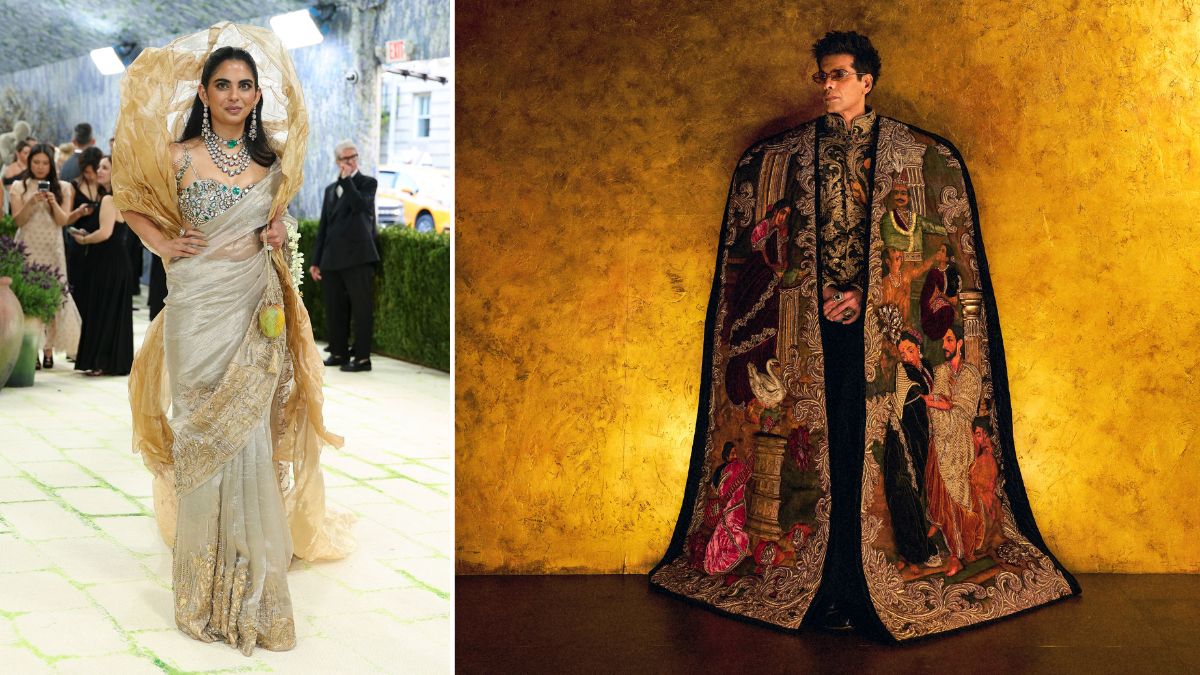
Isha Ambani, in a Gaurav Gupta sari, drew directly from ‘Padmini, The Lotus Lady’. The gold tissue sari was draped conventionally, but a part of it rose and remained suspended in an arc, just like in the original painting. She also carried a mango, seemingly referencing to ‘Woman Holding Fruit,’ another Varma painting. The look was styled by Anaita Shroff Adajania.
The ode to Varma was even more direct in the case of Karan Johar. Several of the artist’s works were hand-painted onto the filmmaker’s lavish cape, turning the garment into a moving canvas. Among them were ‘Woman Holding Fruit’, ‘Hansa Damayanti’ and ‘Kadambari’.
“Raja Ravi Varma felt right because his work does something I’ve always tried to do in cinema. He painted feelings,” Johar wrote on Instagram.
His costume was designed by Manish Malhotra and styled by Eka Lakhani.
Back in 2020, Gaurang Shah took a different approach, bringing Raja Ravi Varma’s iconography to the material itself. In his khadi jamdani series, rather than reproducing the paintings on fabric, he worked with artisans to weave their imagery into saris. The same year, photographer G Venket Ram got 12 leading South Indian actresses, including Samantha Ruth Prabhu and Aishwarya Rajesh, to recreate Varma’s heroines.
For many, he is India’s most iconic artists, someone who came to define India’s idea of gods, goddesses and mythological characters. With his calendar art, he also made art more accessible. Today, there would hardly be any home where one wouldn’t find a Varma painting, especially in their puja rooms. At the same time, he challenged caste hierarchies, by making the iconography of gods and goddesses accessible to the masses.
For many Indians, Varma is not only iconic but one of the most well-recognised artists. His gods and goddesses have shaped the country’s modern religious imagination. Through affordable prints and calendar art, he also brought religious art, once reserved for palaces and temples, into people’s homes, thus also challenging caste hierarchy.
And amid it all are his heroines, who continue to make fashion statements, inspiring the style of today, from the Met Gala red carpet to films, advertising and the larger textile world.
