



I don’t think I have an addiction, doctor saab,” he assured me. “I just have several very strong interests.” He was 46, a successful businessman who had recently developed an extraordinary appetite for things he didn’t particularly need. He bought watches he never wore, ordered food when he wasn’t hungry and spent entire nights playing online poker, convinced that the next hand would restore everything the previous 50 had taken away.
His wife discovered 12 identical white shirts, three unopened espresso machines and a credit card bill resembling the GDP of a small country. “He’s not interested in owning anything,” she complained. “He’s interested in buying it.” Strangely, he rarely enjoyed his purchases. The excitement lay in anticipation. Once a parcel arrived, he was already searching for the next one. More recently, he had become impulsive and restless. An MRI revealed a small lesion in the ventral striatum, close to a fascinating structure called the nucleus accumbens. The man who once negotiated multimillion rupee contracts with ruthless discipline could no longer negotiate with a shopping cart.
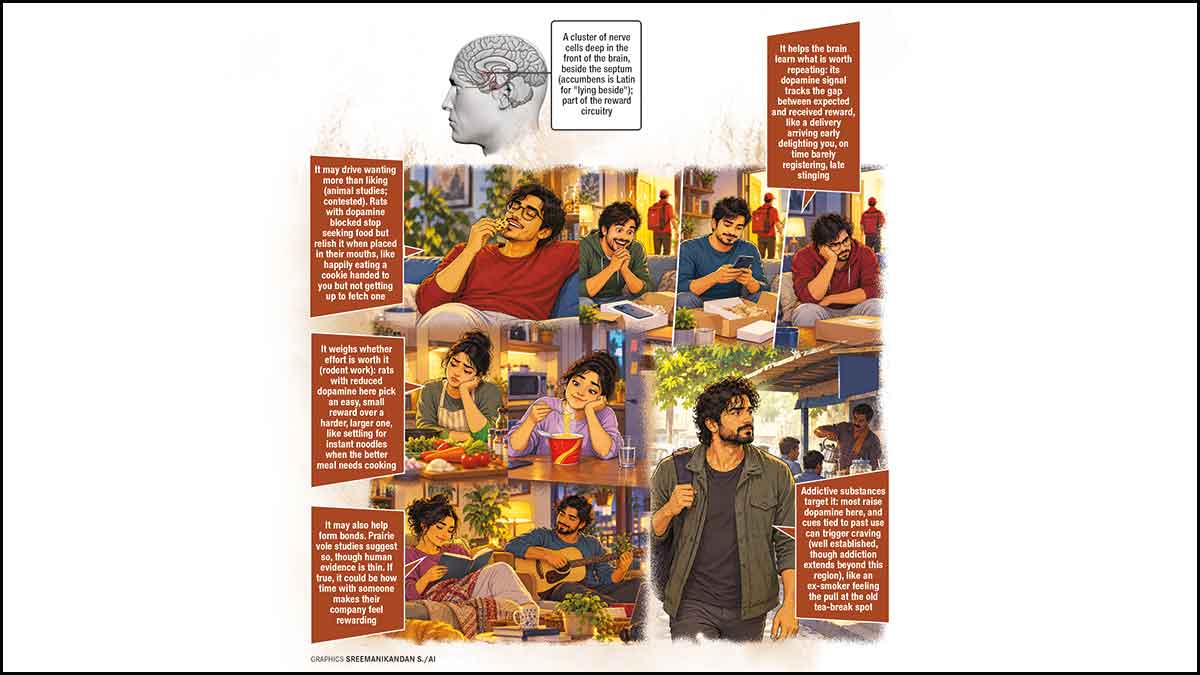
The nucleus accumbens is a tiny collection of neurons buried deep within each cerebral hemisphere, where motivation, emotion and reward circuitry converge. It forms part of the ventral striatum and communicates with regions involved in memory, decision making and emotion. One of its important chemical messengers is dopamine, popularly called the pleasure chemical, which is rather like describing the Taj Mahal as a building with a nice roof. Dopamine is less about pleasure itself than about motivation, learning and the anticipation of rewards. It helps us decide what is worth pursuing and encourages us to pursue it again.
Wanting something and enjoying it are not necessarily the same thing. You can desperately crave a third gulab jamun while knowing perfectly well that the second was a mistake. Evolution designed this circuitry to encourage behaviours essential for survival. Unfortunately, evolution never anticipated Instagram reels or notifications announcing that someone you barely know has liked a photograph of your breakfast.
The system becomes particularly interesting when rewards are uncertain. Dopamine neurons can signal the difference between what we expect and what actually happens, helping the brain learn which actions might pay off. A predictable reward is pleasant. An unpredictable one can keep us checking.
Our patient’s behaviour had become a cycle of anticipation, action and disappointment. His lesion was close to important reward pathways, although no scan could establish that it explained every impulse. We investigated other neurological and psychiatric causes before considering treatment. Surgery in this region requires caution because nearby circuits influence movement, motivation and behaviour. Disturbing them can change a person’s drive in unpredictable ways. The challenge was not merely to treat a lesion but to preserve the circuitry that makes someone pursue a career, fall in love or occasionally agree to visit the in-laws. As Oscar Wilde observed, “I can resist everything except temptation.”
His lesion was ultimately managed without immediate surgery, while his compulsive behaviour was addressed through specialist treatment, family support and practical restrictions on spending and gambling. Recovery was gradual. He began sleeping properly, stopped gambling and surrendered his credit cards to his wife, an arrangement he described as more painful than any operation I could have performed.
Over several months, his urges diminished. He rediscovered pleasures that did not require a delivery service: morning walks, reading, conversations with his daughter and eating a meal without photographing it first. He also began to understand something that had escaped him during years of compulsive wanting. Pleasure is what we experience when we receive something. Desire propels us towards it. Contentment, perhaps, is knowing when to stop.
Without motivation, we would accomplish very little. But the same circuitry that encourages us to climb mountains can persuade us to buy expensive mountaineering equipment while remaining comfortably horizontal on the sofa. The brain’s reward system is essential to living. It becomes troublesome when the pursuit of pleasure replaces the pleasure of living.
At his final appointment, he seemed calmer, happier and considerably less interested in acquiring things. “Doctor saab,” he said, “I’ve finally understood that happiness doesn’t come from having more.” His wife smiled approvingly. “I’m very proud of him. He hasn’t bought anything unnecessary in three months.”
I congratulated him. Then he leaned towards me conspiratorially. “There is one small problem. My wife now controls all our finances.” “And how is that working?” I asked. “Beautifully,” she replied. “I’ve bought six handbags, two pairs of shoes and booked us a holiday in Switzerland.” He looked at me helplessly. “Doctor saab, can this nucleus thing spread from one person to another?” I shook my head, “No. But apparently your credit card can.”
The author is consultant neurosurgeon at Wockhardt Hospital, Mumbai.
mazdaturel@gmail.com @mazdaturel
