


Interview/ Sukhvinder Singh Sukhu, chief minister, Himachal Pradesh
The monsoon brings life to Himachal Pradesh, but in recent years it has also brought devastation. In 2023, the state lost more than 550 people to floods and landslides triggered by intense rain. This month, cloudbursts in Mandi and neighbouring areas killed 74 and left at least 34 missing. Hundreds of homes have been swept away, fields have been flattened and roads have vanished. And it is just the beginning of monsoon.
Like in 2023, when Chief Minister Sukhvinder Singh Sukhu was just a few months into his tenure, he was quick to be among the people. He trekked to some of the most remote and devastated villages—some of them inhabited by just two dozen families—and distributed rations and ensured further help.
From the floods in 2023 to his party MLAs revolting against him in 2024 to an economic crisis the same year and then the recent cloudbursts, the two and a half years of his term have been eventful. Sukhu’s story has also been of a party worker rising to the top.
As he enters the second half of his tenure, Sukhu faces a triple challenge: rebuilding Himachal, fighting for its rightful dues and convincing the nation that climate change isn’t a debate any more.
In an exclusive interview with THE WEEK, Sukhu reflects on what has changed since the 2023 floods, why cloudbursts are becoming more frequent and dangerous, and why the Centre must stop treating Himachal as merely a resource-provider. Excerpts:
Q/ What has been the damage so far this year?
A/ Till now, the damage is estimated to be over Rs800 crore. But more than the financial loss, the real issue is the growing impact of climate change. We witnessed a lot more cloudbursts in the Mandi region, which led to huge losses.
Q/ You have lived in Himachal all your life. How different is this from past rains?
A/ Since my childhood, we have seen monsoons but never such heavy rains or cloudbursts. You can’t imagine the kind of rocks that slide now—some are bigger than two-room houses. They come down like water bombs. The sheer force and flow of water is unimaginable.
Q/ What has been the learning since the 2023 floods?
A/ Landslides are natural in mountainous areas, especially after slope-cutting. In 2023, many landslides happened. But this time, it was the cloudbursts that caused the most destruction. A small rivulet just 20m wide turned into a 200m river. People have lost up to an acre. Many don’t want to rebuild homes there.
The biggest challenge is land. As much as 67 per cent of our state is forest land. We need permission from the Centre to use some forest land to resettle displaced people. A 1950 notification prevents this.
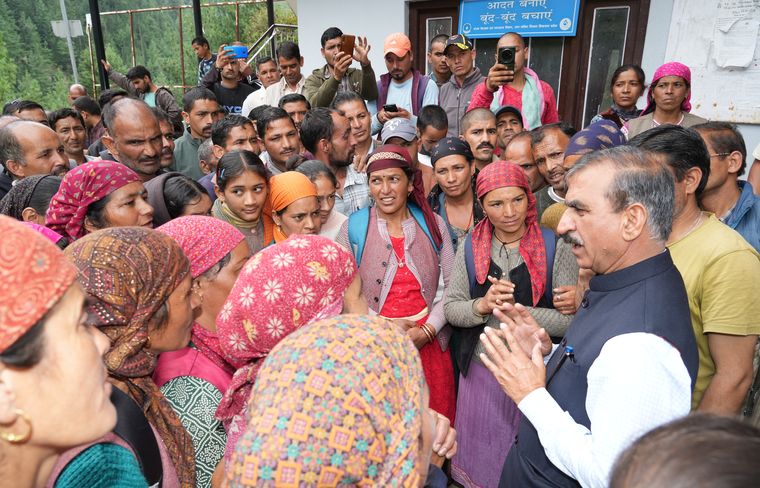 Reaching out: Sukhu interacts with victims of the cloudbursts in Mandi.
Q/ What has been the reason for this destruction?
A/ Climate change.
Q/ Are unregulated urbanisation and infrastructure development also to blame?
A/ No. Development does play a role, but this is primarily climate change. Regions that never saw this kind of rain are seeing floods now. We need a scientific study to understand these changes, and I will ask the Centre to involve prestigious institutions along with our state experts.
Q/ What support has the Centre provided since last time?
A/ Since 2023-24, we have spent Rs4,500 crore on relief. Under the PM Awas Yojana, the Centre gives only Rs1.5 lakh for house construction, of which Rs20,000 is paid by the state. We spent Rs7 lakh for every house built after those floods. We gave Rs50,000 for each animal lost, compared with the Centre’s Rs10,000. While their houses were being constructed, we also gave Rs10,000 per month as rent for displaced urban families and Rs5,000 in rural areas.
When the Centre's team surveyed the damages, they estimated the loss at Rs10,000 crore. However, we got only Rs2,000 crore with 20 to 25 conditions attached, and that too after two years. Inflation has increased the cost of rehabilitation. What is the use of getting help after two years?
Q/ How does that affect state resources?
A/ Reconstruction places immense pressure on state finances. Our natural resources, particularly water, are heavily used by Central public sector undertakings. Water flows from Himachal to other states, but the revenue generated from it is earned by the Centre. States like Punjab and Haryana benefit from our water, yet we receive very little in return. We proposed a water cess, but it was stayed by the courts. As a small hill state, our rights are often overlooked.
Q/ But can such a cess be levied?
A/ In other states, thermal power projects can be levied mining cess on raw materials. Our raw material is water—it powers hydroelectricity. But the cost of this water isn’t factored in. When we try to raise revenue, Central agencies like NHPC, NTPC and SJVN approach the courts and get stays. Their projects remain lucrative, while we get only a 12 per cent royalty, which is ultimately borne by the consumers.
We’re now fighting for our rightful share in court. All the rivers originate here. We protect the rivers, the forests and suffer the brunt of natural calamities. When Bhakra Beas Management Board was created, it was the people of Himachal who were displaced. But the benefits of the electricity went to Punjab, Haryana and the Central government.... At the very least, the states providing the raw material should have a 50 per cent claim on the revenue.
We are only asking for what is due to us. Hill states like ours will never become industrial hubs; the cost of infrastructure is too high. Hydropower is our only real industry. People now understand: we bear the losses, provide the resources and are expected to face the disasters alone, with little support.
Q/ How are state finances faring?
A/ State finances are dependent on water. If we get our rightful share from water, we won’t need any help from others. We gave out Rs4,500 crore in relief, which we have not been able to recover. We have not been able to construct our own big airport as we don’t have resources. SJVN is earning bigger profits based on our resources. Our budget is merely Rs58,000 crore, but SJVN, which used our resources, has become a Rs67,000 crore company.
Q/ How has tourism been affected?
A/ Only some areas are impacted. No tourists were harmed in the floods. In 2023, we rescued 75,000 tourists during the floods. We are now promoting monsoon tourism in mid-Himalayan regions like Dharamsala, Bilaspur, Hamirpur, Kangra and Solan.
Q/ What about those who lost everything in the floods?
A/ We have raised the issue and even asked BJP MPs to convince the Centre to allow the use of forest land for resettlement. I asked the Leader of Opposition Jairam Thakur for a joint inspection; this is also his constituency. People want to stay, rebuild their villages and protect their forests. They are not deserting the state.
Q/ You have completed half your tenure. What about your remaining election promises?
A/ We faced a natural disaster (2023), political crisis (revolt by party MLAs), economic crisis (when the state found it difficult to pay salary) and now another calamity. I have walked to meet people and give them relief. But we need money. Some of our schemes have suffered. We have started giving Rs1,500 to women (as a part of the election promise) in some areas. I will do more once we get our dues.
Q/ Any message for tourists?
A/ Himachal is safe. Tourists are welcome. Even during the rains, mid-Himalayan areas offer a great experience.