


YOU COULD CALL them some of the most desirable voters in the US that any political party would love to have in their ranks. Indeed, Indian-Americans seem to be in all 50 states and are strong players in the American political scene. This is a 4.5 million strong community with 55.8 per cent in the 18 to 49 age group, and 73.2 per cent having a bachelor’s degree or higher in education.
So, how is this viable block going to vote in the upcoming presidential elections? The answer changes depending on whom you ask. M.R. Rangaswami, chairman and founder of Indiaspora, a community organisation, has been in the United States for 40 years and has seen the changing status of the Indian immigrants. He observes that the Indian-American community now has a strong presence in the political scene, and is being sought after by both Republicans and Democrats.
“Indian-American community is by no means homogeneous,” says Rangaswami. “About 60 to 65 per cent Indian-Americans were born in India and another 30 to 35 per cent were born in the US. While those born in India are a mix of conservatives and liberals, the ones born here are younger and tend to be more liberal.”
Karthick Ramakrishnan, who directs the National Asian American Survey and is founder of AAPI DATA, which publishes demographic data and policy research on Asian Americans and Pacific Islanders, says the Indian-Americans are still overwhelmingly Democrats. According to AAPI DATA, in 2016, 48 per cent Indian-Americans identified as Democrats, 22 per cent as Republicans and 30 per cent as neither. He says these figures remain stable in spite of the Donald Trump administration making overtures to the community and having appointed many Indian-Americans to prominent positions over the years.
Indeed, Indian-Americans have embraced the Democratic Party since the start. In the US Congress we have the ‘Samosa Caucus’ comprising four representatives—Ro Khanna (California), Ami Bera (California), Raja Krishnamoorthi (Illinois) and Pramila Jayapal (Washington). Kamala Harris, the high-profile senator from California, became the first Indian-American woman to run for the US presidency. Last year, Suhas Subramanyam and Ghazala Hashmi had victories in the state senate of Virginia and helped flip the state from red to blue for the first time in a generation.
Over $5 million have already been donated by Indian-Americans to presidential candidates like Joe Biden, Elizabeth Warren, Bernie Sanders, Pete Buttigieg, Tulsi Gabbard and Amy Klobuchar. In fact, Indian-Americans are a presence in almost all the campaigns, as donors, staff and volunteers. Shekar Narasimhan, founder and chairman of AAPI Victory Fund—the first Super PAC (political action committee) for Asians—has also seen the growing clout of the Indian-American community. “We have so many Indians on the staff of not just the campaigns, but in congressional staff as well,” he says.
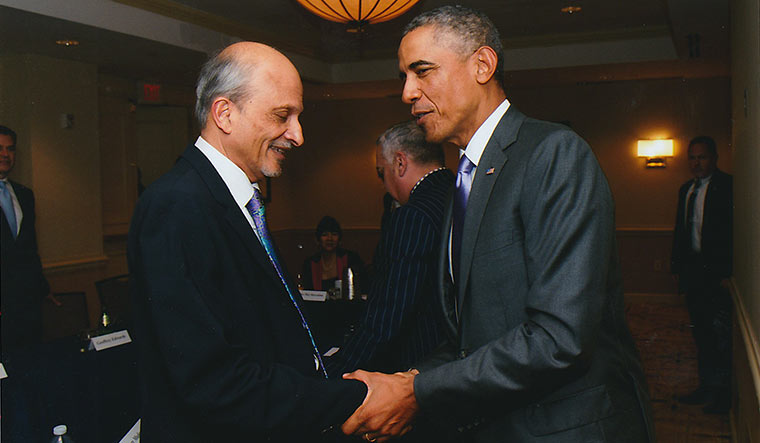 Blue blood: M.R. Rangaswami, chairman and founder of Indiaspora, a community organisation, with former president Barack Obama.
While acknowledging that Indian-Americans tend to vote for the Democratic Party, Rangaswami says President Trump could appeal to the more conservative voters in the community.
Richard Russow, the Senior Fellow and Wadhwani Chair in India-US Policy Studies at the Center for Strategic and International Studies (CSIS) in Washington DC, believes that Trump has made a concerted effort to engage India: “We have got some tensions, particularly around trade issues, but the president has not allowed that to pollute the waters, like it has with some other relationships. And so, even though he has been aggressively pursuing trade remedies in areas where we think the Narendra Modi government has closed the door, he has still continued to pursue and engage India very positively.”
Russow believes that Trump’s India trip at the end of his first term is a pretty significant step. “I think by and large the view from India is that there is a significant chance that President Trump will be re-elected,” he says.
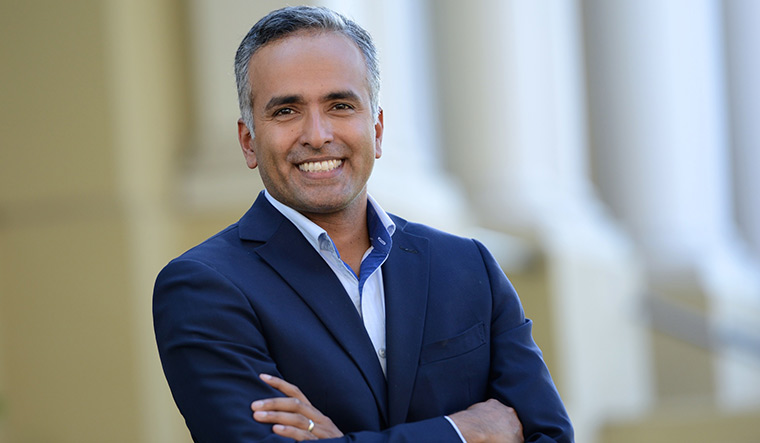 Karthick Ramakrishnan
Ask Indian-American Republicans and they say it is a sure-fire Trump win. Raju Chinthala, a diehard Republican and founder of the Indiana Business Council, says: “The POTUS [President’s] visit to India will strengthen US-India relations tremendously in the coming decades.”
Narender Reddy, a long-time Republican in Atlanta, has been involved in fund-raising for governors, senate and congressional candidates. He says that the Democratic Party’s agendas of “tax the rich”, and give “race-based affirmative action” in educational institutions are detrimental to the Indian-American community.
Reddy mentions Trump’s pro-business reforms, the high stock market and the merit-based immigration as beneficial to the community. He adds that the Trump administration stood by India for its stance of offensive-defence on Pakistan, and showed respect for India’s internal policies by not interfering in the abrogation of Article 370 or Citizenship (Amendment) Act.
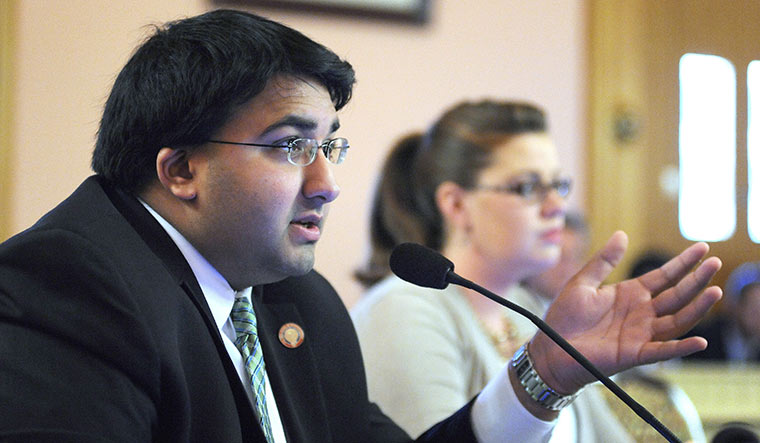 Niraj Antani
Second generation Indian-Americans are also becoming prominent in the Republican Party. Niraj Antani was only 23 when he became an Ohio state representative. He is now the youngest elected Indian-American in the United States. Now 29, Antani is running for the Ohio state senate. Ask him why he thinks the Republican Party is good for desis, and he says: “We are the pro-growth, pro-business, pro-jobs party. Democrats are on the fringes, fighting for illegal immigrants, unlike legal immigrants which Indian-Americans have been. Trump also has a great record of nominating Indian-Americans for different posts.”
Does Antani think there will be a swing of many Hindu voters towards Republicans because of Trump’s India visit and affinity for Modi? “The prime minister has great influence and has a conservative mindset,” he says. “The people want strong conservative leadership, and that is what the president and the prime minister provide.”
Ramakrishnan believes a favourable opinion of Modi would not translate into support for Trump, and that is because for Indian-Americans it is not just what is going on in India that matters. He points out that issues like health care, education, immigration and the rhetoric on race are crucial factors deciding the voting pattern.
He notes that many of the wealthy, highly-educated Indian Americans do not support the Republican Party because it is not strong on fighting discrimination whereas the Democratic Party is better at it. In research done in 2012, he found Indian-Americans who earned over $2,50,000 were quite willing for taxes to be raised on those earning that figure, including themselves.
November is still a long way off and the race dynamics change by the hour. However, one thing is clear: Even though there are Indian-American Republicans, the bulk of the Indian-American community is solidly behind whoever wins the Democratic nomination.
Meanwhile Trump’s India visit provided high drama and pageantry and might have influenced some minds. As Rangaswami points out, Trump has put India and Indian-Americans in the mainstream by attending the ‘Howdy, Modi!’ event in Houston which was huge for the Indian community. Earlier such events were on the radar of only the Indian or Indian-American media, but Trump’s presence transformed it into an international event with every media from CNN to The Wall Street Journal covering it.
Says Rangaswami: “This shows the Indian-American community has come of age, whether you agree with Trump or not. So, for us, this is definitely a side-benefit. With his visit to India, we will once again be in the spotlight as a country and as a community—and that has been a very positive thing for us.”
Lavina Melwani is a New York-based journalist who blogs at ‘Lassi with Lavina’.