

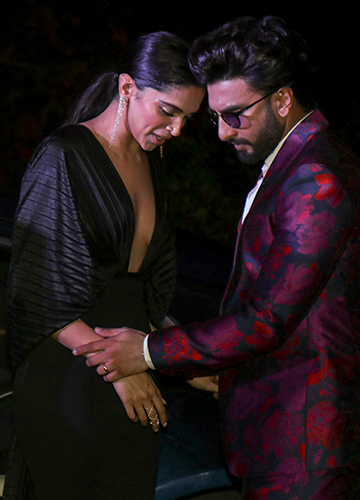
 Love birds: Ranveer and Deepika at an awards function last year | PTI
Meghna Gulzar said that the hardest part for you about Chhapaak was knowing that you would lead a normal life after the prosthetic was removed, but the survivors would not. How did you deal with that?
I was dealing with that emotion on a daily basis during my 9am to 9pm shift. For me, the painful part was knowing that I could go back to my life and revisit theirs when it was convenient for me or when I was required to. That is not the case with them, which is the reason for the kind of emotional toll this film has taken on me. Having said that, it is inspiring that these girls don’t look at it as a scar that weighs them down. They have set themselves free and really taken off, becoming a beacon of hope for millions of people around them.
What was your first meeting with Laxmi Agarwal like?
It was an eye-opener for me. I had interacted with her briefly at some events a few years ago, but this time, I spent many hours with her. As a society, we assume they (acid attack survivors) are a certain way. But what was refreshing was the fact that she was a complete contrast with [what we might have expected]. One would think that they would feel sorry for themselves, or [would be] angry and resentful, but that is not what I saw. I saw forgiveness, strength to move on, hope, contentment and joy.... They are funny, spirited, and cocky at times.
Your role in Chhapaak is the opposite of the one in Padmaavat, your last film. In Padmaavat, your character almost gives in to fear whereas in this one, you fight it. How difficult was it to play such different characters?
I would not say that in Padmaavat, she gave in as much as she said, ‘I would rather kill myself than let you have me’. She was willing to go to any length to protect her sanctity, purity, identity and everything that she believed in. Two things could have happened—he could have gotten the better of her, or she could have succumbed. But with what she chose to do, neither happened. Again, I want to clarify that this in no way justifies the act.
Having said that, for me, the spirit of both characters in Padmaavat and Chhapaak is a common thread. Their worlds are, of course, starkly different. Padmavati was someone who could not really express herself because a queen was expected to conduct herself in a certain way. With Malti (her character in Chhapaak), that was not the case. Also, this is the first time I am playing a real-life character. So I could meet the person, engage with her, and learn and understand.
Does that change how you approach your characters?
No, not really. I think they both come with their share of responsibilities. Sure, there is a lot more liberty with a fictional character like Veronica (Cocktail, 2012) or Piku (Piku, 2015). You have to be more responsible while playing a real-life character.
Do you think the film industry and the government should have done anything about the protests ahead of the release of Padmaavat?
Yes. I think it is important for the industry to show solidarity in moments like these, which did not happen. It is important for people in power to empower those in the creative world and not encourage this sort of hooliganism. This is not the first time it has happened. I think it is important for us to defend and stand up for ourselves collectively. In fact, let me correct [myself] and say that we should reach a place where we do not have to do that. It is important for people to express their likes or dislikes, but peacefully and not through hooliganism.
In an interview, you spoke about how a director did not cast you in his film because you were too good-looking for the part.
(Laughs) Yes, I have had directors tell me that. Some have said I was too tall for a part. A few have said that they do not have the money I charge for a film, because it has gone to my male co-star. Yes, I have been through all that.
So, what do you do in such situations?
Eventually, I think it is the creativity that overrides everything else. If the decision is not in my hands then it is not. But if it is, then ultimately the creative person in me will [dominate] every other tangible or practical [consideration]. Or technical. For me, a technical issue will always be overridden by what I feel instinctively at a creative level. If I really want to do the film, I will do the film. But if someone does not want to cast me because I am too fair or too tall, then it is out of my control.
For Chhapaak, you had to give up your beauty. That is a huge step.
A director once told me that he is not going to watch this movie because he believed I would look ugly in it. My question to him is, 'Are you then saying that Laxmi is ugly?' Hopefully this movie will broaden our minds regarding how we are conditioned to think about beauty.
This is also the first in 12 years of your acting career that you really took a gap in between two films. How did that help you? Has it helped you grow as a person?
I used this as a period of creative fertility. It is extremely important as an actor to keep nurturing yourself and to nurture different aspects of your life. And, sure I might not have physically been on a film set, but it’s been my most creatively nourishing time meeting up with writers, directors, watching movies, reading. All of those things…it is important for me. I think sometimes we just get into this rut of having to churn out film after film and we forget to nurture ourselves. I do not even mean it at a personal level, I mean it at a professional level. The whole of last year was exactly that and that is why I was able to put so much of myself in to a film like this because I felt nourished.
In this time, you also took up the role of the chairperson of MAMI. What has that meant to you?
MAMI is really broadening my mind in terms of creativity and how much more cinema there is out there that a lot of us are not even aware of. It is a lot of learning for me. I do not think I can say I know everything about how a film festival is run or should be run. But at the same time, I am fully cognisant of the fact that being in this position definitely benefits the film festival and the body. I am willing to learn in this journey. I have always been open to that.
You are also doing a film on the Mahabharat from Draupadi's perspective. Would you say your focus has now shifted to women-centric films?
I would not say women-centric as much as I would say meaningful. Chhapaak is not a women-centric film, but rather one about a girl who has been on a certain journey and whose story and spirit will resonate with millions of people. I am also not doing Chhapaak because it is directed by a woman. Similarly, playing Draupadi for me is exciting because it presents an interesting alternate perspective to the Mahabharat. Again, it is not because she is a woman but because she has the most exciting point of view among all the characters.
I do not know [if the transition] is a conscious decision. I think it is more a function of the person I am evolving into, or the person that I have become, or the person that I am.
How much of a role do your parents, sister and Ranveer play in your film choices? Do you discuss roles with them?
So, I have seen Chhapaak and he (Ranveer) was asking me what I thought about it. But I did not say anything. I want them to discover my films on their own. The most I tell my parents, or even my husband for that matter, is that I have signed on this movie. Maybe I will give them one line, like whether it is a romantic or a horror film. With Ranveer, maybe I will say one line more about it. But that is about it. I really want them to have a fresh perspective [when they watch it].
You have spoken a lot about how Ranveer and you are so comfortable with each other. But considering that you are both actors, does the constant scrutiny of each other's work become stressful?
No, I do not feel like I am being scrutinised at all. In fact, I think Ranveer is extremely supportive and encouraging. I feel that what he gives is more like advice, or suggestions. It comes from a good place, not from one of criticism.
You have revealed that you needed a counsellor during the shooting of Chhapaak. It has been some time since you were diagnosed with depression. Do you now recognise your trigger points?
Yes, I do. My friend and I were chatting the other day about how silly we are at times because we know exactly what the trigger points are, but we still keep challenging it because you feel ki ab nahi hoga (now it will not happen). And then boom, it comes back, and you are like, ‘Oh, god! Stupid girl! Why?’ With Chhapaak, for example, I could not identify a trigger point, it was the role itself that was the trigger point.
How do you want to progress with your production house, Ka Productions?
I want to do films that are meaningful and impactful. That does not necessarily mean that every film has to be a socially relevant film. It could be a simple and beautiful film like Piku, which told the story of a father-daughter relationship in an entertaining manner. Eventually, I want to be a part of films that I can be proud of and that impact people in different ways—it could be a film that gives them joy, or makes them reflect, or it could be something as extreme as Chhapaak.
The discourse in the industry on gender pay parity has been continuing for a while. Do you think women turning producers might help?
Yes, somewhat. But what I feel about this issue is slightly different. Unlike the corporate world, this is not a fixed job, where the results are tangible in a certain sense or where you can measure who is bringing what to the table. But yes, at a larger level, there is pay disparity. Does a female actor get paid as much as a male actor? No. Does a female technician get paid as much as a male technician? No. [The problem] is getting recognised, and we are definitely headed in the right direction, but I think we still have a long way to go. When we talk about pay parity, from an actor's point of view, I really hope that it does not mean that the women start charging more to equal what the men get. I would actually hope that the men start charging less and not burden a film financially. I would much rather hope that everyone—male or female—who has invested in a film in terms of time, talent or whatever else, is compensated adequately. But [I hope that comes] in the end, when the film really becomes a success, instead of burdening it with a heavy cost of production. But that also means that the producers have to be honest in their disclosure about box-office [collections]. It is beginning to happen.
After xXx: Return of Xander Cage (2017), do you want to do another Hollywood project?
For me, it is not so much about going to Hollywood as it is about being a part of films that resonate globally. In a way, Chhapaak is also a hugely international movie because of the subject. And the fact that acid violence is not something that happens only in India, but it is also rampant [in countries like] the UK. The thrill is not so much about working in Hollywood as it is about being a part of films with exciting content.