

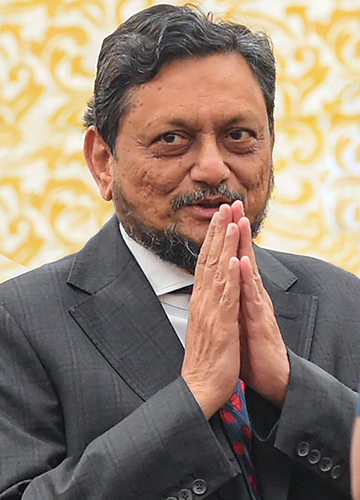
 S.A. Bobde | PTI
JUSTICE SHARAD ARVIND BOBDE, the new chief justice of India, is known for his adventurous streak. Three years ago, he did not think twice before stepping into the basket of a fire engine's snorkel with a lawyer-lensman who wanted to get an aerial shot of the Supreme Court building. Bobde, a photography enthusiast himself—he prefers nature to buildings as his subject though— accompanied Vinay Thakur in the 130ft-high snorkel to capture the building for the latter's coffee table book on the architecture of the apex court and the High Courts.
The adventurous zeal comes through in his passion for bikes, too. Bobde, 63, has spoken about his fondness for them, and used to own a Royal Enfield Bullet. This February, he met with an accident and fractured his ankle while test-riding a Harley-Davidson.
But Bobde's daredevilry, visible in his nonjudicial interests, is in contrast with his approach towards court matters. Last year, when the four most senior judges of the Supreme Court, in an unprecedented move, went public with their grievances against then chief justice of India Dipak Misra, Bobde turned peacemaker. He is learnt to have suggested that the judges resolve the differences internally and advised them against going to the media again as it would only make matters worse.
Also, the way he presides over the court is different from that of his predecessor. Unlike Justice Ranjan Gogoi, who is known for his temper and impatience with lawyers who repeat points in their arguments, Bobde is unhurried and coolheaded, giving ample time to the parties to present their sides. To cool down tempers in his court, he asks questions that bring in a bit of humour. For instance, during the heated debate on the Ayodhya issue, he wondered aloud if any other court in the world had dealt with the question of the birthplace of an incarnation of God.
But Bobde is a no-nonsense judge, too, and takes quick decisions if the case so merits. “My first interaction with Justice Bobde was in the Bombay High Court,” recalled former additional solicitor general Vikas Singh. “I was representing a deemed university, the issue being whether the Right to Information Act applied to it. He passed an interim order in two minutes, saying the Act does not apply to the university. He goes strictly by the letter of the law, and is not moved by the thought of what people might say.”
He is often commended for appointing senior advocate P.S. Narasimha as amicus curiae in the Board of Control for Cricket in India matter and to act as a mediator in resolving the disputes raised by multiple state cricket associations. Bobde is expected to have a moderate stance in dealing with issues where the court and the executive appear to be at odds, especially with regard to appointment of judges. “Justice Bobde believes in team spirit,” said Supreme Court lawyer Sneha Kalita. “He would always consult his fellow judges even as he would patiently hear the lawyers. This capacity to take everyone along will be crucial at a time when the court is seen as a divided house and the collegium has had confrontations with the government.”
Bobde will serve as the 47th chief justice of India for 17 months, retiring on April 23, 2021. He hails from Nagpur and comes from a family of lawyers. His father, Arvind Shriniwas Bobde, was advocate general of Maharashtra. He began his legal career in 1978, practising at the Bombay High Court, with appearances before the Supreme Court. In 1998, he was designated as senior advocate, and was elevated to the Bombay High Court as additional judge in 2000. He was sworn in as chief justice of the Madhya Pradesh High Court in 2012, and appointed to the Supreme Court on April 12, 2013.
Among the important Supreme Court verdicts that he was part of is the Aadhaar judgment, which stated that no individual could be deprived of any essential service for want of the unique identity card. He was part of the bench that heard the case filed on behalf of three children on the issue of pollution in Delhi and ordered a ban on sale of firecrackers. Bobde was also part of the Constitution bench that delivered the verdict in the long-pending Ram Janmabhumi-Babri Masjid case.
Bobde headed a three-judge panel that gave Gogoi a clean chit over the sexual harassment allegations by a junior court assistant. However, there was criticism of the manner in which the issue was dealt with by the top court and it was said that the complainant was not given a fair hearing.
Legal observers said that there has been a smooth transition from Gogoi to Bobde as, after a long gap, the relations between the incumbent and second-in-line were excellent. Gogoi is said to have kept Bobde posted on every important administrative decision, and he was also part of the Constitution benches hearing crucial matters.
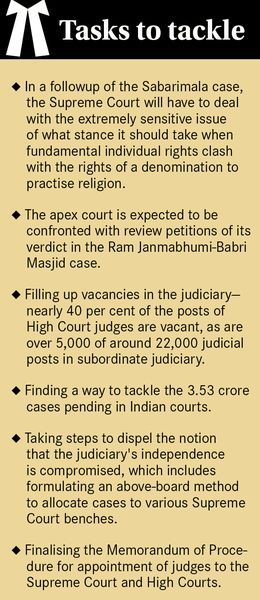
However, as Bobde takes over after Gogoi's rather troubled tenure and as questions are being raised about the independence of the judiciary, the legal fraternity wants him to take steps to repair the damage done to the image of the court. “Justice Bobde can consider setting up a collegium-like body to allocate cases to various benches,” said senior advocate Vijay Hansaria. “This will help deal with the criticism that high-profile cases were being allocated to benches in a selective manner.”
Also, Bobde will be expected to be firm in ensuring that appointments of judges to the High Courts and the Supreme Court are cleared by the government in a time-bound manner. “We have seen of late that the collegium has failed to act in an independent manner with regard to certain appointments,” said Singh. “It has bowed to pressure from the government. I hope Justice Bobde will stand up to the government wherever necessary and will be firm on appointments being made in a fair manner.”
Bobde, it seems, will have to bring his daring side to court.