

 Amit Shah | Sanjay Ahlawat
Narendra Modi’s big day is still three years away. The moment of glory will arrive when he plays host to the world’s most powerful heads of states at the G20 summit in Delhi in 2022, the 75th year of India’s independence. The prime minister has set that year as the deadline for his ministers to achieve various governance goals—economic, social, national security and diplomatic.
Modi 2.0 marks a transition from tentative trust to resolute faith in the top four ministers—Rajnath Singh, Amit Shah, Nirmala Sitharaman and S. Jaishankar, who are part of the cabinet committee on security (CCS). There are now more hawks than doves in the CCS, the most powerful cabinet subcommittee. With Ajit Doval retained as national security adviser with cabinet rank, that message is only clearer. He will continue to drive India’s security establishment, from behind the scenes.
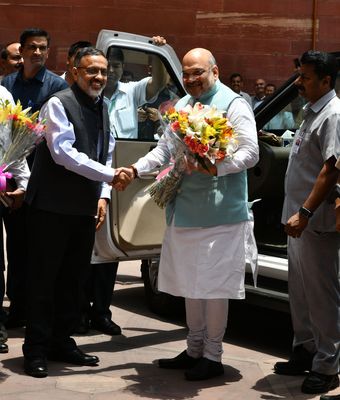
Modi played disrupter again when he brought in his most trusted aide, Amit Shah, to head the Union home ministry. Shah’s decision to contest the Lok Sabha elections from Gandhinagar, which had been L.K. Advani’s constituency, was the first giveaway that he was eyeing a role in the government.
The winds of change have reached Raisina Hill, which houses all four CCS ministries. As home minister in the first Modi government, Rajnath was the quintessential Vajpayee-era politician, whose key words were civility and engagement even in times of crises. “We will give a befitting response to Pakistan. Every brick from Pakistan will be paid back with a stone,” he would say every time there was a border skirmish. With Rajnath moving to the defence ministry, the home ministry now has a much more aggressive boss. “If a bullet comes from Pakistan, we will respond with a bomb,” Shah has repeatedly said. He also has poll promises to keep—driving out illegal Bangladeshis, tackling Kashmir and extending the National Register of Citizens to other states.
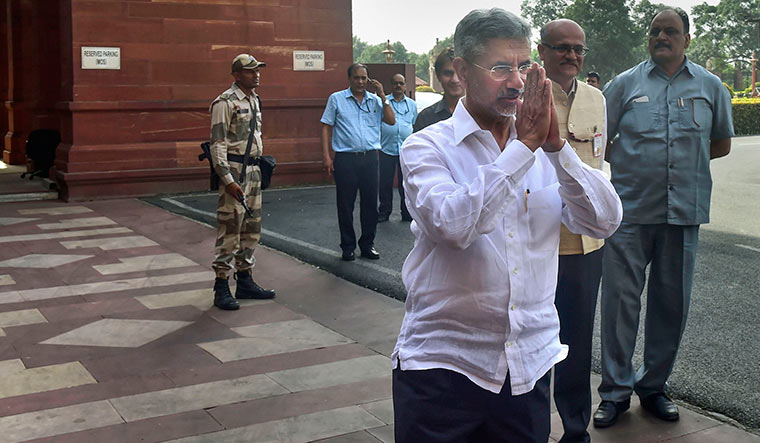
There were many in the BJP who were hoping to make it to the Modi cabinet, thinking that Shah would remain party president. But the duo sprang a string of surprises. The most interesting pick, perhaps, was S. Jaishankar, the former foreign secretary who is now external affairs minister. His appointment resembled the surprise Modi sprang in November 2014, when he made his G20 sherpa, Suresh Prabhu, the railway minister.
As Gujarat chief minister, Modi had met Jaishankar during his China visit in 2011, when the latter was India’s ambassador to Beijing. Jaishankar was asked by the Congress-led Union government to remove Modi’s pictures from the publicity material printed for the visit. Modi later called up Jaishankar, saying he had no hard feelings. Modi’s gesture left a lasting impression on Jaishankar.
 S. Jaishankar | PTI
Jaishankar’s diplomatic skills will now help Modi negotiate a deeply polarised world. A major challenge for Jaishankar will be holding the G20 summit, which will have visiting dignitaries from 19 countries, including the US, the UK, China, Russia, France, Australia, Germany and Saudi Arabia. He had proven his organisational mettle in 2014, when he helped Modi earn his rockstar image in the Madison Square Garden event in New York.
Jaishankar’s networking skills were on display at the meet-and-greet section of that event, where members of India caucus of the US Senate were seen enthusiastically shaking hands with the prime minister. He also saw to it that Modi’s specific instructions—like, he was not to be seated or seen with any Indian industrialist at a reception organised by the Indian American community—did not result in awkward situations. Mukesh Ambani had expressed his desire to be seated with Modi, but Jaishankar ensured that the request was diplomatically ducked.
 Nirmala Sitharaman | PTI
Jaishankar had been the ‘fix-it’ man for Manmohan Singh, too. As prime minister, Singh had wanted to appoint him as foreign secretary in 2013, but apparently the Congress high command overruled him. Jaishankar, who was one of the key negotiators of the India-US civil nuclear agreement, was then sent to Washington as ambassador, to help India out of a rather difficult time in bilateral ties. He successfully defused the diplomatic standoff that was sparked off by the visa fraud allegations against India’s deputy consul general Devyani Khobragade.
After taking over as foreign secretary in 2015, Jaishankar ably steered Modi’s outreach to Gulf countries, especially to the UAE. He was instrumental in widening India’s strategic options from central Asia to Japan. It helps that he speaks conversational Japanese, courtesy his wife, Kyoko. Jaishankar also speaks Hungarian, Russian, Tamil and Hindi. Hard-nosed and hawkish, he once refused to engage with Pakistan prime minister Nawaz Sharif’s staff in Hindi. He spoke in English to signal that he meant business.
A key challenge for Jaishankar would be to lead the trade negotiations with the US, especially in the backdrop of the aggressive policies adopted by US president Donald Trump. In this, and also in charting the course for the G20 summit, Jaishankar will have the helping hand of Finance Minister Nirmala Sitharaman. Both are Jawaharlal Nehru University alumni, and together they would help Modi negotiate the commerce and trade aspects of the summit.
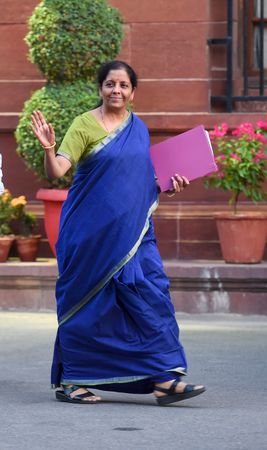
Sitharaman’s role in the cabinet will be much more crucial, as the government rides into economic headwinds. How she plans to go about resolving the jobs problem and the drying up of foreign investment will become clear on July 5, when she presents her maiden budget.
As defence minister, Sitharaman had been part of the previous CCS, too. She is number five in the order of precedence in the current cabinet, up from 24 last time. Her dedication, learning ability and tenacity were key factors in her meteoric rise. Within months of taking over as defence minister, she had won praise from senior cabinet colleagues for her spirited defence of the Rafale deal. Her two-and-a-half-hour speech in Parliament, in stout response to the opposition’s charges of corruption in the deal, saw her cementing her reputation as an aggressive defender.
 Rajnath Singh | AFP
Sitharaman took over as defence minister in September 2017, exactly a week after the India-China standoff at Doklam ended. She effected several changes in the functioning of the ministry, calling daily meetings with the three service chiefs to assess the border situation and fortnightly meetings of the defence acquisition council to expedite procurement. Earlier, such meetings happened only once in three months.
From May 2014 to September 2017, Sitharaman was junior minister of commerce. She faced criticism for the failure of the Make in India scheme in preventing the weakening of the domestic manufacturing sector. But officials at Udyog Bhavan say she left an indelible mark by leading India’s outreach initiatives. No wonder that Trump gave India’s second woman defence minister a red carpet welcome in Washington last November.
Industry leaders say Sitharaman could bring India back to the high-growth trajectory. “This is the right time for India to think big and aim for a 10 per cent growth rate,” said Vikram Kirloskar, chairman and managing director, Kirloskar Systems Ltd, who recently took over as president of the Confederation of Indian Industry in Delhi.
Sitharaman is considered as one of the brighter proteges of former finance minister Arun Jaitley. “Her choice was evident to us. The prime minister had allowed a free hand to Jaitleyji for selecting the name of his successor,” said a close aide of Sitharaman.
She is also seen to be more amenable than Jaitley to directions from the prime minister’s office. Her lack of links with business lobbies was apparently a key factor in Modi’s decision to choose her over Piyush Goyal, who had served as interim finance minister in Jaitley’s absence.
While Sitharaman and Jaishankar are expected to quietly go about their tasks, the focus will be on the de facto number two in the government. Shah will have his hands full dealing with insurgency in Kashmir, cross-border terrorism, illegal migration and Maoist violence. There is also the BJP’s poll promise to remove Article 35A, which allows the Jammu and Kashmir assembly to define permanent residents of the state.
Shah never shies away from experiments and confrontations. It was under his leadership that the BJP decided to form a coalition government with the Peoples Democratic Party in Kashmir in 2015, only to end it three years later over the differences between both the parties on how to tackle insurgency. He had been a driving force behind the government giving the security forces a free hand in crushing insurgents in the valley. It is no surprise that the armed police forces under the Union home ministry are happy with Shah’s cabinet entry.
“The focus is not on cross-border trade or people-to-people contact with Pakistan,” said Arun Choudhry, former special director of the Intelligence Bureau. “The new government has already given a signal that terror and talks won’t go together.”
Shah’s immediate focus will be on holding the assembly polls in Jammu and Kashmir. “This time, they [the BJP] will be talking from a position of strength,” said Choudhry. “The BJP may try to get a foothold in the valley by fielding certain young Muslim leaders who may be wooed to fight against the National Conference and the PDP. The ultimate aim of the BJP will be to eventually form a government in Jammu and Kashmir.”
Shah took charge on June 1, and his style of functioning became clear on that day itself. After meeting a string of visitors—mainly governors and chief ministers of several states—he called a meeting of top officials. Ignoring that it was a Saturday evening, when the ministry usually wears a deserted look, he charted a new course for the officials. After home secretary Rajiv Gauba’s welcome speech, Shah sat through presentations from all 19 divisions of the ministry—centre-state, counter-terror and counter radicalisation, internal security, left-wing extremism and border management divisions, to name a few.
There was no tea or snacks to lighten the mood. Just when everyone thought he would conclude the meeting without asking any questions, Shah threw a poser at the joint secretary in charge of the freedom fighters’ division: How many families were still drawing the freedom fighters’ pension?
He was informed that there were 9,000 families who were drawing direct benefits, and 25,000 families who were dependants. The meeting concluded after Shah told officials to make individual presentations from June 3 onwards, flagging the internal security division as his top priority.
All through his schedule, Shah kept his eyes and ears open to the goings-on in North Block. Kishan Reddy, his junior minister, was summoned as he was happily giving soundbites to journalists. The visit to Shah’s office appears to have sealed his lips. “With Shah as home minister, one thing has become clear—everything will be done now, not later,” said an official.
Shah was made home minister in Gujarat in 2002, when Modi was chief minister. He handled as many as 12 portfolios at a time, and was credited with maintaining law and order, even if he was criticised for using strong-arm tactics. In his new assignment, Shah will be expected to close unfinished deals for the government, such as the proposed Naga peace accord.
Former home secretary G.K. Pillai said it was good to have a powerful home minister with political clout. Such a presence, he said, would not only bring stability to the government, but also push state governments to bring about necessary changes to bolster the internal security setup.
“Federal issues are key to the smooth functioning of the government and the home ministry,” Pillai said. “Shah may need to do something like what Jaitley did for goods and services tax—get all the states on board. Because key security projects—like the Crime and Criminal Tracking Network and the National Intelligence Grid, which aim to link all police stations and databases for tracking criminals and terrorists—require consensus among state governments.”
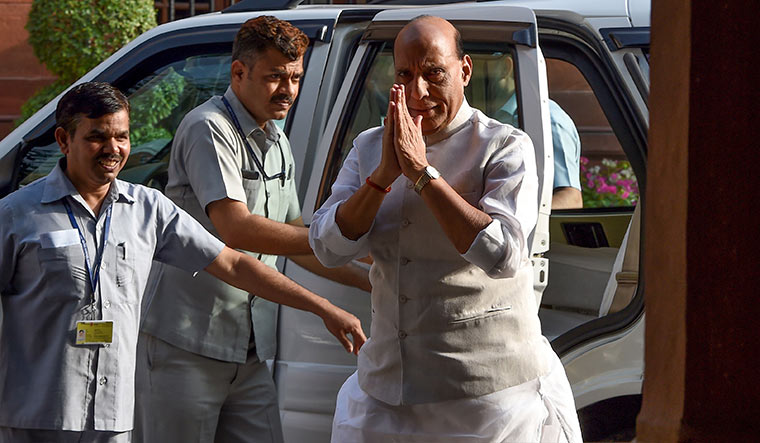
The only old-style politician in the brave new CCS is Rajnath. His move is expected to stabilise South Block, which has been a revolving door for defence ministers in the past five years. Rajnath, a fitness-conscious leader who starts his day with yoga and meditation, will lead the armed forces from the front. The day after he took charge, he flew to Siachen and interacted with soldiers at the world’s highest battlefield.
Amid the growing challenge from Pakistan and China, Rajnath will have to quickly decide on several crucial pending procurements—400 fighter jets for the Air Force, 800 helicopters for the Army, the Navy and the Air Force, and six new submarines and 57 jets for the Navy. If any issue related to the Rafale deal crops up again, say observers, Rajnath’s old-world niceties could help mend fences with the opposition.
The CCS is not complete without the contribution of an ‘outsider’—Doval. He is Modi’s inside man in the intelligence machinery, and the pivot around whom key security decisions were taken in the past five years. Doval has been able to blend his hawkish security approach with smart diplomacy, a feat that has elevated him to a stature his detractors thought he was incapable of achieving.
Doval will be expected to continue what he has been doing—balancing security priorities with regional diplomacy. Said an intelligence official: “The spiralling tensions between Washington and Tehran, and the developments in Afghanistan, will keep him occupied.”
AMIT SHAH
Home minister
TOP PRIORITIES
■ Holding assembly polls in Jammu and Kashmir
■ StrengtHening internal security
■ Ending illegal migration
S. JAISHANKAR
External affairs minister
TOP PRIORITIES
■ Organising the G20 summit in Delhi in 2022
■ Helping the government negotiate global uncertainties
■ handling trade talks with a belligerent US
NIRMALA SITHARAMAN
Finance minister
TOP PRIORITIES
■ Presenting her maiden budget in July
■ Resolving economic problems
■ Helping the government negotiate commerce- and trade-related issues at the G20 summit
RAJNATH SINGH
Defence minister
TOP PRIORITIES
■ Modernising the armed forces
■ Speeding up crucial defence purchases
■ refuting Rafale-related allegations