


Almost a month before the trailer of The Accidental Prime Minister dropped, I met its director, Vijay Ratnakar Gutte, 33, at a high-rise in Andheri, Mumbai. Son of sugar baron Ratnakar Gutte and producer of three vaguely remembered films—The Film Emotional Atyachar, Time Bara Vait (Marathi) and Badmashiyaan—Vijay was arrested for a GST fraud of Rs34 crore last year and later released on bail.
As I was guided towards his apartment’s balcony, an aroma wafted in. What’s cooking? A recipe for the upcoming Lok Sabha polls, perhaps, considering that the film, based on Sanjaya Baru’s namesake book, is in the news more for political reasons. Dressed in shorts and a tee, Vijay looked tired. He had been working on post-production and was behind schedule, he said. The film’s journey began when its producer, Sunil Bohra, came across the book at an airport. Not a reader, he read this one and was quite impressed with it. He then contacted Baru and got the film rights for the book in September 2015. That was the easy part. For, none of the film studios he contacted wanted to be associated with the film. “Raising funds to make the film was very hard. It was a daunting task to put together the actors and the director, too. We started shooting for it only in early 2018,” he said. Researching for the film also took time, he said, as not many knew the inside workings of the Prime Minister’s Office. But, he has faith in Vijay. “Being a first-time director, he has put all his energies into the film,” he said.
Bohra then got Vijay to read the book. While he really liked it, Vijay said, “I was not very convinced about making a film though. Reading a book is a different experience than watching a film. I told him that I want to meet Sanjaya Baru before taking a decision.”
Vijay spent a week in Delhi, talking to Baru for four to five hours daily and recording their conversation. And, he was hooked. “Knowing the PMO so closely was interesting,” he said.
Like Bohra, Vijay, too, faced hurdles. Actor Anupam Kher, who plays Manmohan Singh in the film, had initially said no. If the director’s account is to be believed, Kher initially told him that he would have little to do on screen, as he would have to stand mum while Sonia Gandhi speaks. “And maybe something else, but let’s not go there,” said Vijay.
Kher, in an interview with THE WEEK in September 2018, said that he accepted after being fully convinced that he could give the character his 100 per cent. “As an actor, you can get exposed if you do not portray him really well,” he said.
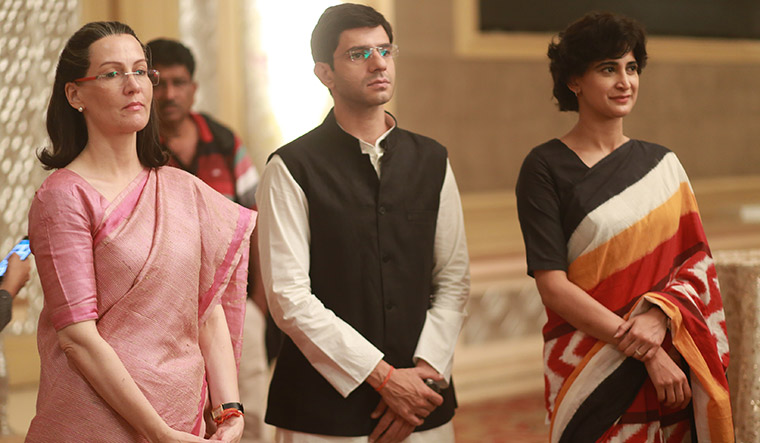 True to character: (From left) Bernert, Arjun Mathur as Rahul Gandhi and Aahana Kumra as Priyanka Vadra.
From then on, it was a step-by-step process. While he spent eight months casting other actors, Vijay would send Kher every scene that he wrote, along with videos of Singh speaking in public on those occasions.
Things got better after that. Kher was convinced, and the director wanted to explore things that he believed were puzzling for everybody. “Everyone has a perception that Manmohan Singh doesn’t speak, but is that really the case? We wanted to explore that aspect. Or, his Mona Lisa smile, which, I believe, has come out beautifully,” said Vijay.
According to Mayank Tewari, who has written the script along with Vijay, the film will show the hero in Singh, who fell victim to the circumstances. He said the book was very tense, and their primary motive was to make an entertaining film.
When the book released, many thought that it was a result of personal biases. Tewari, who was a journalist, does not deny it. But he said it was better to call it “personal opinion” rather than bias. “And an opinion has a certain context and experience. He (Baru), perhaps, has been a witness to certain things and that is why he has these opinions,” said Tewari.
It has never been easy to make films around political events, forget political figures, in India. Releasing them have been even more difficult a task. The Maharashtra Congress has already objected to the movie’s trailer. But, why would anyone like to debut with a film that has trouble written all over it? “It was a tricky situation for me, but I was really attracted towards the book and the character of Singh,” said Vijay. “He is very enduring and with characteristics that you find in slice-of-life cinema. You will love him when you observe him. The film is a little risky, but I never felt that during the process of making it.”
While he does not mind praising Singh, Vijay is more forthcoming while talking about Prime Minister Narendra Modi, using adjectives like daring and aggressive to describe him and saying that he is someone “who can change the face of the country”. He added a disclaimer though: “I have no opinion of the current political party, because I have not been following anything since the last two years. I was busy making the film.”
Tewari sticks to facts and the book. “When the United Progressive Alliance-II regime began, the credit was given to [Congress president] Rahul Gandhi because he won 20 seats in Uttar Pradesh. It is a fact,” said Tewari. “Everyone was waiting for Rahul Gandhi to be crowned prime minister. Suddenly, the news of scams started tumbling out, the Anna Hazare movement started... things were out of control. There was a polity paralysis from 2010-2014.”
The big question, however, is whether the film has a political agenda. “It is just a film,” said Vijay, adding that giving it too much importance is not the best approach. Bohra said that he did not have any political agenda in making the film. “We have told all the film committees and everyone that we do not want to get into any kind of controversies,” he said. “The film is simply an adaptation of the book. We have added nothing.”
When told that the book is harsh on the UPA regime and calls the Gandhis authoritative, Bohra said, “When you see the film, you will realise that whatever we have taken in the film has been researched well.” His small production house, which has produced films like Shahid and Mastram, believes in entertaining the audience, and nothing else, he asserted. “Even with this, we have tried to create an interesting and entertaining storyline, without trying to take any [political] side or create any kind of melodrama,” he said.
Though not sure about the film’s fate, Bohra hopes it is loved. Well, in a country that loves cinema, there is nothing better than a political film sans agenda. If that is what The Accidental Prime Minister is, we are all for it. Anything else, we will just have to wait and watch.