


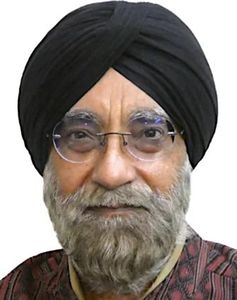
 Surinder S. Jodhka
Last September, following a directive from the Allahabad High Court, the Uttar Pradesh government banned the use of caste titles in official communications, police files and notifications. The government also banned the use of caste titles on vehicles, in social media and even in political rallies. It is hard to question the value of the court judgment, but it could produce an opposite effect.
Quoting extensively from the writings of B. R. Ambedkar and invoking the secular spirit of the Constitution, Justice Vinod Diwakar, in his order delivered on September 16, 2025, had expressed dismay over the practice of recording caste and religious identities of the accused in police files. Such a practice in the procedural systems of the state departments and their police files rendered the official processes vulnerable to caste prejudice and discrimination.
The sweeping directive of the state government bans the use of caste titles/identities in the public sphere, without specifying the context. No wonder the directive has been welcomed only by the traditionally privileged castes. Those on the margins of the system—dalits and the OBCs—have expressed their dismay. They see it as having the potential to disable their politics and make it harder for them to raise questions of caste discrimination and deprivations. Silencing caste could function only as a cover for the underlying divisions and discriminatory structures and conceal the historically produced inequalities, which continue to shape the present-day economy and everyday social life for many of them.
The paradox
At another level, this ongoing political slugfest also serves as a good example of the paradox that the question of caste poses in contemporary India. For example, how would such a directive banning the use of caste measure up against the decision of the Union government to enumerate caste as part of the national census? Enumeration is not simply a matter of filling census schedules and compiling numbers. Once enumerated, the numbers come to acquire a life of their own. They begin to speak and could even scream, demanding active political engagement. They would reveal the underlying structure of inequality, deprecations and privileges that could produce a different kind of politics.
Caste has been a challenging subject for state actors in independent India. It was not only Ambedkar who had vehemently denounced the system of caste hierarchy and argued for its annihilation for India to become a ‘nation’, a constitutional democracy, in the true sense of the term. Most of his contemporaries agreed with him. There was a near ‘consensus’ on the subject, and even the Nehruvian elite, who took over the reins of power from the colonial masters, saw caste as antithetical to the idea of a modern nation. However, except for the reservation policy, caste could not become part of the policy narratives or a variable in the development planning initiated with much gusto soon after independence.
Perhaps the reason for this lay in the manner in which much of the critique of caste was framed. Except for Ambedkar, a large majority of the nationalist elite viewed caste merely as a cultural relic of an outdated tradition and a mental hangover. For them, moving on the path of development and modernisation would take care of it. As the classical theories of modernisation and development models—originating from American think tanks—suggested, the increasing opportunities for social and economic mobility made available by industrialisation and the modern service economy, along with a steady decline of traditional agrarian and caste-based occupations, would usher in a new society. Organised around a ‘modern ethos’, individual merit and skill acquired through formal education would transform the hierarchical order into an open system of stratification. Democratic/electoral politics, too, would give it a push. The system of universal adult franchise, where every individual voted according to their will, would make the ‘communities’ redundant in the political life of the nation.
Since caste was viewed primarily as a mental hangover, the solution thus lay in education, economic growth and exposure to urban culture. Such modernising processes were to enable the “ignorant masses” to come out of their conservative mindset. For the metropolitan elite, the caste system typically flourished in the social ecology of the Indian village. Urbanisation would help them forget it. The modern nations of the west have all forgotten their ascribed identities. India too would!
However, the unfolding of India’s modernisation did not erase caste. On the contrary, it appears to have made it far more ‘active’. It has emerged as a potent platform for articulating political aspirations, particularly among those who could not find space in the English-educated elite networks. In caste terms, the post-colonial elite was not merely a social class; it mostly came from a narrow set of non-agrarian urban “upper” castes. The language of modernity and merit only served as a caste blinder.
The political resurgence of caste
Electoral processes work through numbers. As democracy spread from metropolitan centres to the interiors of India’s regions and countryside, its grammar began to be shaped by local processes, from the ground up. The agrarian rich from the regionally dominant castes were the first to mobilise their caste communities for electoral politics. It soon went further down, to the “backwards” and the “dalits”. By the 1980s, the language of ‘social justice’ emerged as a new idiom of electoral politics.
While the regionally dominant and “backwards” could gain access to state or political power through the electoral process, their representation in government jobs and institutions of higher education remained marginal. It was in this context that the introduction of quotas for the Other Backwards Classes (OBCs), as proposed by the Mandal Commission in the early 1990s, marked the beginning of a new caste-centric phase in Indian politics. Caste was no longer merely about tradition and conservative mindset. For those on the margins of the system, it had always been a source of social exclusion and discrimination. It began to be framed in the language of citizenship.
Such a reframing of caste also changed it into a question of state policy. It began to be treated as a variable in discussions on poverty and development. However, policies require data. How does caste correlate with poverty? What is the nature of their deprivations that accompany caste-based marginalisation? How do such deprivations vary across jatis and regions? How have they changed over time? Such questions also began to be discussed in Parliament, assemblies and the courtrooms.
Hindutva could not stop it?
Also Read
- Census 2027 explained: What you need to know about the two phases, questions, key dates
- The great Indian shake-up: Is India ready for political storm of Census 2027?
- The delimitation dilemma: Why India's north-south divide is at a breaking point
- Nari Shakti Vandan Adhiniyam: Progressive law or a 15-year setback?
- One Nation, One Election: India's solution for reform or a democratic risk?
Many saw the rise of hindutva politics during the second decade of the current century as a defeat of the ‘social justice’ politics unleashed by the ‘Mandal moment’. With the BJP in power, Hindu consolidation gained momentum over caste-based divisions and social justice parties. Political parties, such as the SP, the RJD and the BSP, experienced a significant decline in electoral support.
However, the reality of caste as a structure of inequality and exclusion persists. The growing politicisation of the OBCs and other socially excluded categories, even among those who subscribe to hindutva politics, has also sharpened their awareness about their persistent marginality in an economy guided by neoliberal policy frames. It is in this context that the demand for including caste in the national census began to gain traction among the wide range of castes in the broader category of the ‘backwards’. Clearly, the Modi government’s decision to include the ‘caste variable’ in the much-delayed national census is intended to blunt the appeal of such demands from opposition leaders.
The author is professor of sociology at Jawaharlal Nehru University, New Delhi.