



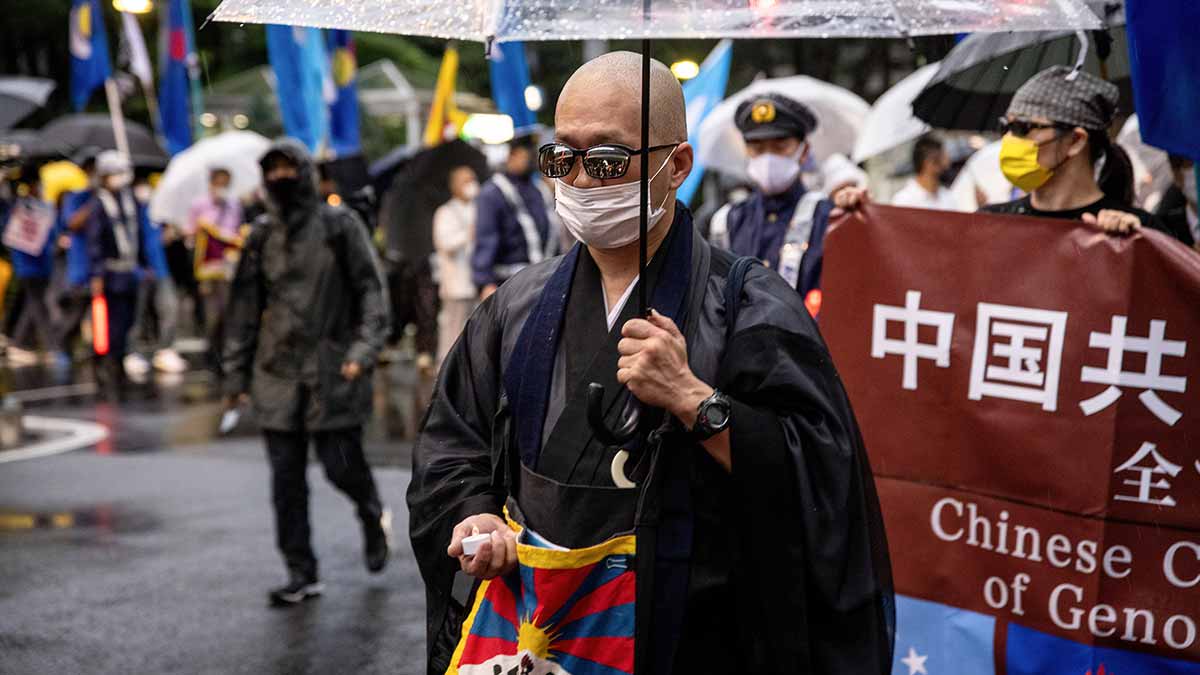
The Dalai Lama has clearly shown us what is most important for humanity amid the various conflicts happening around the world and the serious challenges humanity faces. The world is returning to an era in which the order created after World War II has been destroyed, where powerful countries use force to obtain what they want.
The invasion of Ukraine is a typical example. In this war, territorial expansion and the revision of history are being carried out openly through the use of force. President Vladimir Putin is using force to seize Ukrainian territory and, furthermore, claims that all of Ukraine is Russian territory because Russians and Ukrainians are the same ethnic group. This is a clear rewriting of history. The People’s Republic of China, ruled by the Chinese Communist Party (CCP), is no different. It has seized Tibetan territory by force and is relentless in its efforts to rewrite history. It distorts the history of China and Tibet in a manner far removed from the truth.
They also advocate the ‘Sinicisation of Tibetan Buddhism’, which is the CCP’s scheme to effectively eliminate Tibetan Buddhism. This kind of rewriting of history and the eradication of Tibet’s unique culture will likely continue under the CCP.
Nevertheless, the Tibetan people have not given up on their efforts to learn and preserve their identity. In particular, the younger generation deserves our attention. They have lived under the oppressive rule of the CCP since birth and have never met His Holiness. Yet they trust His Holiness, continue to study Tibetan Buddhism, and refuse to yield to pressure.
Tibetans living in Dharamsala and around the world are no different. They refuse to succumb to China’s brutal oppression and remain steadfast in their resolve to live as Tibetans. Behind this stands the presence of His Holiness.
We in Japan are deeply inspired by His Holiness’s efforts to deepen his study of Tibetan Buddhism, guide many monks and Tibetans, and practise the way of life as a Tibetan in the real world. We are also moved by his wisdom in adhering to the middle way policy toward the CCP, refusing to give them any pretext for further aggression or oppression. We wholeheartedly support his quiet strength.
There are several important similarities between Tibet and Japan. The first is that both face the issue of distortion of history by the CCP. Japan has also been subjected to what is known as a “historical war”. The CCP claims that it was they who liberated the Tibetans from slavery and brought them happiness.
They also assert that the sovereignty of Okinawa, which is part of Japanese territory, is undecided, and that Okinawa, which has been strongly influenced by Chinese culture, should be referred to by its former name, ‘Ryukyu’, and that it is Chinese territory. To promote this theory, the Chinese government has begun preparations to establish a ‘Ryukyu Research Center’ at Dalian Maritime University in Liaoning province. We Japanese, like the Tibetan people, are determined to resolutely prevent the CCP from falsifying history.
Another important commonality between Japan and Tibet is the value placed on human life. His Holiness’s teachings on human happiness and equality are indeed the national policy of our country.
In our country, Prince Shotoku established the ‘17 Articles Constitution’ in 604 BCE. This constitution stipulated that the ultimate goal of politics is to stabilise the lives of the people, create a peaceful society where people can live in security, and bring happiness to them. Our country established such a noble national policy and began to walk a path opposite to that of the Sui dynasty of China at the time. It was a clear break from the Chinese empire. Since then, for over 1,400 years, our country has upheld these values and followed the path of Japan.
What the global society of the 21st century needs is the human-centred values of Japan and Tibet. We must create a society, a nation and a world where everyone can have their own thought, express themselves and act freely, feel happiness and fulfil their lives. In this great goal, Japan and Tibet are spiritually bound together.
The 90-year life of His Holiness has been a journey towards this great purpose. How invaluable is His Holiness to the global society and all of humanity? We express our deepest respect and gratitude to His Holiness’s relentless effort to make this world a better place for all sentient beings.
The writer is president, Japan Institute for National Fundamentals, where she develops long-term strategic policies for Japan in areas such as national defence, diplomacy, constitutional reform, education and economy.
