



The audacity of that dream still lingers.
At an event in Oslo, soon after he received the Nobel Peace Prize, the Dalai Lama turned to me and whispered, “Wouldn’t it be wonderful if the Pope, the Shankaracharya, a few others and I could travel together to Mecca and pray there for world peace?” It wasn’t for the cameras. It was a quiet longing, improbable, tender and heartfelt—a pilgrimage not to convert, but to honour sacred reverence.
The measure of that dream lies not in its fulfilment, but in how he embodies it.
He claims no mystical powers. He has no divine pretensions. Though revered by millions as the embodiment of Avalokiteshvara—the Buddha of compassion—he describes himself, with disarming humility, as “a Buddhist monk, nothing more”. His aspiration is not for elevation, but for a vow: to live as a Bodhisattva, one who returns, life after life, not to escape suffering, but to serve.

“For as long as space endures, and for as long as living beings remain, Until then, may I too abide, to dispel the misery of the world.”
This is not just a line of poetry for him—it is his daily prayer, drawn from Shantideva’s Bodhicharyāvatāra. A vow he renews each morning. It embodies the essence of his life’s purpose: to return, again and again, not for liberation alone, but to serve all beings.
He believes the mind is as unique as a fingerprint. No single religion or method can serve all. Some minds are drawn to reason, while others are drawn to devotion or ritual. What matters is not uniformity, but inner transformation. That, he says, is the true purpose of faith.
His openness is not performance. It is practice.
In 2008, eminent surgeon Dr Pradeep Chowbey and his team prepared to remove hundreds of gallstones from the Dalai Lama’s gallbladder in a high-tech laparoscopic procedure. The operation theatre was calm, focused and clinical.
While we waited outside, prayer beads in hand, murmuring silent mantras, something inexplicable unfolded inside. Just as the surgery began, all the equipment suddenly shut down. Monitors went blank. Machines fell silent. For a few long seconds, the theatre was suspended in an eerie hush.
No technical fault. No power failure. Just complete stillness.
Dr Chowbey would later describe it not as a glitch, but as a spiritual pause. This moment defied logic and left even the most seasoned surgeons awestruck. “It was as if time itself had stopped to acknowledge the presence of something greater,” he reflected.
The equipment restarted on its own. The surgery continued without complication.
Afterwards, in his hospital bed, the Dalai Lama gently motioned for Dr Chowbey to sit beside him. When the surgeon hesitated, His Holiness smiled: “I am your disciple now. Tell me what I must do to heal.” There was no spiritual authority on display—just the humility of a student. He later joked that Dr Chowbey had “tortured” him for hours.
This same spirit of openness and humility defines his lifelong dialogue with science. He listens not to confirm his views, but to refine them. “What do you think?” he asks. “What did you discover?” That curiosity helped seed the field of contemplative science, bridging ancient introspection with modern neuroscience. It was never about reconciling Buddhism with science, but allowing both to question each other deeply.
“If science disproves a Buddhist claim,” he once said, “then Buddhism must change.” However, he also notes that science itself evolves. If something has not yet been proven by science, it need not be discarded. The Buddha reminds us that he never demanded blind faith. He urged his followers to examine his teachings in the light of reason, logic and personal experience. Even the Dalai Lama says that his words should not be accepted uncritically.
Few spiritual leaders would say that. Fewer still would mean it.
He has modernised monastic education, advocated for the full ordination of women and relinquished political authority—not out of political convenience, but moral clarity. His reforms were not concessions to the times—they are rooted in timeless principles.
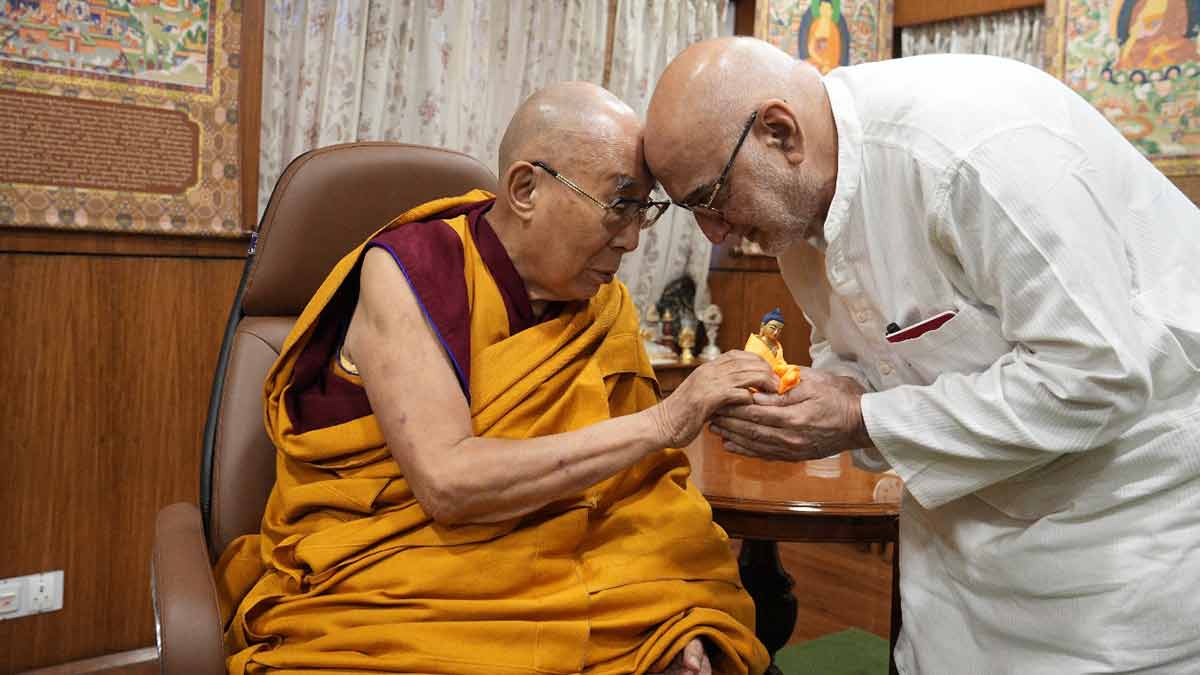
In private, he is irrepressibly human—affectionate, mischievous, disarming. Once, he gave me a nickname in Tibetan that means “Baldy.” Even now, in quiet moments or occasionally in public, he taps my bald head and gently strokes my beard, teasing me in Tibetan—something that translates roughly as “pretend monk” or “bearded impostor”. As he reminds me, with a delighted laugh, real monks don’t wear beards.
He speaks candidly about his struggles as a young monk with anger. He continues to study, to meditate, to seek instruction from younger lamas. “Why should age matter,” he asks, “when wisdom is being offered?” He returns to the classical texts, not as relics, but as living companions. He does not claim final enlightenment. He affirms the journey. His teachings today serve as a guide for others and for generations to come.
His reverence for other faiths is genuine. It is a practice—quiet, embodied and consistent. I have seen him offer namaz in mosques, bow low before Sufi saints, sing hymns in cathedrals, and join in aarti at Hindu temples. At the dargah in Ajmer, he once prostrated on cold marble for a long time. Asked afterwards what he had felt, he answered with characteristic brevity: “Something special, like maybe divine vibrations.” Later, I asked, “How could an agnostic speak of such things?” He laughed, then paused, and said, “I may have experienced what it must feel like.” That, perhaps, is his way: not to borrow belief, but to honour and learn experience wherever it arises.
He never urges people to convert. “Be a good Christian,” he says. “Be a good Muslim. Be a good Hindu.” His concern is not with identity, but with sincerity.
Even those without religion are drawn to his message. He reframes spirituality as “mental hygiene”—a discipline of quieting the ego, calming the mind and cultivating a kind heart. For him, compassion is not sentiment, it is a survival skill. A way of remaining human.
I remember a Tibetan monk once telling him, after over 20 years in a Chinese prison: “The greatest danger I faced was not torture—it was losing compassion for my jailers.” The Dalai Lama took his hands, eyes glistening: “That is real courage. That is real practice.”
In that moment, compassion became more than a principle. It became defiance. A form of resistance that preserved dignity in the face of dehumanisation.
I, too, was a faltering student. I once confessed to him that despite years of practice, I had never experienced anything remotely mystical. “That’s a good sign,” he said, then chuckled at my puzzled look. Years later, I brought it up again. He laughed and added: “What’s the hurry? It takes aeons of lifetimes.” I protested: “You could have told me that earlier.” He grinned: “That’s why I didn’t.”
Even now, when he sees me, he leans in and whispers, “Practice, practice.” As if reminding me—and perhaps himself—that we are all still on the path.
Birthdays don’t mean much to him. But he receives each greeting with affection. This year, the US Congress declared his 90th birthday a Day of Compassion. The Tibetan community in exile, joined by countless admirers around the world, has designated it as a ‘Year of Compassion’ in action. It is a worthy tribute.
In a world bloated with certainty and hollowed by cynicism, he reminds us that saying “I don’t know” is not a flaw—it is where wisdom begins.
He remains what he has always been: a teacher—but more profoundly, a student.
And perhaps that is why the world still leans in to listen. Not because he speaks with power, but because he listens with presence.
The author is the managing trustee of the Foundation for Universal Responsibility of the Dalai Lama. These are his personal reflections.
