



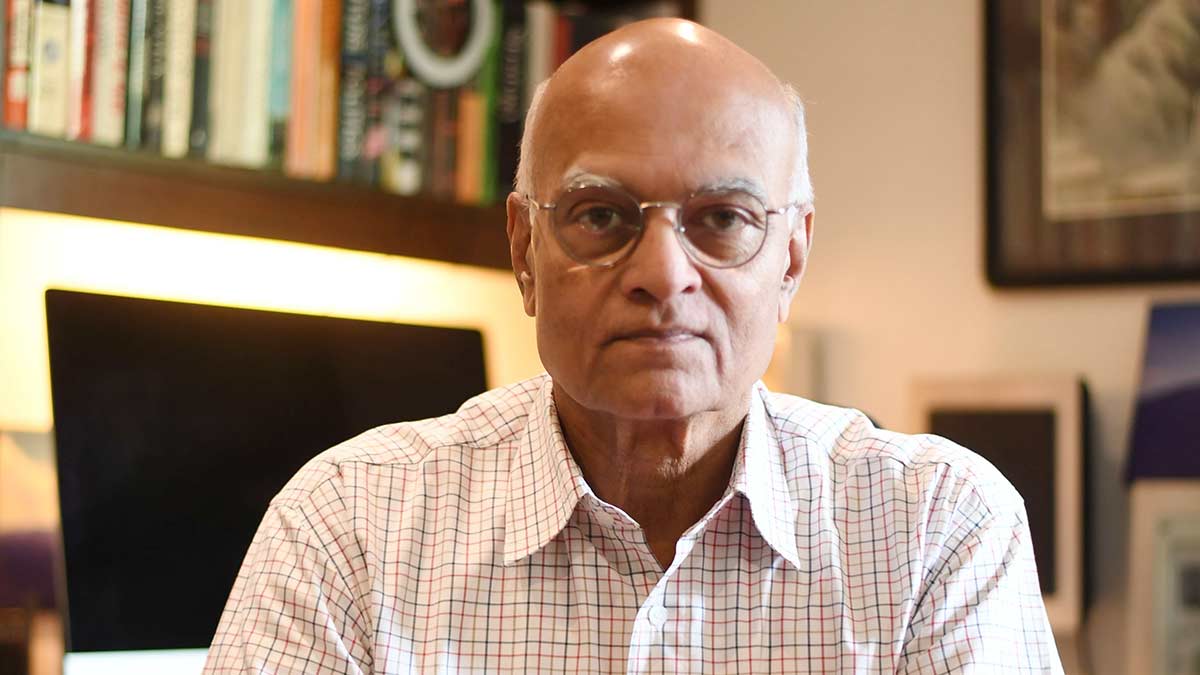
Interview/ Shivshankar Menon, former national security adviser
A transactional and unpredictable United States has put India’s foreign policy to the test at a time when regional peace and stability have become paramount for the country’s progress. At the moment, despite a fragile ceasefire, the Iran-Israel conflict is roiling the Middle East, even as Israel’s operations in Gaza continue. Meanwhile, the Russia-Ukraine conflict is in its third year. US President Donald Trump has intervened in these conflicts, even as he claimed to have pressed the “pause” button on a potential fourth war between India and Pakistan, a statement strongly denied by New Delhi. Former national security adviser Shivshankar Menon argues that New Delhi’s interests cannot be served either by remaining silent or by attempting a balancing act, and that it needs to actively pursue peace and stability in the Middle East.
Warning that US-backed military aggression against Iran to remake the Levant is harmful to long-term peace and stability, Menon says, “Peace imposed through war does not last.” New Delhi must avoid seeing the world through the lens of the US President, he says, calling for nuance in dealing with Pakistan and confidence with smaller neighbours. “Our job is to produce real outcomes, not win popularity contests.” India should be able to offer some economic cushion and security to neighbours. “This policy of abstention doesn’t reflect our interests.” Excerpts from an interview:
Q/ With the Middle East in turmoil and the Russia-Ukraine war continuing, what are India’s immediate concerns?
A/ For India, there are several types of crises. First is the safety of nearly eight million Indian nationals in the region—about 10,000 of them in Iran, including nearly 1,500 students. If evacuation becomes necessary, that is a major operation. Second, the economic impact. If the war spreads and affects critical areas like the Persian Gulf or the Red Sea, shipping lanes may come under attack—as we have already seen with the Houthis. If the Strait of Hormuz is closed, oil prices could skyrocket. If these two wars in West Asia actually join up or spread, then we have a real problem.

Q/ After the targeting of Hamas, Hezbollah and Syria’s Assad regime, the strikes on Iran are being seen as part of a plan to remake the Middle East.
A/ Since the October 7, 2023 Hamas attack, the US and Israel have used the moment to pursue longstanding objectives: weakening Iran’s allies and reshaping the region through force. After Hamas, they went after Hezbollah and the Assad regime in Syria. Now Israel has directly attacked Iran. It couldn’t have done this without US support, both military and diplomatic. Israel even used airspace under US control to strike. It is a bold attempt to reshape the Levant and West Asia militarily. Tactically, some of the operations may be executed with skill. But strategically, this approach is deeply flawed. History shows that you cannot force peace. Since the collapse of the Middle East peace process in the late 1990s, Israel has relied on military action to secure itself, but this has made it more dependent on the US and more isolated globally. Relying on permanent conflict for security is no long-term solution. Peace imposed through war does not last.
Q/ Can India balance its relations with both Iran and Israel?
A/ I don’t see this as a balancing act. India should follow its interests. We have a clear interest in peace in the region, but we have been largely silent. We have abstained on recent UN ceasefire resolutions on Gaza. At the IAEA (International Atomic Energy Agency), while Iran’s nuclear issue was being discussed, India’s voice was absent. We also abstained on Ukraine. This policy of abstention does not reflect our interests. We should be actively promoting peace.
Q/ Israel supported India’s position on Pakistan. Does it mean a closer alignment during conflict?
A/ Our conflict with Pakistan is not about gathering international support or counting allies—it is about imposing costs for cross-border terrorism. Our aim is to defend India and change Pakistan’s behaviour. That hasn’t happened yet. Each country will act in its own interest. The world knows what Pakistan is doing and will react to what bothers them. Otherwise, they will use each crisis to pursue their own interests.
Q/ How has India’s counter-terror approach evolved over the last two decades?
A/ There has definitely been learning—starting from the 1990s. We have become better at handling and responding to terror threats. The gaps between major attacks have grown, and the nature of attacks has changed. But improvements have been mostly tactical. Politically, the context has changed. In the early 2000s, Pakistan was isolated. That is why Pervez Musharraf made public promises, though he did not keep them. Today, due to US-China rivalry and shifting alliances, Pakistan is more useful to global powers. Domestically, the situation in Jammu & Kashmir has also changed. So we must understand terrorism in its current context. Have we learned enough? Not if we are still looking at how many countries will support us. Our job is to create outcomes, to create peace and not win any popularity contest.
Q/ President Trump claimed credit for pausing tensions between India and Pakistan.
A/ He is trying to claim credit, like he often does. Trump may say many things, but we do not need to see the world through his lens.
Q/ Going forward, do you see India’s US policy facing challenges?
A/ Only if we define diplomacy as getting other countries to say what we want. That is not our job. Our job is to produce real outcomes. We need the US for broader reasons because we are a developing and transforming country. Therefore, what we are doing on the bilateral trade negotiation, for instance, matters because it affects our future and development. The joint statement after Prime Minister Modi’s recent visit to the White House lists exchanges across a range of issues from high-tech defence to energy security, technology and innovation. These things matter and I would watch their progress carefully rather than focus on spectacular statements meant to get attention.
Q/ Trump says the US uses trade negotiations to prevent conflicts. As it makes deals with China and Pakistan, is India getting squeezed out?
A/ Trade is not zero-sum. Just because the US trades with China or Pakistan does not mean it is at our expense. The US has long been China’s top trading partner and had even closer ties with Pakistan in the past. Yet, we transformed our relationship with the US to our advantage. Rather than worrying about what others are doing, we should focus on what we can do, based on our interests.
Q/ The US is moving away from multilateralism; what does that mean for the Quad?
A/ I think the US is reviewing the fundamental aspects of its Indo-Pacific strategy. They are reassessing AUKUS (the trilateral partnership between Australia, the UK and the US), the submarine deal with Australia and the UK. With rising tensions in West Asia—Israel, Iran—it may be harder for them to focus here. The US has always struggled to prioritise—whether pivoting to Asia or dealing with distractions like Ukraine or Gaza. Also, the messaging varies depending on who you speak to. We have seen the CENTCOM commander say wonderful things about Pakistan, because that falls in his domain. If you ask the commander of the US Indo-Pacific Command in Hawaii, who covers India, he will probably tell you wonderful things about India. So I think we have to accept it as part of a normal give and take process.
Q/ Back to our immediate neighbourhood, are there gaps in India’s ties with its neighbours?
A/ As global uncertainty rises, it is even more vital to maintain peace and steady relations in our own neighbourhood. Smaller neighbours will naturally balance us by engaging with others—China, the US, Japan—due to our size. That is normal. But many of them—Bangladesh, Nepal, Sri Lanka, Pakistan—are facing serious domestic issues and are turning to the IMF. This is a time for us to be careful and proactive. It is also an opportunity, because when there is crisis, it is also a chance to actually do things that normally we might find difficult. For instance, the way we helped Sri Lanka did not stop it from engaging others, but the new president did make India his first stop. That’s significant.
Q/ What are three key steps that India should take in the neighbourhood?
A/ I think our strength lies in two main areas. India is the largest economy here. We should be able to open up and offer some economic cushion to help them. Secondly, we also have the capacity to impact their security in positive ways. So if we are a source of stability and security for them and work with them on their problems, I think it covers a lot of problems. And lastly, we must be careful about how we speak. You cannot insult a neighbour and expect good relations.
Q/ But shouldn’t India prioritise national security, given the challenges from Pakistan and China?
A/ Are we threatened by our smaller neighbours? India cannot feel threatened by Bangladesh, Nepal or Sri Lanka. It reflects a lack of confidence. We are not a small country. Of course, we should prioritise national security, but we shouldn’t feel threatened by our smaller neighbours, economically or otherwise. I find it amazing that some people do.
Q/ When we talk about mutual interest, are we also talking about reciprocity with our neighbours?
A/ I have heard many people say “reciprocity.” I don’t see how that works. You don’t apply reciprocity when you deal with a bigger economy like the US, do you? You can’t treat every country exactly the same, especially on economic matters.
Q/ On India’s ties with Bangladesh—how important is resolving issues like trade, visas and people-to-people contact in the context of security?
A/ India’s relationship with Bangladesh improved significantly post-2008 because both sides addressed each other’s security concerns. Bangladesh stopped allowing Indian insurgent groups to operate from its territory. India responded by acting on Dhaka’s concerns about criminals hiding in India. Once that trust was built, we could move on to trade and other ties. Today, the real issue is: no one knows who is really running Bangladesh or whether they can deliver. But that doesn’t mean we stop engaging. We should say, ‘These are my interests. I will protect yours—tell me what they are—but you must address mine, too.’ When Bangladesh stabilises, we will know how far we can go. But, as I always say, not talking is not a policy.
Q/ After Operation Sindoor, there is a pause in India-Pakistan tensions. Are we staring at uncertainty?
A/ Yes, I think there is uncertainty. In the past, we have always had backchannels that kept talking, even during crises. I don’t know if that is happening now, and I would rather not speculate. But remember, Pakistan is not one actor. There is the army, which thrives on hostility; the jihadi tanzeems, who are hostile by nature; civilian politicians, who go with the wind; businesses, who want better ties with India; and the ordinary Pakistani, who is not necessarily hostile. So a differentiated approach is essential. Isolate those who are hostile, but talk to the rest. Engagement does not hurt.
Q/ Do you think it is time India developed a national security doctrine?
A/ I think it would be helpful, though it is up to the political leadership to adopt one. A doctrine helps unify thinking across government and avoids functioning in silos. For example, during the recent Pakistan crisis, we lacked strategic communication. That vacuum was filled by speculation—not just in our media, but abroad, too. The Pakistani version gained traction simply because they said something first. A national security doctrine could help align priorities and prepare us before the next crisis.
“The policy of abstention does not reflect our interests. India should be actively promoting peace.
*****
Today, due to US-China rivalry and shifting alliances, Pakistan is more useful to global powers.
*****
Trade is not zero-sum. Just because the US trades with China or Pakistan does not mean it is at our expense.
*****
We must be careful about how we speak. You cannot insult a neighbour and expect good relations.
*****
India cannot feel threatened by Bangladesh, Nepal or Sri Lanka. It reflects a lack of confidence.”
