


You have to be a romantic to invest yourself, your money, and your time in cheese.
— Celebrity chef Anthony Bourdain
Creamy. Sour. Nutty. Earthy. Pungent. Fruity. Mushroomy. Rustic. Sweet. Stinky.
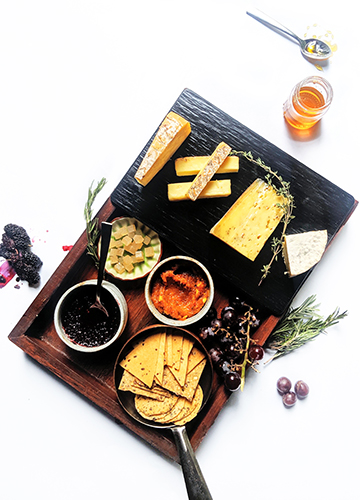 Cheese platter from Begum Victoria
It is almost impossible to run out of adjectives that describe flavour and aroma profiles of cheese varieties. With a plethora of cheese types, each with a strikingly different persona, the world’s extended cheese universe is nothing short of a creational marvel. India’s cheese vocabulary, however, was largely limited to milky blocks of paneer, with kalari from Kashmir, bandel from West Bengal or chhurpi—yak milk cheese from Himachal Pradesh’s Spiti Valley—also on the list.
In recent times, the likes of France’s Brie, Greece’s Feta, Italy’s Mascarpone or Halloumi from Cyprus are finding their way into Indian psyche and palates, courtesy a bunch of artisanal cheesemakers who want to redefine the Indian perception of cheese.
“Artisanal means you are not mass-producing it; you are carefully hand-crafting it in small quantities,” says Prateeksh Mehra, founder of The Spotted Cow Fromagerie in Mumbai. A food photographer, Prateeksh’s tryst with cheesemaking was pure serendipity. It all started when he and his brother Agnay Mehra set out in search of good-quality cheese to be paired with the beer they were brewing at home. Much like wine and cheese, beer and cheese pairing is a global phenomenon. “We were not happy with the way imported cheese turned out. So we started emulating traditional European or French cheeses here,” he says, “and we try to keep it as close to the original as we can.”
They offer Brie, Camembert and Robiola cheeses, packaging them with an Indian touch—with titles that reflect the brothers’ love for their city, Bombay—Bombrie, Camembay and Rombay. The Mehras, who started supplying their cheeses to restaurants and hotels in Mumbai as early as 2015, now cater to over 60 restaurants and hotels across India. The initial phases were challenging, but artisanal cheese is now finding its feet in the dining space, thanks to the growing focus on healthy eating and locally sourced ingredients. “Chefs are more than happy to opt for our cheese over commercially produced or imported varieties because this is a healthier alternative, and, more importantly, tastes close to what the original one should be,” Prateeksh says.
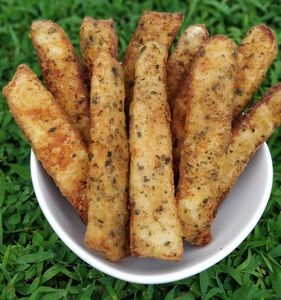 Halloumi cheese fries from Casaro Creamery
An improving ‘cheese literacy’ among urban Indians—courtesy travel and a host of international food shows—is pushing fromagers and restaurateurs to deliver authentic cheese experiences to their customers. “This is very anthropological,” says Manu Chandra, chef partner with Olive group and restaurants. “Travel, opening up of the economy, television, and social media usage over the decade—all of these have led to this change.”
Manu recently turned fromager with his Bengaluru-based venture—Begum Victoria—which he launched along with Shruti Golchha and Pooja Reddy in December last year. Shruti and Pooja, who swear by the rapidly evolving and refined palates of Indians, offer a mesmerising range of organic artisanal cheeses—Brie, Gruyere, Feta, Bel Paese, Fontina and clothbound Cheddar. “Most restaurants are moving towards the farm-to-fork movement using locally sourced ingredients,” says Shruti. “This has ushered in tremendous growth and acceptance for our niche space of artisanal cheesemaking.”
 Freddy George and Anu Joseph
At The Cheese Collective in Mumbai, Mansi Jasani, who found her calling in these chunks of love, has her mind set on getting more people hooked on to 'real' cheese and freeing them from 'plasticy' processed ones. A fromager who is into goat milk cheese, she also curates cheeses from across the country and serves the platters at restaurants and corporate events. The tasting workshops she hosts opens up the fascinating world of cheese and food pairings. “It is mostly taste and talk—about types of cheese and cheese families, how to categorise based on country of origin or flavour, texture and so on, and how to pair them with wine or beer, breads, fruits and vegetables.”
What is fuelling the artisanal cheese revolution in the country is also the growth of the individual customer base. “There is an increasing number of food lovers who want to support local food movements; who take great pride in the fact that something is being done in their very backyards,” says Manu. With no added preservatives or emulsifiers, fresh artisanal cheese is a growing favourite among health-conscious people. If artisanal cheese makers find takers in fine-dining cafes and restaurants, it is in the mushrooming league of ‘healthy eating’ ventures that their future lies in, says Freddy George, who co-founded Casaro Creamery in Kochi with his cousin and fromager Anu Joseph. “The outlets that offer fresh, organic salads to health conscious customers will have to choose an organic Feta cheese, for instance, over the mass-produced counterpart, if they want to stay true to their motto,” he says.
Ask Anu and Freddy how they introduce their cheeses to the curious customer and they let you indulge in their special Ricotta cheese samosas, Halloumi cheese fries or even pickled Feta. When Anu’s search for Mascarpone cheese for a tiramisu recipe hit a dead end, she decided to take things head-on. With lessons picked from a cheese-making course she had attended in the US, books and YouTube videos to fall back on, Casaro Creamery was born in December last year. We are still experimenting, says Anu, whose Mascarpone, Halloumi and Ricotta cheeses have been steadily attracting customers—both eateries and individuals, including many who are on Keto diets.
Manu, however, says it will take at least 10 years for a complete shift to artisanal cheese at the restaurant-level in India, taking into account the relatively higher rates of artisanal cheese in comparison with the commercially produced brands. Artisanal products cannot be priced like their processed counterparts, says Manu. “It is about quality of food at the end of the day.”
‘Cheese is sheer magic, it is alchemy’
Cheesemaking is not for the faint-hearted. Bourdain was not joking when he famously said it is only for the romantics; the hard-core ones we would say. The process demands all of your self, patience and time—you add in the ingredients, and wait patiently, often for months, hoping it turns out the way you want it to. No guarantees.
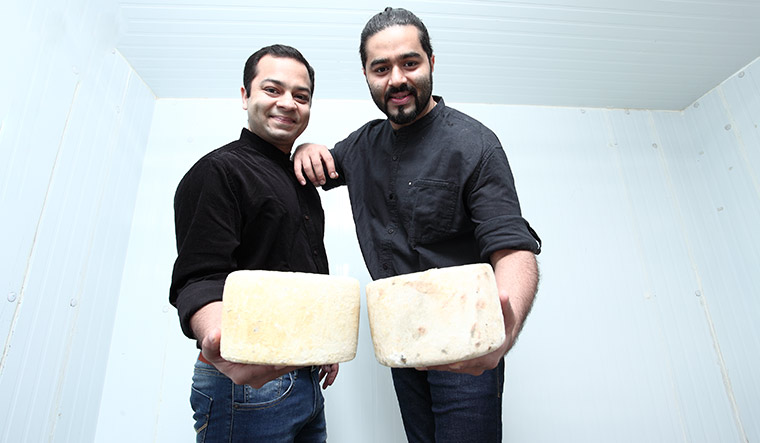 Agnay and Prateeksh Mehra
Cheese can be very unforgiving, says Pooja. “You might think you have got it all right, but even the minutest changes can completely change the taste,” she says. Three basic ingredients—milk, bacteria culture and rennet (coagulant)—in different permutations and combinations of temperature, humidity and ageing, make up the base of every artisanal cheese. For every variety, a different type of bacteria culture is used.
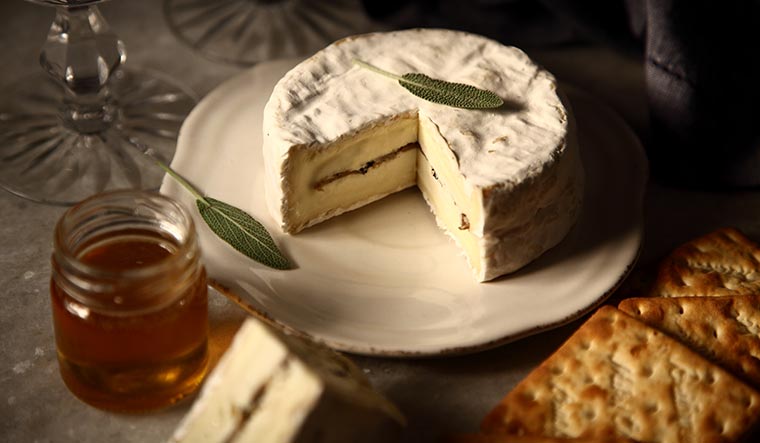 Black Truffle Brie from The Spotted Cow Fromagerie
A fromager’s day starts in the morning when the milk arrives. After the culture is added, and it settles, rennet is added to coagulate the milk. The resultant curds are then scooped up into moulds, and pressed. Most of these processes are done by hand. These are then transferred to a specialised temperature and humidity-controlled space called a cheese cave where conditions are set so as to keep the culture bacteria alive. Quite reminiscent of wine cellars, a cheese cave, with shelves full of cheeses stacked away for ripening or ageing, is at the heart of cheesemaking. Ageing ranges from two weeks to an year, depending on the cheese type. A Feta, for instance, is ready in about two weeks, but a Parmesan typically takes a year to mature.
Finding good quality milk is a challenge for cheese-makers in India; most of them have gone through multiple rounds of checks to zero in on local dairy farmers they source from. The milk is what defines the cheese, giving each one its subtle identity traits. “In artisanal cheese, the milk is celebrated; it is the environment, weather, the cattle, what they have eaten and so on. It is all so connected, it is mind-blowing,” says Mansi.
“It is left to nature,” Prateeksh says. “That is what makes the cheese truly artisanal.”
PAIR GAME
BRIE
Pair with fruity red wine or beer, or keep it simple by spreading on plain bread or crackers
FETA
Best enjoyed as chunks in a fresh salad or as crumbles on pizzas
BEL PAESE
Pair with apples, pears, figs and fruity wines
HALLOUMI
Best served as grilled or pan-fried cheese slabs, paired with a slice of lemon or watermelon
MASCARPONE
Most popular in tiramisu and cheesecakes, this one has countless possibilities—spread on your toast or sandwich, add to pasta and salads, or pair with wine
RICOTTA
Mix it with honey for a delectable spread. Whip it up with some maple syrup for pancake topping
ROBIOLA
Slice and add to salads, or spread on bread and crackers. Also, an excellent topping for pizza
CAMEMBERT
Can be baked as a whole! Melt and stir into your mac and cheese, or pair with fruits, nuts, chocolates or peated whiskey