



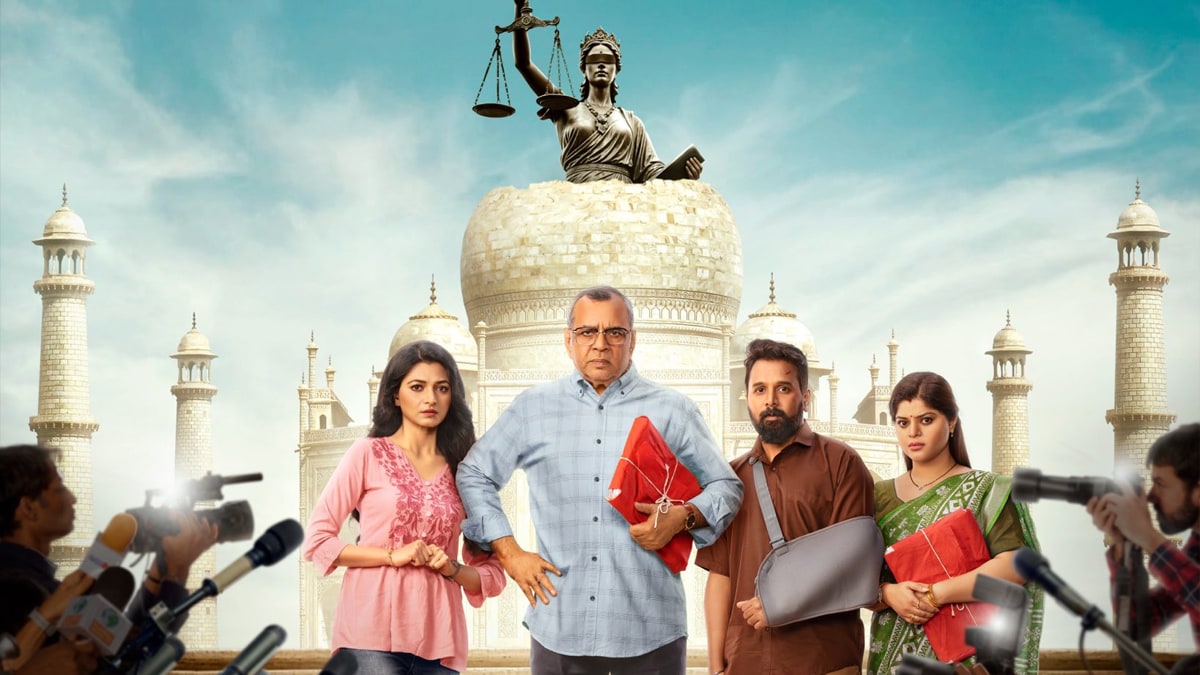
When WhatsApp University spills on the screen, the result is Paresh Rawal-starrer The Taj Story, a mind-numbing snoozefest.
Let’s start with the premise: An Islamic structure built on the ruins of an ancient Hindu temple, has been recycled so many times, in politics and fiction alike, that it has ceased to outrage or even amuse. It just bores.
The Islamic structure in question here is the Taj Mahal, one of the seven wonders of the world, a UNESCO World Heritage Site, which draws millions of visitors to Agra every year, and remains a tall symbol of love between the 17th-century Mughal emperor Shah Jahan and his wife Mumtaz.
The film insists that the Taj Mahal wasn’t built by Shah Jahan, but was, in fact, a repurposed Shiva temple given a Mughal makeover, a conspiracy theory debunked several times, including by the apex court.
Paresh Rawal plays Vishnu Das, a veteran Taj Mahal guide who turns into a petitioner challenging the monument’s history after a drunken video of him questioning its origins goes viral and costs him his job.
What follows is a role Paresh Rawal has slipped into many times before — the unassuming everyman who, after a few stumbles, rises to the occasion and argues his own case, turning into a self-taught legal warrior, only that this time what he’s settling is not only personal but also civilisational. But while his 2012 film OMG landed well, given the tight writing, The Taj Story falls flat and not just as a propaganda film, because I can dare even the firm rightwing supporters to sit through this three-hour-long film, which can be a test for both your patience as well as intellect.
The film is so lazy it doesn’t bother to make Rawal’s ‘clever’ arguments clever. We’re simply told they’re clever through the reaction shots, his own self-satisfied stance and a swelling background score. Not to mention, everyone Rawal debates -- whether it’s Anwar Rashid, the defence lawyer played by Zakir Hussain, or the token historians, educationists, and archaeologists – is written as too feeble to withstand Rawal’s rhetoric, rendering the film as not just lazy but also non-serious.
There’s a constant us vs them rhetoric, no matter how much Rawal’s character tries proving that the question is about history, culture and civilisation. For example, you would instantly know who the kohl-eyed, bearded bad guys are. Oh! And there’s also a historian named Rahman Habib.
The film lines up every righting punching bag imaginable -- from the Mughals to ‘leftist’ historians and minorities -- to once again hammer on the tired question of “our history.” And also, they invent a new term: 'Intellectual terrorism'.
While the premise itself is lazy, what renders it even worse is the bad writing and editing. There are a few AI shots too, which further doesn’t do it any service. By the end, you’re left wondering -- why the Taj Mahal, of all things? And more importantly, can we finally move past our medieval history?
