



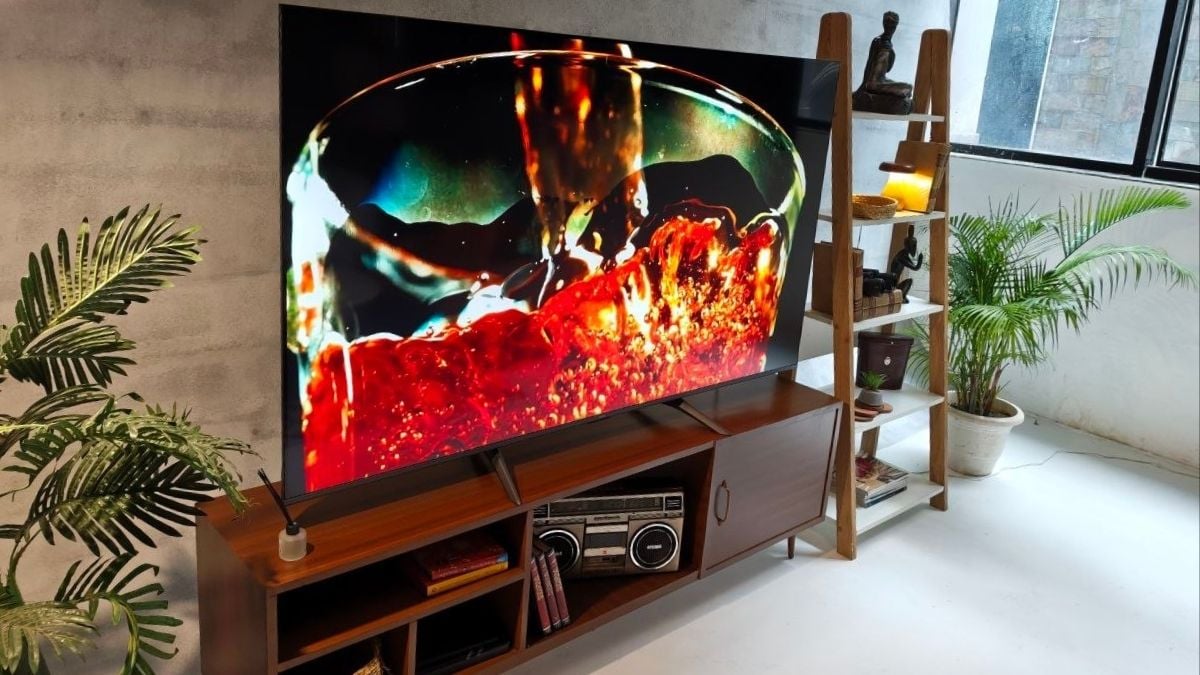
Quantum Dot Mini LED or QD-Mini LSD are a different type of LED TVs than the traditional LEDs that we have been seeing in the Indian market for a while now. These generally aim to offer higher brightness and punchier colours. Xiaomi's new TV S Mini LED Series (2026) comes in 55, 65 and 75-inch sizes. I tried its 65-inch model, and here's how my experience has been with it:
The TV has familiar narrow bezels around the display with feet near the ends. Made of plastic, I didn't really notice much hollow or flimsy quality at the back or anywhere in the TV. The back houses three side-facing USB 2.0 ports, three HDMI 2.1 (one with eARC support) ports, one Ethernet port, a 3.5 mm audio jack and AV.
The remote control is longer and slimmer than most and carries shortcut buttons for popular streaming apps alongside the usual Home, volume and power buttons. The stands lift up the TV enough that there's sufficient space between the TV and your table to put a soundbar underneath. The TV weighs 16kg and doesn't ship with wall mounts in the box.
Coming to the picture quality, the 65-inch display has good viewing angles, and its Filmmaker Mode does a really good job giving more accurate colour output than other modes, including the default Standard mode. It's perhaps the one you should be keeping at for most of the time. HDR and Dolby Vision, while not the best I have seen at around this price point, are still quite good in terms of detailing as well as handling of dark scenes and moving subjects. It could have been a little brighter to really get it all right in this department, but it's not missing by much. This is a 60Hz native display that does 120Hz in gaming mode, but that's not its native refresh rate, so it might be a noteworthy point for regular gamers.
The 34 watts 4-way audio setup (two speakers and two twisters) comes with support for DTS:X as well as Dolby audio, though no Dolby Atmos (available in eARC audio passthrough). The sound quality on the TV is more than decent enough. I would still opt to get a dedicated audio system attached to it, but in its own, the TV, importantly, delivered clear dialogues, decent depth for background effects, while handling bass in an okay manner, too. Attaching an audio accessory via the audio jack or wirelessly over Bluetooth with the TV also works reliably.
The TV is equipped with a quad-core processor and Mali G52 GPU, along with 2GB of RAM and 32GB of internal storage. While the internal storage space is fine, daily performance, in terms of navigating the Google TV UI, opening an app as soon as the TV boots up or switching between apps, seemed a bit jittery. It is not always laggy, but it's not something I would call a snappy performer on a consistent basis.
On the other hand, it doesn't have any troubles in handling high-resolution videos and photos, in playing 4k Dolby Vision content in streaming apps or locally over an external drive without any stuttering, so that was nice to see.
It has Patchwall+ on top of Google TV—giving some free live TV channels with Xiaomi TV, parental lock with the Kids Mode, as well as universal search for content. If you don't like Patchwall's look and feel, you can continue with the usual Google TV launcher or install a third-party launcher from the Play Store.
All in all, the Xiaomi TV S Mini LED is a good performer on most counts. While I would have liked to see a snappier TV navigation and switching between apps, it does perform up to par for its price tag when it comes to audio and video.
