



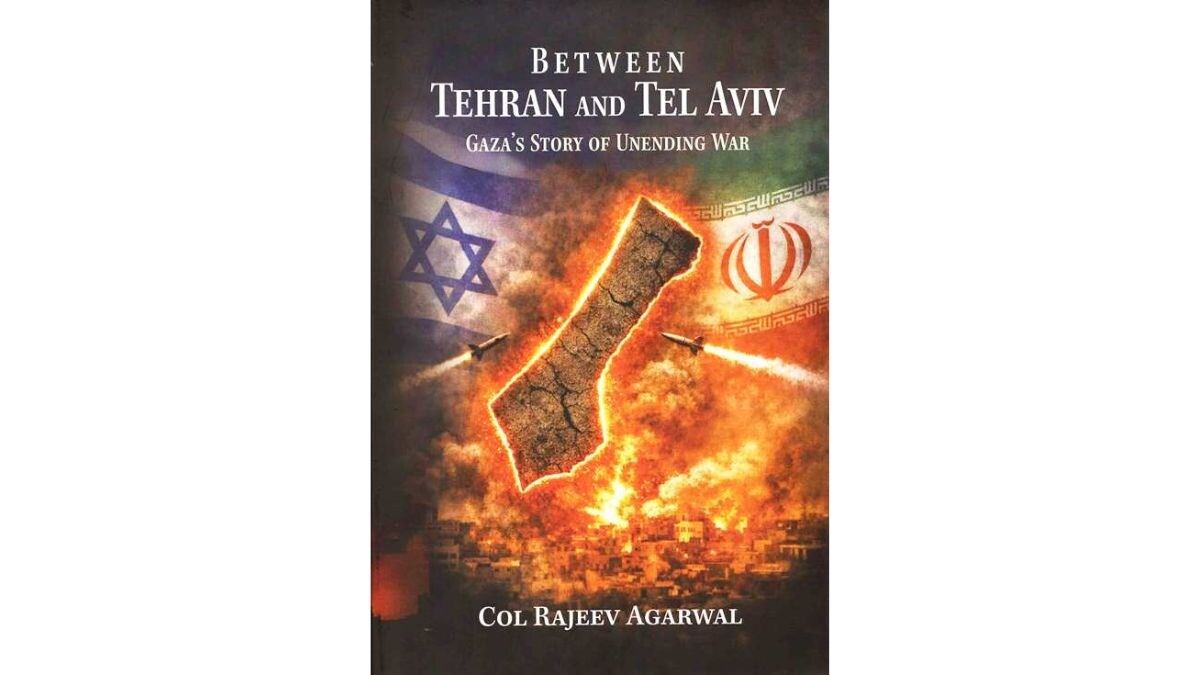
The book has a two-pronged title—one is the conflict between Israel and Iran, in which the USA has become the principal actor, and the other is the conflict between Israel and Hamas in Gaza.
The book, though originally intended to focus on the latter, ends up being currently relevant by tracing the seeds of the Israel-US-Iran conflict to the killing fields of Gaza.
That is right too. The current impasse over the US-Israel war with Iran is indeed a spillover of the lava that had erupted from the conflict in Gaza.
The narrative, written mostly in present tense, which indicates that the chapters were articles or essays written by the author at the time of each event or each phase of the conflict, takes Donald Trump’s Abraham Accords of 2020 as the starting point of his analysis.
The accords signalled that the West Asian region had begun to think “beyond Israel as enemy or problem No 1,” especially with reports of behind-the-scenes communications between Saudi Arabia and Israel.
It was therefore natural that Iran would soon loom larger in the region’s security calculations, given its rivalry as the emerging Islamic power in the region, and a military power capable of challenging Israel by itself.
The early chapters of the book examine how domestic, political, and other security calculations led Benjamin Netanyahu to pursue an over-aggressive policy towards the Palestinian cause, often disregarding past commitments and globally recognised humanitarian norms.
Even then, Israel is faulted for having lowered its vigil, while Hamas was building its subterranean tunnel defences in Gaza and overground offensive capabilities.
And finally, when the electronic fences were breached and Hamas arrived with their killer weapons, Israel was simply overwhelmed.
When it began to hit back, it had to hit back, drawing more blood than even the worst, most vengeful conscience would permit.
It sought to flatten Gaza, killing children and women, and bombing schools and hospitals, costing whatever international support it had had till then.
But what interests a current reader of the book is the Iran factor, rather than the Gaza conflict.
With the Sunni Arab states too petrified to act or politically restrained by their economic and strategic links with the US, it was only natural that Iran had to emerge as the challenger to Israel.
Yet, confined as it was to its nation-building and nuclear endeavours [as the author says, the IMF report of January 2024 said that the Iranian economy had outperformed many of the world powers in 2023 with a growth of 5.4 per cent], Iran appears to have been initially hesitant.
The damage it sought to inflict on Israel in the few missiles and drones exchanged over the last couple of years was pretty limited.
It also had to be remembered, as the author rightly points out, “as a policy, Iran had not been known to engage itself in a direct military conflict [since] ... it fought a direct military war [in] ... 1980-88 ... [with] Iraq.” It had, all the same, developed in three H-proxies—Hamas, Hezbollah and the Houthis.
One reason for the restraint, perhaps, was that Iran was still assessing its capabilities to prosecute a direct conventional war. Its air force, it must have realised, was poorly equipped—mostly with old Soviet-era fighters—compared with the more modern western-origin flying wares possessed by Israel.
On the other hand, it had a massive missile and drone inventory, and we have seen how it made use of those darts effectively over the last month and more, against not only Israel, but also virtually every threat that came from the Arab neighbourhood.
Yet, Iran was careful. As the author points out, “the fact that it targeted only military sites clearly indicated a sense of caution, restraint and non-escalation.”
He also explains the rationale for the restraint, and a gives a detailed account of how the conflict evolved over many fronts—the pager attacks on Hezbollah, the war in Lebanon, the elimination of Hezbollah leadership, the attack into Syria, and last year’s June war, in which the US claimed to have eliminated most of Iran’s nuclear capability.
In the end, however, the author returns to Gaza, where it all began, dissects Donald Trump’s ‘Board of Peace’ initiative, and offers a definite conclusion: “Lasting peace in Gaza looks remote. Hamas is ready to lay down arms. Without it happening, Gaza cannot be completely demilitarised. Without it, Israeli forces will not vacate Gaza or pull back from the Yellow Line.”
And finally, he says that “the odds of Gaza ... returning to another period of conflict are therefore live and real.”
On the whole, the book is a must-read for any study of the evolving West Asian situation—both for its analyses, and for its detailed recall of every event.
Between Tehran and Tel Aviv: Gaza’s Story of Unending War
Author: Col Rajeev Agarwal
Publisher: Pentagon Press LLP (2026)
Pages: 299
Price: Rs 995
