



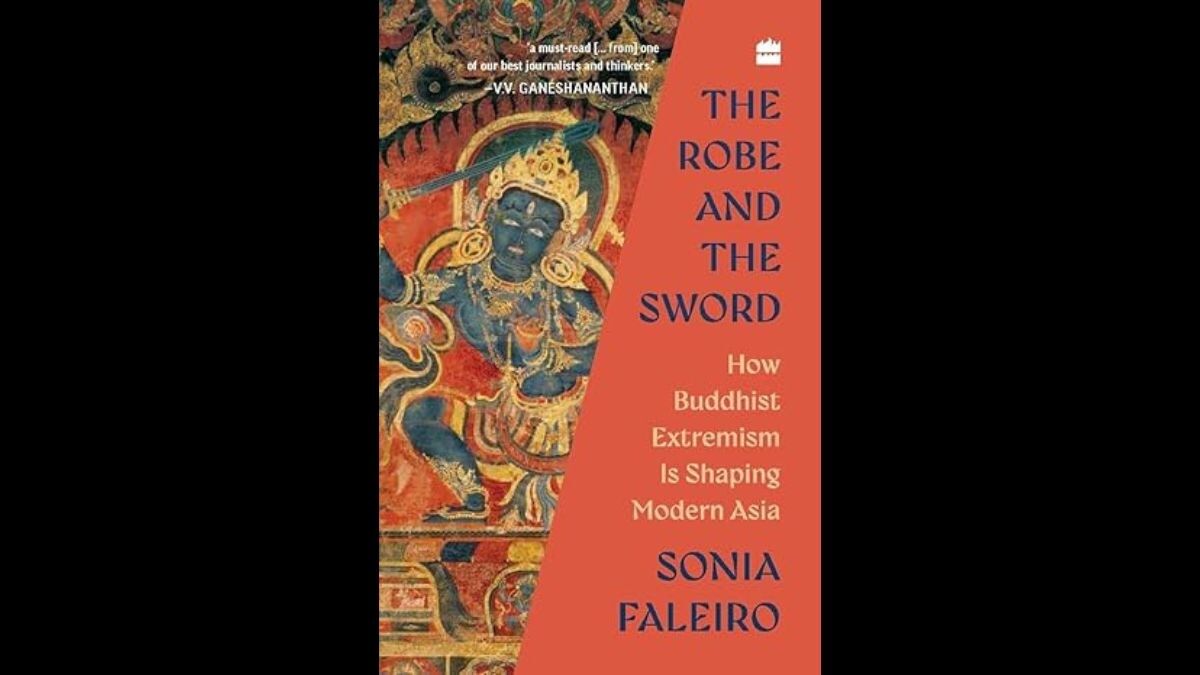
Against sweeping deep orange, the colour of the Buddhist robe, a blue, Buddha-like figure sits squatted, with a sword. It is a startling image, far removed from the calm, meditative renunciation Buddhism is known for. In Buddhist iconography, the figure is Manjushri, the Bodhisattva of Wisdom; the sword is meant to cut through ignorance. But in parts of modern Asia, monks have taken up the sword not as metaphor, but as politics -- directing their ire at religious and ethnic minorities in the name of “saving Buddhism.”
This is the unsettling premise of journalist Sonia Faleiro’s ‘The Robe and the Sword: How Buddhist Extremism Is Shaping Modern Asia’ (HarperCollins). The sword-wielding Bodhisattva against saffron is the book’s cover.
Faleiro begins in Dharamshala, the adopted home of the Dalai Lama, before travelling to violence-scarred towns in Sri Lanka and the refugee settlements along the Myanmar–Thailand border. Across these landscapes emerge stories of incitement and violence in which Buddhist monks are not bystanders but participants.
The militant monks
There is Galagoda Aththe Gnanasara, the notorious hardline monk in Sri Lanka, and Ashin Wirathu, described as “one of modern Buddhism’s most polarising figures,” in Myanmar. In the latter part of the book, Faleiro turns to Thailand, where Buddhist institutions take on a different character, deeply enmeshed with the monarchy–military state, benefiting from its patronage while remaining “above politics.”
Across the three countries she studies, Buddhism is inseparable from national identity. But what becomes of those who fall outside that definition of belonging? They are cast as outsiders, sometimes as enemies, targeted, persecuted, and punished. Faleiro recounts these consequences in chilling detail, particularly in Sri Lanka and Myanmar, both scarred by prolonged civil wars rooted in ethno-religious conflict.
A complex picture
Here, Faleiro employs a stark juxtaposition by placing survivors’ testimonies alongside the incendiary speeches and actions of the monks themselves. The effect is unsettling without being sensational. The author also handles the subject, which is both difficult and sensitive, exceptionally well. For instance, she resists generalisation with respect to both the religion and its followers. Hence, alongside hardline figures, she also introduces monks who challenge extremism, invoking the Buddha’s original teachings to counter the politics carried out in his name.
Economics and colonialism
Here, she rightfully places Asia’s colonial history as a major reason behind the ethno-religious divide, such as through the census and preferring one religion over others.
Then there’s the economic inequality, which “compounded these tensions, compelling the public to seek solace in religion and, in turn, granting monks disproportionate social and political influence,” she writes.
Faleiro adopts a narrative non-fiction approach, writing in the first person and grounding the book in what she witnesses and hears. The effect is immediate and immersive. It strikes a chord with the reader while lending the work a quietly probing, thought-provoking quality.
Echo back home
Perhaps the most chilling aspect of the book is how insistently it echoes back home. Faleiro opens in India, which shares with Sri Lanka and Myanmar not only colonial histories but, increasingly, the rise of hyper-nationalism and religious majoritarianism.
When she recounts a Burmese monk’s claim that Muslim men were seducing Buddhist women to “overtake Myanmar’s Buddhist population,” the rhetoric feels unsettlingly familiar. References to laws restricting inter-faith marriages and religious conversion sharpen that resemblance. And when victims of violence speak of police who “never came,” the pattern of majoritarian aggression met with institutional indifference is difficult to ignore.
In October 2014, the Bodu Bala Sena (BBS), a far-right Sinhalese Buddhist organisation in Sri Lanka known for inciting anti-Muslim violence, announced plans to collaborate with the Rashtriya Swayamsevak Sangh (RSS), the ideological parent of India’s ruling Bharatiya Janata Party (BJP), which had come to power earlier that year.
‘The Robe and the Sword’ is a timely and important work. Just over 150 pages long, it is deceptively slime, accessible in form, but deeply expansive.
