



National anthems are among the most recognisable symbols of a country. They are sung on national days and to mark diplomatic ceremonies, sporting events, historic moments, schools and even at protests. The sound of “Jana Gana Mana” fills every Indian heart with pride, joy and nostalgia. The Indian national anthem composed by Rabindranath Tagore reflects love of the people and the pride they feel for their motherland. Its words can be sung or it can be musically played. Yet despite their formal role, national anthems are full of fascinating quirks, contradictions and unusual histories. Across the world, one sees several peculiarities, from anthems without words to those written by foreigners and from shared melodies to revisions in lyrics. The world of national anthems reveals how culture, politics and identity intersect in unexpected ways.
Anthems without words: Some countries have national anthems with no official lyrics at all. The best-known example is Spain, whose anthem “Marcha Real” (Royal March) is purely instrumental. Although several attempts have been made to add lyrics, political divisions have prevented consensus, so the anthem remains wordless. Others without words and only music include Bosnia and Herzegovina, San Marino and Kosovo (India does not recognise it). In these cases, neutrality is often the reason. Choosing lyrics could privilege one ethnic, linguistic or political group over another. Silence, ironically, becomes a form of unity.
One person, multiple anthems: Perhaps the most remarkable authorship story is of Tagore, who wrote the national anthems of two countries: India’s “Jana Gana Mana” and Bangladesh’s “Amar Shonar Bangla” (My Golden Bengal). Sri Lanka’s anthem “Sri Lanka Matha” (Mother Sri Lanka) was also strongly influenced by Tagore. It was written by one of his Sri Lankan students who studied in Vishwa Bharati university in Shanti Niketan. This is unique in modern history. It reflects historical ties in South Asia during the late colonial period, when intellectuals, artists and political activists often worked across emerging national boundaries as also the respect they commanded.
Countries sharing anthems or melodies: Some nations share not only history but also music. Greece and Cyprus both use ‘Hymn to Liberty’ as their national anthem, reflecting cultural and linguistic connections. Elsewhere, identical melodies appear with different lyrics. Finland’s ‘Maamme’ (Our land) shares its tune with Estonia’s ‘Mu isamaa mu õnn ja rõõm’ (My Fatherland, My happiness and joy). Such overlaps illustrate how national identity can emerge from shared regional traditions rather than completely distinct cultural origins.
Multiple official anthems: While most countries have a single official anthem, a few maintain two simultaneously. Denmark recognises both ‘Der er et yndigt land’ (There is a lovely land) and ‘Kong Christian stod ved højen mast’ (King Christian stood by the lofty mast). One is used primarily for civilian occasions, the other for royal or military ceremonies. Similarly, New Zealand has two equal anthems, ‘God Defend New Zealand’ and ‘God Save the King’. The coexistence reflects the nation’s historical ties to the British monarchy while maintaining its own national identity.
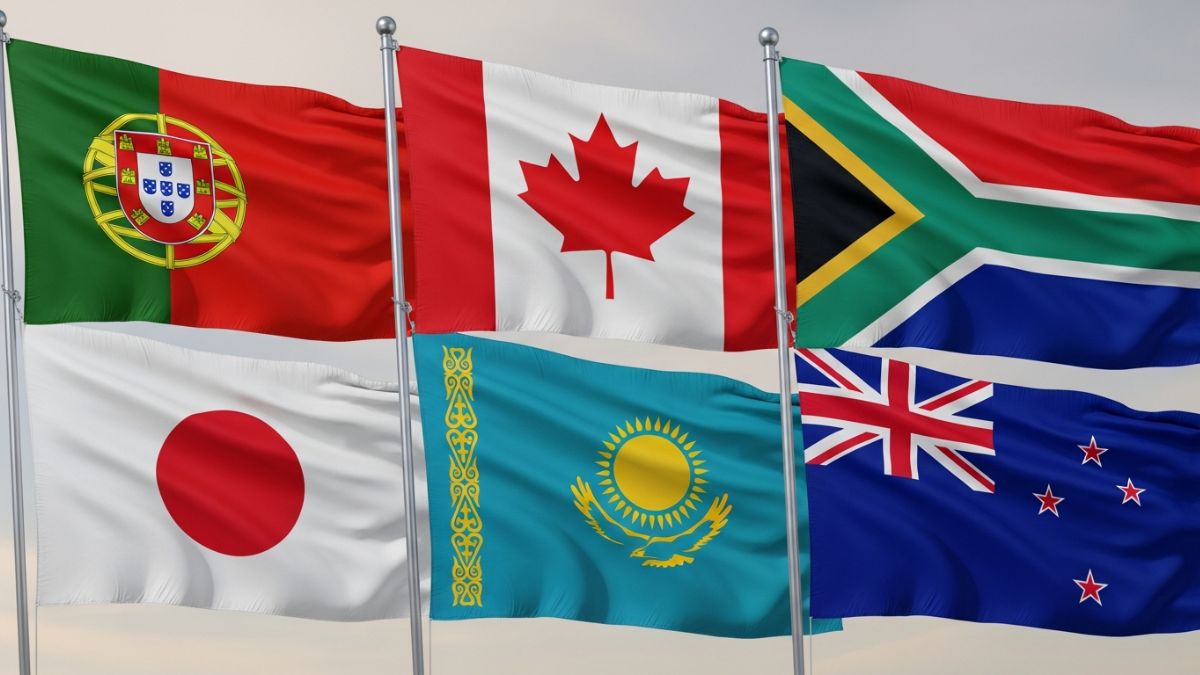
Revolutionary and evocative lyrics: The anthem of France, “La Marseillaise”, famously calls citizens to arms and includes imagery of enemy blood watering fields. Written during the French Revolutionary Wars, it was originally a military marching song. Likewise, Algeria’s ‘Kassaman’ (We pledge) reflects its anti-colonial struggle, containing strong references to resistance and sacrifice. The Portuguese national anthem ‘A Portuguesa’ (The Portuguese) was composed as a patriotic response to political tensions with England in colonial Africa. It has a strongly nationalistic tone and reflects resolute pride and fighting against odds. These examples show how national anthems often preserve the emotional intensity of formative historical conflicts.
Anthems that are reflective: Not all anthems celebrate triumph. Some express longing, suffering or quiet patriotism. Hungary’s ‘Himnusz’ (Hymn) is essentially a prayer asking for divine mercy and joyous time after centuries of hardship. Its slow melody reinforces the solemn mood. Similarly, Israel’s ‘Hatikvah’ (The hope) centres on hope and yearning after long diaspora experiences. Poland’s ‘Mazurek Dąbrowskiego’ (Poland is not yet lost) originated when Poland had disappeared from the map and was composed to boost morale for Polish soldiers serving under Napolean. It is also the only national anthem that mentions Napolean’s name emphasising resilience rather than victory.
Evolving and reshaped anthems: Anthems also reflect political change. After World War II, Germany restricted the use of ‘Deutschlandlied’ (Song of Germany), allowing only the third verse because the earlier two verses had been associated with Nazism. Russia’s anthem history is also another example of an anthem evolving rather than being replaced entirely. Russia replaced the Soviet national anthem in 1991 and for some time the Russian anthem was played only as music with no words. The old melody was then brought back with new lyrics in 2000. The same tune, but a different ideology. Even Australia changed their national anthem from ‘God save the Queen/King’ to ‘Advance Australia Fair’ in 1974. The Canadian national anthem, “O Canada” has two distinct sets of lyrics in the country’s official languages, English and French. While they share the same melody, the lyrics are not direct translations of each other. Canada enacted legislation in 2018 to change its English lyrics to ensure gender inclusivity. No change was required to the French version. Political change reshapes national symbols and anthems are no exception.
Language complexity and cultural fusion: Some anthems stand out linguistically. South Africa’s national anthem, ‘Nkosi sikelei iAfrika’ (God bless Africa) combines five languages in a single composition, reflecting the country’s rainbow character and post-apartheid reconciliation efforts. It shows how an anthem can serve not only as patriotic music but also as a political statement about unity in diversity. Singers say it’s one of the hardest to perform. ‘Nkosi sikelei iAfrika’ was the Pan African Liberation Song and versions of it were adopted as national anthems of many countries, including Zambia, Tanzania, Namiba and Zimbabwe. However, Zimbabwe and Namibia changed to new anthems with other melodies.
Anthems with names of other countries in them: There are not many known currently used anthems that have names of other countries. Three anthems stand out. The Netherlands national anthem mentions Spain in its lyrics, the Polish national anthem mentions Italy and the Algerian national anthem makes a mention of France. Although there are several other anthems that had names of other countries in their lyrics but deleted them at one point of time or the other.
Musical style and length: Uruguay’s ‘Himno Nacional’ (National Anthem) is unusually long and operatic, and can take up to six minutes if performed in full. By contrast, Japan’s ‘Kimigayo’ (His Majesty’s Reign) is among the shortest, based on an ancient poem about longevity. These differences reflect musical traditions such as European classical influence in Latin America, poetic minimalism in Japan and even folk-inspired melodies in other places.
A moment of confusion: At the 2012 shooting contest in Kuwait when Kazakhstan won gold medal, the ceremony accidentally played the parody anthem from the film Borat instead of the Kazakh national anthem. It of course caused a major controversy.
National anthems are living symbols and far more than formal patriotic songs. They encapsulate history, politics, identity, and emotion in condensed musical form. Their peculiarities — wordless compositions, shared melodies, multiple official versions, evocative lyrics or sombre tones — reveal how complex national identity can be. Studying these quirks offers a unique lens on global history. Anthems preserve memories of wars, independence struggles, cultural exchanges and political transformations. They are not static. Lyrics get revised, melodies rearranged and meanings reinterpreted. Political transitions, revolutions, independence movements and social change all influence how anthems are perceived. What once was a war cry may become ceremonial music; what once united may later divide or vice versa. Every national anthem has a unique story behind it. However one thing is for certain, national anthems remain powerful expressions of how nations see themselves or how they wish to be seen by the world.
The author is Indian ambassador to Portugal. The views are personal
