


“The mystery of human existence lies not in just staying alive, but in finding something to live for.” ― Dostoyevsky
While people around the globe spent the greatest part of 2020 worrying about what to do in order to survive, filled with fear and seeking ways to reinvent themselves and their lives to adjust to the pandemic reality, naturalist Hugo Santa Cruz spent the year wandering in paradise, the Costa Rican jungle that is.
He is in the Central American rain forest along the Paso de Las Lapas Biologic Corridor, an area that converges with the mountainous foothills of the western dry tropical forest where he has taken the pandemic precautions in stride and used that time to find a profound, more focused purpose in life.
Maintaining quarantine in an area of some 370 hectares of ample primary and secondary forests, and biodiverse jungle, Santa Cruz is deep in the wilderness, far from home due to the COVID-19 shutdown of travel and normal activities. He is exploring the jungle, studying the animals, photographing, filming, and registering the species he encounters.
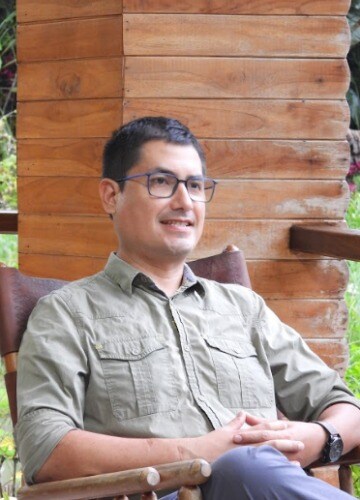 Naturalist Hugo Santa Cruz
Yes, he has found a paradise that allows greater depth and originality of observation, a refuge from isolation in isolation. The perfect place for environmental inspiration. The zone provides food for the red limpet scarlet macaws and some 350 species of birds.
“I am surrounded by nature in its maximum splendour,” said Santa Cruz. “Here I am studying and experiencing that it is possible to live sustainably.” He is finding ways to connect with himself with nature and with the world.
Santa Cruz is keenly aware that the living world is neither static nor cyclical but it is undergoing perpetual change. Spins, bobs, and blinks in the foliage hide amphibian body shapes. A closer inspection and he can see the moist skin of frogs. This is close enough to touch nature, to taste it, to feel the jungle, to hear its sounds. In the forest, there are things going on all around him, inexplicable action, tremendous cracklings, and stirrings of nature. He has to be alert to capture the movement and the surprises.
“The trips to jungles, beaches, deserts, mountains, and rivers, they were replaced by trips to the interior of my being,” he said of his concentration, “trying to get to know myself better, reflecting on what is happening to me and what is happening to the world; trying to control the nostalgia and anguish, which invades my thoughts from being so far from the most important people in my life.”
Santa Cruz is finding within himself a clear understanding that we humans live because the animals and the forest live. As a nature and wildlife photographer and videographer, he is documenting his experience and is among experts in different fields contributing to aggregators for a pilot documentary for Netflix on life, fears, and coping with the pandemic.
“In this nature reserve, which is now my home, I have spent a lot of time completely alone, or at least without human company,” recounted Santa Cruz. “From one day to the next, from being surrounded by people of different nationalities and listening to several languages at the same time, I started to hear only the trill of the birds, but my presence does not even matter to them.”
Leaves rustle in the wind, a branch snaps, and a bird’s flight is whipped into the air. In the singsongy silence of the jungle, one can almost hear the deep breaths coming from the nostrils of nearby mammals, but the real show is in the air in the birds and their diversity of size, colour, and complexity of their songs.

Early on, he has spotted and recorded in nature Baltimore orioles, broad-winged hawks, Baird’s trogons, gray hawks, green kingfishers, greebles, social flycatchers, Rufous-tailed hummingbirds, scarlet-rumped tanagers, white-necked Jacobins, and yellow-bellied flycatchers.
Santa Cruz has admired the blues and other iridescent colours of bird feathers up close, seen the refracting light through the minute feather structures that produce colour like tiny prisms. The picture of it stays not only in this camera, but in the memory, in the experience, and in his understanding. Of the approximately 10,000 bird species in the world, all are thought to see in colour.
The green parrots prevalent in this part of the world have blue structural colours that reflect and refract light, overlaying by yellow pigment colours on their feathers, it is the blending of those that makes their vibrant green colour.
Staring at leopard frogs on the ground, Santa Cruz’s camera has captured on the trees red-eyed leaf frogs, cascade glass frogs, pug-nosed frogs, and Yellow Hourglass Tree Frogs with the golden hourglass on their backs and inflated throats that amplify the sound of air rushing across their vocal cords.
A yellow pitviper curled among the leaves on a branch. Click. A blue-tailed damselfly. Click. A pink lotus flower. Click. An iguana by the pond. Click. Weightless flight. Click, a scarlet macaw. Silence. Breath held. The photographs focus everything.
Yet, “despite being in a kind of ‘Garden of Eden’, sometimes it is just a prison where I have to fight with my fears anyway,” said Santa Cruz, collapsing into a classic split between body and mind.
“I am from Bolivia but life circumstances brought me to Costa Rica some time ago, where I cannot leave now, I am trapped thousands of kilometers from home,” explained Santa Cruz.
“Fortunately, I have a wonderful refuge, a small paradise in the middle of the Central American tropical forest. I am fortunate to have the help of wonderful people with the Center for Biodiversity Restoration Foundation and the Macaw Wildlife Sanctuary who make me feel very privileged in these difficult times for everyone.”

He has been able to focus on the diverse range of strength and moving ability of various animals and has been working on creating corridors of connectivity so that animals can be in their wild environments. Along the way, his study now ranges an impressive number of forms and an array of functions. He is making conservation models to restore animals and plants to their natural habitats and environmental systems that reflect the diverse adaptations in the area.
But even with the voices of fauna and flora all around, an invisible hand reorders, controls, and reaches across our world: COVID-19.
Knowing that microscopic living beings are capable of causing so much panic and instability in almost all societies in the world, and realizing our vulnerability as a species and our illusory control over indicates that the human being is not all-powerful,” reflected Santa Cruz.
“It tells us that nature is not here for us and that if we want to survive we will have to learn to live in harmony with it because we are only a tiny part of it,” he said.
In this cauldron, “the Center for Biodiversity Restoration foundation was born with the idea of expanding the landscape restoration work outside the Macaw Sanctuary,” explained Santa Cruz of the vision. “This area that was once a deforested area, with poor and compacted soils, today it is a small Garden of Eden brimming with life, everything.”
Biological diversity is related to the air we breathe, the water we drink, and the food we eat, said Santa Cruz, thus the importance of biodiversity restoration. “The levels at which biodiversity is comprised are different; from genes, followed by species, communities, ecosystems, and finally landscapes; where life interacts with its physical environment.”
As the coronavirus crisis continued, Santa Cruz found meaning in his escape.
“We want this existing model to expand over the biological corridor which includes the sanctuary,” said Santa Cruz thanking the efforts of the land’s owners “who managed to regenerate the ecosystem with the help of reforestation, agroforestry, and ecotourism.”

He said his dream is to create an international exchange of experiences that would draw from the successful Costa Rican experience to allow people from Bolivia and other countries with environmental problems to exchange experiences and develop solutions.
“We plan to open a biological station that would ideally direct the environmental projects of the biological corridor and will serve as an environmental school and experimentation center for people interested in contributing to conservation, whether local or even from other countries,” added Santa Cruz.
Perhaps, thinks Santa Cruz, in his shelter from the COVID storm he has found an open door for a rebirth and a reconnection between humanity and nature.