



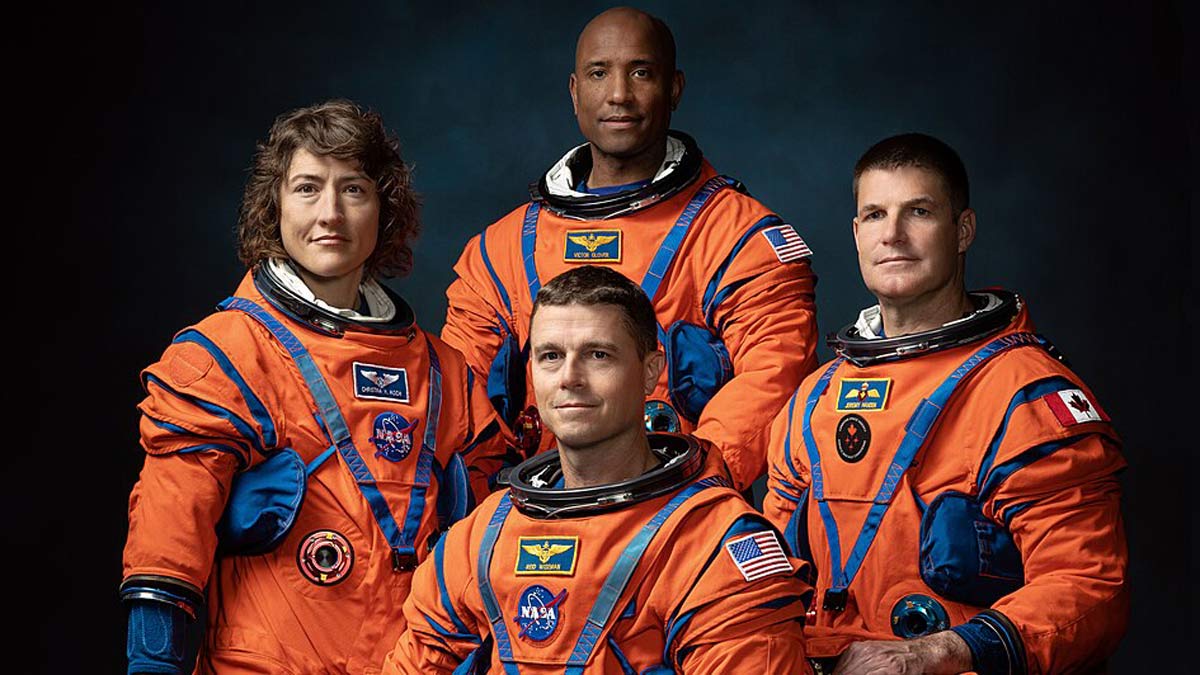
NASA's Artemis II mission has done what most of us can only dream of — four humans have successfully gone around the moon. Reid Wiseman, Victor Glover, Christina Koch and Jeremy Hansen are now heading home. The most dangerous part of their entire journey is not what happened in space. It is what happens in the next few hours, as their spacecraft screams back into Earth's atmosphere.
When the Orion capsule, the small pod where these four people have been living and working all this time, hits Earth's atmosphere, it will be moving at nearly 38,500 kilometres per hour. That is faster than a bullet. At that speed, the friction with the air creates a wall of fire reaching about 2,760 degrees Celsius on the outside of the spacecraft. To give you a sense of how hot that is, iron melts at around 1,538 degrees Celsius. The capsule will be facing nearly double that heat.
Re-entry is expected to get extremely intense around 5:00 a.m. IST on Saturday. If all goes well, the Orion capsule will splash down in the Pacific Ocean near San Diego roughly 40 minutes later, where Navy divers and a recovery team will be waiting to bring the crew safely home. Each astronaut will be wearing a special pressurised suit designed to keep them cool and protected throughout this intense phase. Mission controllers expect the crew to stay mostly silent during re-entry, while Wiseman and Glover will be watching the spacecraft's instruments closely.
The return of Artemis II represents one of the most complex and high-risk phases of modern human spaceflight. While launch captures global attention, it is the return to Earth that ultimately determines mission success. The Orion spacecraft must transition from deep space travel at lunar-return velocities to a safe ocean landing, all within a matter of minutes, while enduring extreme thermal and mechanical stresses.
This process begins long before the spacecraft reaches earth. Artemis missions follow a carefully designed free-return trajectory, allowing Orion to loop around the moon and naturally head back toward earth using gravitational forces. This trajectory acts as a built-in safety system, ensuring that even in the event of propulsion failure, the crew will still return home. After completing the lunar flyby, Orion begins its approximately four-day journey back, during which engineers and astronauts conduct detailed inspections of the spacecraft, particularly the thermal protection system that will face the harshest conditions during re-entry.
As Orion approaches earth, the first critical milestone is the entry interface, occurring at an altitude of about 120 kilometres. At this point, the spacecraft is travelling at nearly 11 kilometres per second, approximately 39,600 kilometres per hour, or Mach 32. This speed is far greater than anything experienced in low-earth orbit missions and is comparable to the velocities required for future Mars returns. As Orion begins interacting with the upper atmosphere, air in front of the spacecraft compresses violently, forming a superheated plasma layer around the capsule. Temperatures outside the spacecraft rapidly climb to between 2,500°C and 2,800°C, hot enough to melt most known materials. This plasma sheath also causes a temporary communications blackout, as radio signals cannot penetrate the ionised gases surrounding the vehicle.
The most intense phase of re-entry follows immediately. “During peak heating, which lasts approximately three to five minutes, the spacecraft experiences maximum thermal and mechanical loads. Orion’s heat shield, made from an advanced ablative material known as Avcoat, plays a critical role here. Instead of resisting heat entirely, the material is designed to absorb and dissipate it by slowly charring and eroding. Nearly 20 to 30 per cent of the heat shield material may ablate away during this phase, carrying heat with it and preventing it from reaching the crew module. Despite external temperatures nearing 2,800°C, the interior of the spacecraft remains stable at around room temperature, ensuring astronaut safety. At the same time, the crew experiences deceleration forces of approximately four to six times the earth’s gravity, making this one of the most physically demanding moments of the mission,” explained Srimathy Kesan, founder and CEO of SpaceKidz India Limited.
Unlike the Apollo-era capsules, Orion is capable of controlled, guided re-entry. Rather than simply falling through the atmosphere, it generates a small amount of aerodynamic lift, allowing it to “fly” its descent path. This capability enables mission controllers to precisely adjust the landing location and manage heat and g-load distribution. During Artemis I, NASA successfully demonstrated a skip-entry technique, where the spacecraft briefly exits and re-enters the atmosphere to reduce stress. However, for Artemis II, engineers are likely to employ a steeper, single-pass entry to gather more detailed data on heat shield performance under crewed conditions.
As Orion descends deeper into the atmosphere, its velocity decreases dramatically from nearly 40,000 km/h to below 500 km/h within about 10 to 15 minutes. Once the spacecraft slows to supersonic speeds and reaches an altitude of approximately 7.5 kilometres, the parachute deployment sequence begins. Two drogue parachutes are deployed first, stabilising the capsule and reducing its speed further. These are followed by three large main parachutes, each approximately 35 meters in diameter. Together, they slow the spacecraft to a descent speed of around 30 kilometres per hour, ensuring a safe and controlled splashdown.
“The final phase is the ocean landing and recovery operation. Orion splashes down in a predetermined zone in the Pacific Ocean roughly 20 minutes after entry begins. Recovery teams, typically from the US Navy, are already positioned nearby. Divers secure the capsule, attach recovery lines, and guide it into the well deck of an amphibious recovery ship. Astronauts are then safely extracted, undergo initial medical evaluations, and begin their transition back to Earth’s gravity. This entire recovery process usually takes one to two hours after splashdown,” said Kesan.
During the first Artemis mission back in 2022 — which had no astronauts onboard — the Orion spacecraft's heat shield, the protective outer layer designed to absorb all that fire, did not behave as expected. Pieces of it chipped and broke off in more than 100 places. If this had happened with people inside, it could have been catastrophic. That discovery delayed Artemis II by years while engineers worked around the clock to understand why it happened.
“NASA has changed the angle at which Orion comes back to the earth. Instead of gliding in gently like a paper plane, the spacecraft will come in at a steeper angle, briefly bounce back upward like a skipping stone on water, and then make its final descent. Think of it exactly like that — when you throw a flat stone on a lake, it hits the surface, jumps slightly, and then settles. This "skip re-entry" method releases the trapped heat and gases slowly and steadily, instead of all at once, which reduces the stress on the heat shield and keeps it from overheating,” explained space analyst Girish Linganna.
As reported in the media, mission commander Wiseman, a retired Naval aviator, had his own doubts about this new plan when it was first proposed. He initially expected NASA to simply replace the damaged heat shield with a better one. But after a detailed technical briefing, his doubts disappeared.
Not everyone agrees, though. Dan Rasky, a former NASA engineer who worked on re-entry systems before retiring last year, believes NASA should have first tested this new skip re-entry method without astronauts on board just to be completely sure. He had also suggested a different type of heat shield, similar to what SpaceX uses on its Dragon spacecraft. His concerns were heard, but NASA moved forward with its plan after extensive ground tests and reviews.
NASA Administrator Jared Isaacman approved the plan. Amit Kshatriya, NASA's associate administrator, had said they had done all the necessary work and fully trusted the team.
“NASA has never forgotten the Challenger disaster of 1986 or the Columbia accident in 2003. Both shuttles were lost. Fourteen crew members never came home. Those tragedies shaped how NASA thinks about every single decision, every risk, every calculation,” remarked Linganna.
