



The transition to a “knowledge economy” has become one of the most frequently invoked themes in discussions on Kerala’s social and economic future. In that shift, the Kerala University of Digital Sciences, Innovation and Technology—also known as Digital University Kerala (DUK), India’s first dedicated digital university—has a crucial role to play.
Established in 2020 by the Kerala government through an ordinance upgrading the multidisciplinary postgraduate institute IIITM-K, DUK has recorded notable achievements in its early phase, including unveiling the first silicon-proven artificial intelligence (AI) chip, the Kairali AI Chip.
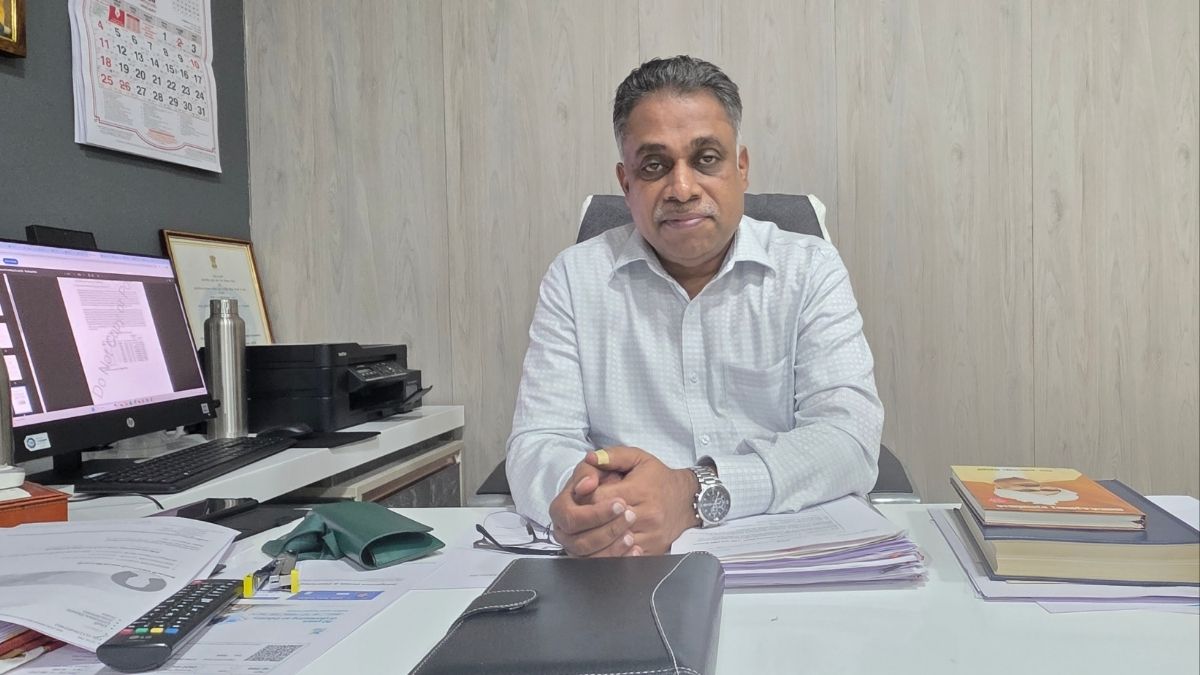
Saji Gopinath, who earlier led the Kerala Startup Mission and IIITM-K and was instrumental in converting IIITM-K into DUK, served as the university’s first vice-chancellor. After his tenure ended in October 2024, the university went through a short period without a permanent VC. In December 2025, however, the government reappointed Gopinath as vice-chancellor.
In a freewheeling interview with THE WEEK, Gopinath speaks about the university, its operating model, its future, and the controversies and allegations that arose during the interim phase when the university did not have a permanent VC.
Q: Given that Kerala already has APJ Abdul Kalam Technological University catering to nearly one lakh UG, PG, and PhD students, what additional role—or unique value—does a dedicated Digital University bring to the state’s higher education ecosystem?
We are not operating in the same space as a conventional technological university. Technology universities primarily focus on undergraduate engineering education through affiliated colleges and then offer higher studies at the master’s and PhD levels in specific technical domains. A digital university emerges from a very different philosophical orientation.
We believe the digital world represents a post-industrial reality where digital technologies are no longer peripheral but core to all human activity. This shift creates a need for professionals from non-technical and conventional disciplines to excel in a digital environment. Digital competence is no longer optional; it is foundational.
Our programmes are designed with this premise. For example, a student with an undergraduate background in life sciences—biology, zoology, or botany—can pursue programmes that retain their core disciplinary strength while making it relevant to a digitally driven world.
Similarly, students from geography or earth sciences can move into geospatial analytics, which integrates domain knowledge with advanced analytical and digital tools. Chemistry graduates can work on computational drug design, applying their discipline in a context where computation and digital modelling are central. Environmental studies graduates can pursue ecological informatics, which combines ecology with digital systems for planning and development.
This interdisciplinary integration is not the primary focus of traditional technological universities. While we do offer domain-based programmes like computer science, that is not our central emphasis. We position ourselves as a multidisciplinary university focused on how digital technologies reshape disciplines across the spectrum.
Beyond teaching, the university has a strong research orientation. Almost every faculty member is involved in externally funded research projects, both national and international. We host major research centres in areas such as blockchain, nanotechnology for electronics, sensors, and biomedical technologies.
A third and perhaps unique pillar is our strong product development and consultancy vertical. One of the defining differences between the industrial and digital eras is the need for “day-one-ready” professionals. Industries can no longer afford extended training cycles. Graduates must be immediately employable.
The medical education system has historically achieved this well by immersing students in real-world environments throughout their training. We have adopted a similar approach by creating our own industry-grade product development ecosystem within the university. Our product development group has around 200 professionals, many recruited from industry, and is close to achieving CMM Level 3 certification—something rare for a university in India. Students work on enterprise-level product development in live environments, not simulations.
This model is also being implemented in areas such as blockchain and geospatial technologies. Teaching, research, and product development are tightly aligned so that students gain hands-on experience alongside academic learning and emerge as industry-ready professionals.
We are now planning to launch a work-integrated learning programme, potentially within this year. In this model, students will earn a stipend from day one while working in a real industrial environment alongside limited, credit-based academic instruction. It will be similar in spirit to medical postgraduate training, where practical engagement dominates, supported by theory—but without the traditional classroom-heavy structure.
This is the distinctive role and value proposition of the Digital University.
Q: Is there any comparable model in India—any similar university?
To my knowledge, no. We are often mistaken for a virtual university, but we are not one. We are a university for the digital world. That distinction matters.
Several conventional universities offer courses related to digital technologies, but no other institution, as far as I know, has built a comprehensive university model that focuses exclusively on the digital domain—across teaching, research, and product development. That is what differentiates us.
That said, we do plan to expand into the virtual space. At present, regulations do not permit offering online degree programmes without NAAC accreditation, which requires a minimum period of existence and graduating multiple batches. We have now met that requirement, with three batches having passed out, and we will apply for accreditation.
Even now, we offer online short-term programmes, particularly in areas like blockchain and advanced technologies. Through these, we have trained around 20,000–25,000 learners from across India and multiple other countries. Once accreditation is in place, we will expand this significantly.
Q: How financially viable is it to run a university largely on internal revenue, without depending heavily on government grants?
Globally, very few universities are fully self-sustaining. Even in the West, top universities rely heavily on endowments, research funding, and government support. In India, studies suggest that nearly 99 per cent of university revenue comes either from student fees (especially in private institutions) or government grants.
We consciously chose to attempt a different model—one where revenue is generated through research projects, product development, and consultancy. Over the last five years, this approach has shown results. About 70–75 per cent of our revenue now comes from non-fee and non-grant sources. Only around 20–25 per cent comes from fees and government grants, and that gap is steadily narrowing.
Infrastructure development does require capital support. However, even this can be managed through structured financing mechanisms. Central institutions, for example, access interest-free loans through the Higher Education Financing Agency. If similar institutional financing is available, we can expand without depending on direct government grants, since the university generates enough revenue to service such loans.
This model also has an important academic consequence: faculty members remain continuously engaged with industry needs, government priorities, and real-world problem-solving. They develop products, undertake consultancy, and pursue applied research. In the process, both academic relevance and institutional infrastructure are strengthened.
That is the sustainability model we are deliberately trying to build.
Q: Can you tell us about some of the products, solutions, or services through which the university also generates revenue?
A significant portion of our solutions is in the e-governance space.
For example, we provide tax analytics solutions for the Government of Kerala. While many states rely on multinational vendors for similar systems, our solution is far more cost-effective. More importantly, it enables the government to identify tax fraud, locate revenue leakages, and take proactive corrective measures. It also helps inform policy decisions such as tax-rate rationalisation. This is a large project, and we believe it has the potential to be adopted by other states as a national-level solution.
We have also developed an e-health system for animal healthcare—not human health, but veterinary services. This platform connects veterinary clinics across the state and includes predictive components that help anticipate and manage the spread of animal diseases.
In geospatial analytics, we work closely with agencies such as the Rubber Board and the Coffee Board, providing data-driven insights for planning and monitoring. We also have active projects in the blockchain space. One such initiative, recently launched by the Chief Minister in collaboration with the Public Service Commission, ensures standardisation and transparency in PSC processes.
Another key platform supports state-level planning. Kerala is among the few states that still follow a structured planning model, and several departments use our platform for this purpose. In effect, a significant part of the state’s planning process runs through systems developed by us.
We are also working on advanced projects involving large language models, but in highly controlled environments. In certain organisations, documents are extremely sensitive and cannot leave secure, on-premise systems. These settings cannot use third-party or cloud-based AI tools. We specialise in building LLMs that operate entirely within such isolated environments.
In addition, we have projects that use AI to digitise, translate, and interpret ancient knowledge systems, including palm-leaf manuscripts and similar sources.
As a general principle, we take up projects that have a strong research and innovation component. Even though these activities are a major source of revenue, we avoid routine or purely transactional work. Our focus remains on projects that combine problem-solving with research, innovation, and long-term value creation.
Q: This is also seen as one of the pioneering institutions to introduce a formal entrepreneurship policy for faculty members. How successful has this initiative been in terms of startups, industry engagement, and real-world impact?
I would not claim that we are the first university in India to promote faculty entrepreneurship. Institutions outside Kerala, including the IITs and IISc, have long had strong faculty-led entrepreneurship ecosystems.
However, our strength lies in the institutional lineage and the ecosystem we inherited. The Digital University evolved from IIITM–Kerala, which established Maker Village several years before the university itself. Maker Village is today arguably the largest electronics hardware incubator in the country, and several successful companies have emerged from it. Some of these startups are now operating in advanced areas such as robotics and are working with global firms like Zoho.
Across this broader ecosystem, we have supported over 100 startups. Many of the same faculty who were part of IIITMK continue at the Digital University, and their engagement with entrepreneurship has carried forward.
Faculty members working in areas such as semiconductor chips, blockchain, cybersecurity, and related domains have helped create enterprises—often student-led—while serving as mentors or co-founders.
Our faculty entrepreneurship policy allows a faculty member to actively engage with a startup for up to two years while continuing at the university.
If they choose to deepen that engagement, they can take an additional two years of leave to work full-time with the enterprise while maintaining limited research engagement with the university. Beyond that period, if they decide to continue full-time with the startup, they may need to exit the university. This policy has already been used by several faculty members, some of whom are currently in the process of building companies.
Since the university’s formation, around six to seven startups have directly emerged from our student community. While that number may appear modest, it needs to be seen in context. We are a postgraduate-focused university with an annual intake of only about 300–350 students, so the scale of our physical student population is relatively small.
At the same time, some of our programmes have had a much wider entrepreneurial impact. For instance, a blockchain entrepreneurship programme conducted in collaboration with the Entrepreneurship Development Institute in Ahmedabad has led to the creation of numerous blockchain enterprises globally. While the university does not take equity in these ventures, it actively promotes and supports such outcomes.
Broadly, our work is anchored around three horizontal strengths that cut across all our activities: digital computation, entrepreneurship, and innovation. In the innovation space, we were the first university in Kerala to receive a four-star innovation ranking from the Government of India. We also extend our innovation efforts beyond the university through school-level outreach programmes, working closely with students to encourage early-stage innovation and problem-solving. This forms an important part of our social outreach mandate.
Q: The Digital University announced Kerala’s first AI chip—the Kairali chip. Has this achievement progressed beyond the laboratory stage?
The first version of the chip was developed and validated at the laboratory level, roughly at Technology Readiness Level (TRL) 3–4. Since then, a second series of chips has been developed, and these are now being prototyped within select products. Some of these applications are of strategic importance. Over time, our objective is to evolve this work into a more complete, end-to-end AI solution.
We are realistic about the scale. We are not claiming that this will immediately compete with global players like NVIDIA. However, it is important to note that most chips currently used for AI were not originally designed specifically for AI workloads; they were designed for other purposes and later adapted because of their high computational capacity. Globally, research is now focused on developing chips that are purpose-built for AI.
Our work aligns with that direction. We have two dedicated teams—one focused on AI software and the other on AI hardware—and the chip series has emerged from the integration of these efforts. The goal is to steadily move from experimental prototypes toward application-ready AI hardware solutions.
Q: In the recently presented Kerala budget 2026, a new IT policy announced four mission-mode initiatives—Kerala AI Mission, SEMICON Kerala, Emerging Technologies Mission, and Safe Tech—with a combined allocation of Rs 22 crore. How can Digital University Kerala strategically contribute to these missions?
We are already directly involved in several components of these mission-mode initiatives. The new framework includes four to five major elements, and we are closely engaged in at least two to three of them.
First, the Kerala AI Mission is an area where we work in close collaboration with the state’s IT Mission. Our role spans research, talent development, and applied AI solutions aligned with governance and industry needs.
Second, the focus on exponential technologies—such as blockchain, quantum computing, and related deep-tech areas—originated from proposals developed by us. We are actively working on translating these proposals into operational programmes and platforms.
Third, the Semicon Kerala initiative is another critical domain. This builds on earlier work done at IIITM–Kerala, our sister institution. For instance, a major Centre of Excellence in sensor technologies already exists there and is led by one of our own faculty members. The AI chip initiative discussed earlier also fits within this broader semiconductor and hardware ecosystem.
Beyond these, there are additional initiatives mentioned in the policy that are being led by other sister institutions under the broader IT ecosystem. We work very closely with all of them, with strong coordination and shared expertise.
Overall, our contribution is anchored in three core areas—AI, exponential technologies, and semiconductor systems—while collaborating seamlessly with allied institutions to ensure these mission-mode initiatives translate into tangible outcomes for the state.
Q: Last year, the university was in the news over certain controversies, particularly audit-related concerns and the Graphene–Aurora project, a Ministry of Electronics and Information Technology–supported initiative to promote industry in advanced materials such as graphene. There were also allegations in which your name was mentioned. Since you stepped away from the VC post for a brief period and later returned, how would you respond to these issues?
Let me address the two issues separately, starting with auditing.
From the very beginning, when the Digital University Act was drafted—an exercise I was directly involved in as Special Officer—we envisaged this as a largely self-sustaining university. That meant the university would receive funds not only from the state but also from national and international research agencies. Because of this, the Act explicitly mandates rigorous financial oversight, including audits by the Comptroller and Auditor General (CAG), in addition to regular statutory audits.
In the very first year of the university’s operation, after completing internal audits through a chartered accountant, we formally requested the CAG to conduct a statutory audit. There was no response. Since the requirement was embedded in the Act, the university’s Board decided to appoint the same independent auditor who had been appointed by the CAG for IIITM–Kerala, our sister institution, to conduct the statutory audit. These audit reports were submitted to the CAG, the Chancellor’s office, and the state government.
This process was repeated in subsequent years. Each year, we requested a CAG audit, but there was no response initially. In the third year, the CAG informed us that requests must be routed through the state government, specifically the IT Department. We followed that process as well. By the fourth year, which coincided with my brief exit from the university, the CAG had finally decided to conduct the audit. Recently, the CAG completed a full audit of the university.
So, it is incorrect to say that the university did not undergo audits. We are among the very few universities that consistently complete internal audits by June and statutory audits before September every year. While the audits were not directly conducted by the CAG initially, that was not due to any failure on our part—we can request the CAG, but we cannot compel them.
Now, on the Graphene and Aurora project. The graphene initiative was conceived as a three-stage ecosystem. We studied global best practices and found that the most advanced graphene ecosystem existed in Manchester. A delegation—including representatives from the Government of India, the Government of Kerala, and senior officials—visited Manchester to understand this model.
Based on that, we designed a three-stage approach. The first stage is research and technology development. The second stage is technology translation—converting lab-scale research into usable products. Nationally, it is well recognised that only a small fraction of research ever reaches the market, primarily because this translation layer is missing. Manchester addressed this gap effectively, and we adopted a similar approach. The third stage is industrialisation, through a dedicated industrial park where companies can scale production.
The first stage materialised as the India Innovation Centre for Graphene. This involves three partners: the UK side, a Government of India institution, and Tata Steel. The focus of this centre is advanced graphene research. Tata Steel has the first right of refusal to scale any technology emerging from this centre. Infrastructure creation, including clean-room facilities, faced some delays due to construction issues but progressed within the approved framework.
At the Government of India’s direction, a separate company was formed to manage this collaboration. This led to allegations about “creating a company,” but it is important to clarify that this is a Section 8, not-for-profit company created solely for governance and implementation purposes, as mandated by the Centre.
The next phase was the Graphene Pilot Production Facility (GPPF), proposed to the Government of Kerala. This phase focuses on scaling technologies developed at ICG and elsewhere. The state approved funding through KIIFB, with additional support from the Industries Department. The final industrial-scale phase will be fully driven by the Industries Department.
Graphene Aurora is part of this translational layer. It is a joint initiative of the Government of India and the Government of Kerala, with a total outlay of about Rs 90 crore—Rs 50 crore from the Centre and Rs 40 crore from the state. Its objective is to take graphene technologies developed not only at ICG but also at other institutions, including universities in Kerala, and scale them for market deployment.
During evaluation, a national-level expert committee recommended that this project should not be implemented by a company under the university, but by an independent entity. The Ministry made it clear that funding would be released only after such a company was formed. Accordingly, an independent Section 8 company was established with a distinguished board, including a former Chairman of Indian Oil Corporation, a former Secretary of MeitY, and a former Chief Secretary of a state.
The implementation model was that the Government of India funds would be routed through this company, while the Government of Kerala would spend its share directly. Representatives of the Digital University, as well as nominees from both governments, were to be on the board. Following board approval, the programme coordinator was also inducted.
As the company began operations, it recruited domain experts and undertook activities such as market engagement and travel, strictly within the expenditure norms prescribed by the Government of India. Some of these expenses were later interpreted as excessive, and that became the basis of the controversy.
In essence, the projects followed due process, were structured based on expert and governmental guidance, and were implemented within approved institutional and financial frameworks.
Q: Many of the expenses that came under scrutiny were travel and food-related. How do you respond to that?
To clarify, the majority of the travel was domestic. There were a few international trips, but those were fully permissible under the approval conditions. The Government of India’s sanction letter clearly specifies expenditure heads—manpower costs, travel, material costs, and so on—and all spending was within those approved categories.
When you are trying to commercialise high-technology products, especially at a national or global scale, travel is unavoidable. You need to engage with large companies, potential customers, and technology partners across the country and, in some cases, abroad. Similarly, you cannot expect to attract or retain high-calibre professionals by offering compensation levels that are appropriate only for academic or routine government roles. This model is different, and for many stakeholders it is still unfamiliar.
The Government of India itself was keen to experiment with such a translational model. Unfortunately, because it is new, it became a subject of controversy.
Q: In practical terms, how long might it take to translate these graphene technologies into market-ready products?
The translational phase has only just begun. Operational activity started in early 2024, and even then, it has been less than a year in real terms. Of the total approved outlay of around Rs 90 crore, only about Rs 3 crore has been released so far. That is a very early stage in what is necessarily a long journey.
At the same time, we recognise the need for tighter control systems. Those are now being put in place. One challenge is that many of the professionals recruited come from corporate backgrounds, where spending norms are very different from those in academia or government. That mismatch requires clearer financial controls, which are now being formalised.
Despite this, the translation process has already begun. Some technologies have moved into product form, initial work orders have reportedly been secured, and there is a longer pipeline under development. Because this is an independent company, it can also attract funds from other sources, which is precisely why the model was designed this way.
We will be engaging with the Ministry of Science and Technology shortly to resolve outstanding issues. If this initiative succeeds, it could become a replicable national model. One of the biggest challenges in India’s research ecosystem is that very little laboratory research reaches the market—not because the science is weak, but because institutions are neither funded nor structured for translation.
Industry needs plug-and-play solutions. Research institutions are not traditionally supported to deliver that. Bridging this gap is exactly what this model is attempting to do.
Q: As the VC, what are the immediate goals in front of you now?
One immediate priority is launching a new work-integrated academic programme. This would be a distinctive model where students begin working on real projects from day one. Under the current National Credit Framework, work done on live projects can be converted into academic credits—for example, a defined number of work hours translates into course credits. We plan to use this framework to design a rigorous, industry-embedded programme.
My long-term vision is to make education essentially free, without compromising on quality. Many institutions charge very high fees, but if universities can develop alternative revenue streams through research, product development, and consultancy, education does not have to be prohibitively expensive. This also allows us to attract high-quality faculty from across the world—people with postdoctoral experience from places like Stanford, Oxford, Cambridge, or Manchester—who can significantly shape students’ careers.
At the same time, students should be able to earn not by doing trivial jobs, but by working on meaningful projects that add real value and are directly connected to their field of study. In many Western systems, students often take up unrelated part-time work. Our aim is to create an ecosystem where students work on domain-relevant problems while they study, setting up a new and more integrated education model.
This is not easy—it requires a steady pipeline of projects and sustained funding—but that is the direction we are committed to.
Another short-term goal is to secure NAAC accreditation. We aim to achieve this within the next two to three years. Parallel to this, we plan to expand both physically and digitally. Our current campus spans about 28 acres, which is relatively limited, and we are exploring expansion to accommodate new academic domains.
Every discipline today is undergoing digital transformation. Media, for example, is increasingly driven by data and analytics. This creates the need for a media school focused on data journalism and evidence-based reporting rather than conventional journalism training. Similarly, areas such as entertainment, law, and governance are being reshaped by digital technologies.
Our approach is to bring together domain experts and digital specialists to reimagine education in these fields. Over the next three years, we aim to grow our on-campus student strength to around 5,000, alongside a much larger presence in the online learning space.
