



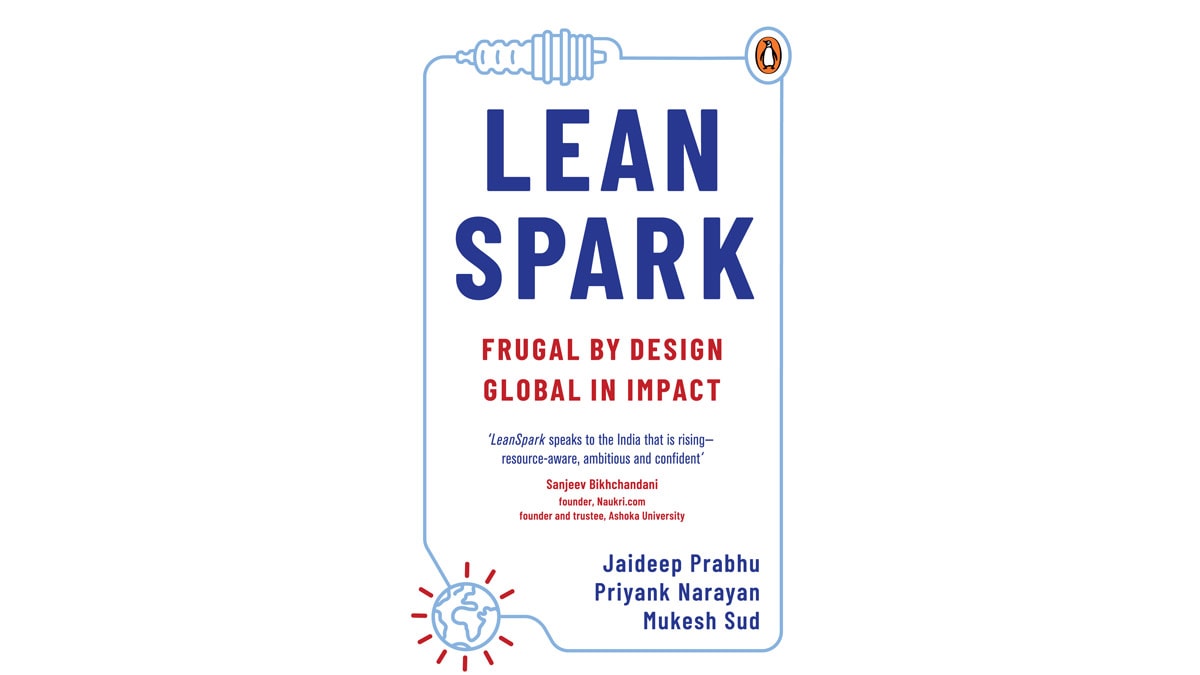
India’s next decade will be defined by a simple question: can we raise living standards for hundreds of millions of people without exhausting our financial, human, and ecological resources? LeanSpark is my answer – a way of turning scarcity into a systematic engine of innovation, not just a backdrop to it.
From jugaad to LeanSpark
For years, I have studied and celebrated jugaad: India’s ability to improvise clever fixes under constraint. But jugaad has its limits. It is often ad hoc, hyperlocal, and risky at scale. A bridge held together by quick fixes is a miracle until it collapses.
LeanSpark is a modern, evolved framework that carries forward the spirit of jugaad – ingenuity under pressure – but reshapes it into solutions that are lean, scalable, and sustainable. It asks innovators to start with frugality and constraint, but insists on discipline, ethics, and long-term thinking.
In the book LeanSpark: Frugal by Design, Global in Impact, my co-authors Priyank Narayan, Mukesh Sud and I define LeanSpark through four principles: lean execution, purposeful simplicity, adaptive scalability, and systemic sustainability. Together, they describe a mindset that does not simply “make do” but designs for resilience and scale from day one.
How three journeys converged
LeanSpark grew out of a decade of research, teaching, and conversations with Indian entrepreneurs who were quietly building the future in labs, garages, and backstreets.
My own journey is rooted in research, in trying to understand how firms in emerging markets innovate with limited resources. Earlier books such as Jugaad Innovation and Frugal Innovation documented how companies around the world were doing more with less – often out of necessity. Over time, I became convinced that frugality had to move from the margins to the core of how we think about innovation.
Priyank has approached the problem as an educator and ecosystem builder. At Ashoka University, he has designed entrepreneurship programmes built around real projects, not just case studies. In his classroom, students wrestle with messy constraints – unreliable infrastructure, price-sensitive consumers, hard trade-offs. He has needed frameworks his students can use, not just understand. That has pushed us towards a clearer, more actionable language for frugal, tech-enabled innovation.
Mukesh comes at this as a scholar of entrepreneurship and as a close observer of founders. At IIM Ahmedabad and beyond, he has followed entrepreneurs who are building businesses on “bare-bones budgets” – from electric vehicles to food and retail. His work with Priyank on Leapfrog explored how Indian enterprises could vault ahead by rethinking practices rather than just copying Western models.
Our paths crossed in classrooms, conferences, and even airports, and we eventually co-taught a course on frugal innovation at Ashoka. Each semester, student projects surfaced new stories: drones used to reinvent sports broadcasting, low-cost mobility solutions, social enterprises turning scraps into life-changing devices. We realised we weren’t just collecting anecdotes; we were seeing a pattern that needed a new name.
What exactly is LeanSpark?
LeanSpark is the intentional spark of innovation that emerges under constraints. It is rooted in four ideas:
Lean execution: Instead of spending heavily on untested ideas, LeanSpark emphasises rapid experimentation, prototyping, and learning from real users. In a world of scarce capital and volatile markets, building the perfect product in isolation is a luxury few can afford.
Purposeful simplicity: LeanSpark solutions strip away the non-essential, but they do not cut corners. By focusing on what truly matters to users, they lower costs, speed up adoption, and make scaling easier – especially in price-sensitive markets.
Adaptive scalability: The goal is not a one-off fix but a solution that can be adapted across geographies and segments. LeanSpark encourages modular designs and flexible models that can evolve as conditions change.
Systemic sustainability: Quick fixes often ignore environmental and social costs. LeanSpark demands that constraints – on capital, carbon, or community trust – be built into the design brief, not discovered later as unpleasant surprises.
Put simply, LeanSpark is frugal by design, global in impact.
Stories that sparked the framework
The framework did not emerge from theory alone. It was shaped by people.
Take Quidich, a company that began with two young founders renting a single drone to film aerial shots. They said “yes” to a national TV contract before they fully knew how to deliver it – then used sheer ingenuity, long nights, and incremental experimentation to make it work. Over time, they moved beyond basic drone footage to develop AI-powered tracking systems and immersive cricket experiences, including a collaboration with the ICC and Apple’s Vision Pro. That journey – from improvisation to a sophisticated, exportable product – is high-tech jugaad in action.
Or consider India’s digital public infrastructure: systems like Aadhaar and UPI that have reimagined digital identity and payments for hundreds of millions of people at extremely low cost per transaction. These are not glamorous gadgets; they are invisible rails on which entire ecosystems now run. They show how LeanSpark can operate at the level of policy and national platforms, not just start-ups.
In sectors from space to sports, we found similar patterns: lean teams using constraint as a design principle, building simple but powerful solutions that could travel. Each story helped us refine what LeanSpark is – and what it is not.
Practical applications: Beyond inspiration
LeanSpark is not meant to be just a label for nice stories. In the book, we build a toolkit – including a Frugal Innovation Canvas – that organisations can use to structure their own efforts. The applications cut across four domains:
Start-ups and small enterprises: Founders can use LeanSpark to pressure-test ideas. Does this solve a real, constrained problem? Are we overbuilding? Can the model work at low price points without endless subsidies?
Large companies: Big firms often struggle with bureaucratic innovation. LeanSpark offers a way to create “small, hungry teams” within large organisations that experiment cheaply and scale only what works.
Government and public policy: Governments face acute constraints: limited budgets, high expectations, and urgent crises. LeanSpark encourages them to design policies and programmes that are modular, testable, and co-created with users – rather than rolled out as monoliths that are hard to fix later.
Global North and South: While our examples are rooted in India, the logic travels. Rich countries are hitting hard limits on energy, materials, and public patience with waste. The same frugal ingenuity that helps an Indian entrepreneur stretch a rupee can help a European or American firm reduce its dependency on scarce inputs and shrink its environmental footprint.
Why LeanSpark matters now
At Cambridge Judge Business School, my research over the years has spanned innovation, marketing, and development, with a particular focus on frugal innovation in both large and small firms. The more I look at today’s crises – from climate change to inequality – the clearer it becomes that “more of the same” innovation will not work.
We need to do better with less, not just do more. That means treating frugality as a source of creativity, not merely an accounting constraint. It means asking, in every sector: If India can build world-class innovation with less, what’s stopping the rest of the world?
