



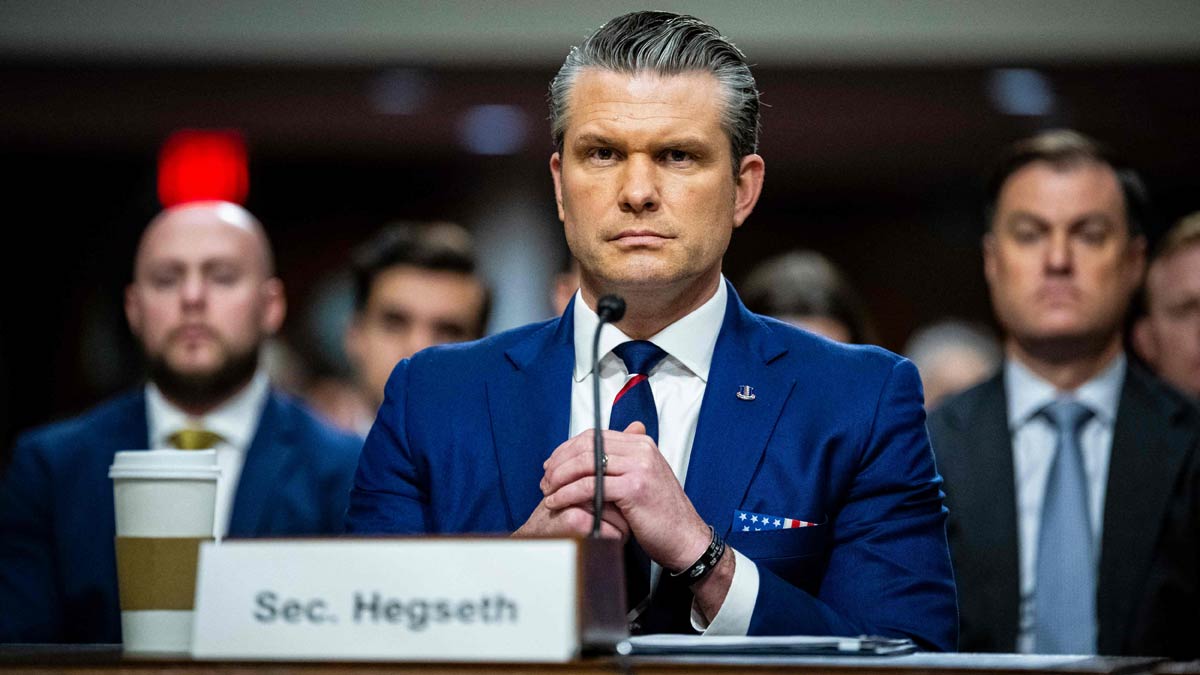
US Defence Secretary Pete Hegseth, along with Chairman of the Joint Chiefs of Staff General Dan Caine and Pentagon Comptroller Jay Hurst, faced three hours of intense questioning before the Senate Armed Services Committee yesterday. Although the ostensible purpose of the hearing was to review the Defence Department’s historic $1.45 trillion budget request, proceedings quickly devolved into a fiercely confrontational debate over the ongoing US war in Iran and Hegseth’s controversial tenure.
A central theme of the hearing was the accusation that Hegseth had deliberately misrepresented the reality of the conflict. Senator Jack Reed, the committee’s top Democrat, delivered a blistering critique, accusing Hegseth of offering “dangerously exaggerated” accounts of military triumph while failing to provide President Donald Trump with an accurate picture of the war. Reed argued that Hegseth was telling the president what he wanted to hear rather than what he needed to hear, describing this as a disservice to both the commander-in-chief and US troops.
Despite Hegseth’s declarations of success, lawmakers pointed out that the conflict is largely in a stalemate after eight weeks, Iran’s hardline regime remains in place and Tehran continues to possess nearly 500kg of highly enriched uranium. Peace talks remain stalled, with Iran demanding the lifting of a US naval blockade, while Washington insists on ending Tehran’s nuclear programme and reopening the Strait of Hormuz.
The severe economic and financial toll of the war was heavily scrutinised. Hurst confirmed that the campaign has already cost the United States $25 billion, with future reconstruction costs for damaged US bases still uncalculated. The closure of the Strait of Hormuz—a vital conduit for roughly 20 per cent of the world’s oil—has pushed up fuel prices, placing a tangible burden on American households. Senator Elissa Slotkin stressed that until the strait is reopened, Washington cannot credibly claim success. Senator Gary Peters added that tactical military gains are meaningless without creating the political conditions necessary to end the war, a view that drew rare bipartisan agreement from Republican Senator Roger Wicker.
Hegseth’s combative rhetoric and dismissal of civilian oversight drew sharp criticism. Senator Kirsten Gillibrand confronted him over his decision to cut the Pentagon’s civilian protection division by 90 per cent. The rollback came under particular scrutiny following reports of civilian casualties, including a US Tomahawk cruise missile strike on an elementary school in Minab that killed 168 students on the war’s first day. While Hegseth maintained that the strike remains under investigation, Reed condemned his earlier rhetoric—such as calls for “no stupid rules of engagement” and promises of “no mercy”—warning that such language risks crossing into the territory of war crimes.
Public support and the legal basis for the conflict were also fiercely debated. Gillibrand described the campaign as an “unauthorised war”, arguing that the American public is exhausted and unconvinced. Senator Richard Blumenthal echoed this sentiment, saying voters are not persuaded by claims of success. Hegseth countered that the war enjoys public backing and that troops appreciate a president willing to confront what he called a 47-year threat of a nuclear-armed Iran. The legal timeline also came under scrutiny, with the 60-day deadline under the War Powers Act approaching—a requirement for congressional approval to continue hostilities. Hegseth’s claim that a pause in fighting effectively halts the “60-day clock” drew scepticism from Senator Tim Kaine.
Lawmakers also targeted Hegseth’s sweeping cultural and personnel changes within the military. Reed accused him of hollowing out senior leadership by dismissing top commanders based on race and gender, including women and Black officers. He further criticised Hegseth’s emphasis on Christian nationalism, citing the introduction of monthly Christian prayer services at the Pentagon and changes to the chaplain corps. Hegseth rejected these accusations, calling them a smear against his faith. Senator Mazie Hirono pressed General Caine on whether the inclusion of women in combat roles affected standards; Caine’s response was cautious, while Hegseth insisted that the “highest male standard” should define combat requirements. Separately, Senator Jacky Rosen accused Hegseth of using antisemitic language by referring to critics as “Pharisees”, a charge he declined to retract.
Throughout the hearing, Hegseth frequently deflected criticism by attacking lawmakers, at one point describing congressional Democrats and some Republicans as the “biggest adversary we face”. He dismissed critics as “reckless naysayers” and “defeatists” undermining military efforts. The hearing ultimately exposed a deeply polarised political establishment grappling with fundamental questions over the war’s strategy, cost, legality and moral conduct.
