



You can run, you can hide, but you cannot escape Arundhati Roy and her latest book Mother Mary Comes to Me, about her relationship with her mother. Those salt-and-pepper curls, expressive eyes and deceptively mellifluous voice are everywhere—at talk shows, Instagram reels and lit fests. Much like Arundhati, the book has proved to be polarising, with both her fans and critics ready to wage war in offence or defence of it. Despite all the noise, or perhaps because of it, Mother Mary Comes to Me seems to be ticking all the right boxes; it recently won the 2026 National Book Critics Circle Award for Autobiography and is shortlisted for this year’s Women’s Prize for non-fiction.
Regardless of its title, the book is not religious. In fact, Arundhati’s mother, Mary Roy, was staunchly opposed to religion. She made a stark distinction between religion and God. It first manifested in the disagreements with Mrs Mathews, a British missionary with whom Mary co-founded her school, Pallikoodam (then Corpus Christi), in Kerala in 1967. They parted ways when Mrs Mathews strongly objected to Mary employing two classical dancers, Bhavani and Chellappen, to teach bharatnatyam to the students. Mrs Mathews felt the ‘vandana’, the opening invocation to Lord Shiva, was “heathen, unchristian and unacceptable”. Mary, she said, would have to choose between her and Chellappen-Bhavani. Mary chose and Mrs Mathews left.
But the bigger religious controversy Mary faced was when she decided to stage Jesus Christ Superstar—the rock opera by Andrew Lloyd Webber and Tim Rice—in her school. The new district collector of Kottayam banned the play’s performance on the grounds that it was “blasphemous and offensive to Christian sentiment”. To bolster his case against Jesus Christ Superstar, the collector got some Syrian Christian bishops and priests to back him, writes Arundhati. Three thousand people signed a petition against the play. There were calls to “shackle the wild elephant” (Mary). Some policemen raided the school campus to confiscate a video cassette that was made before the play. Being previously warned, Mary got the tape taken out of the school. She got an anticipatory bail and while the police searched her house and school, she sat at her table and had her nails clipped. The tape that they finally found turned out to be blank.

Ironically, the line in the Beatles song ‘Let it be’—’When I find myself in times of trouble, Mother Mary comes to me, speaking words of wisdom, let it be’—from which Arundhati gets the title of her book, also does not have any religious connotations. It does not refer to Jesus’s mother, but rather to band member Paul McCartney’s mother, who was also named Mary. The song apparently came to him in a dream. At a time when the band was coming undone and its business a shambles, McCartney was going into a deep depression. Then one night, he saw his mother in a dream assuring him that all would be well. “Just let it be,” she told him. McCartney’s mother, a Catholic, had died when he was 14 and many Catholics feel that even though he did not mean it, his Catholic roots must have been playing on his subconscious when he wrote the song.
On a meta scale, the world—entangled in the chaos of war and destruction—could do with a Mother Mary visitation, someone who will tell us that all will be well, and that we just need to let it be. Until then, what we get is David Lowery’s recent psychosexual thriller Mother Mary, starring Anne Hathaway as a pop diva fashioned after Taylor Swift. “I definitely brought a lot of Taylor Swift to the table in terms of who Mother Mary was,” said Lowery. “I would often be like, ‘Imagine Taylor Swift in 10 or 15 years—that is sort of who this character would be’.”
Lowery was probably thinking more of Swift than the Virgin Mary while crafting his heroine, which is fitting since the singer has more followers on Instagram (280 million) than there are Americans who identify as Christians (around 223 million in 2025). Traditional religion in the US has experienced a significant decline since the 1990s. According to Gallup, the percentage of Americans who said religion was very important to them dropped from 52 per cent in 2015 to 47 per cent in 2025.
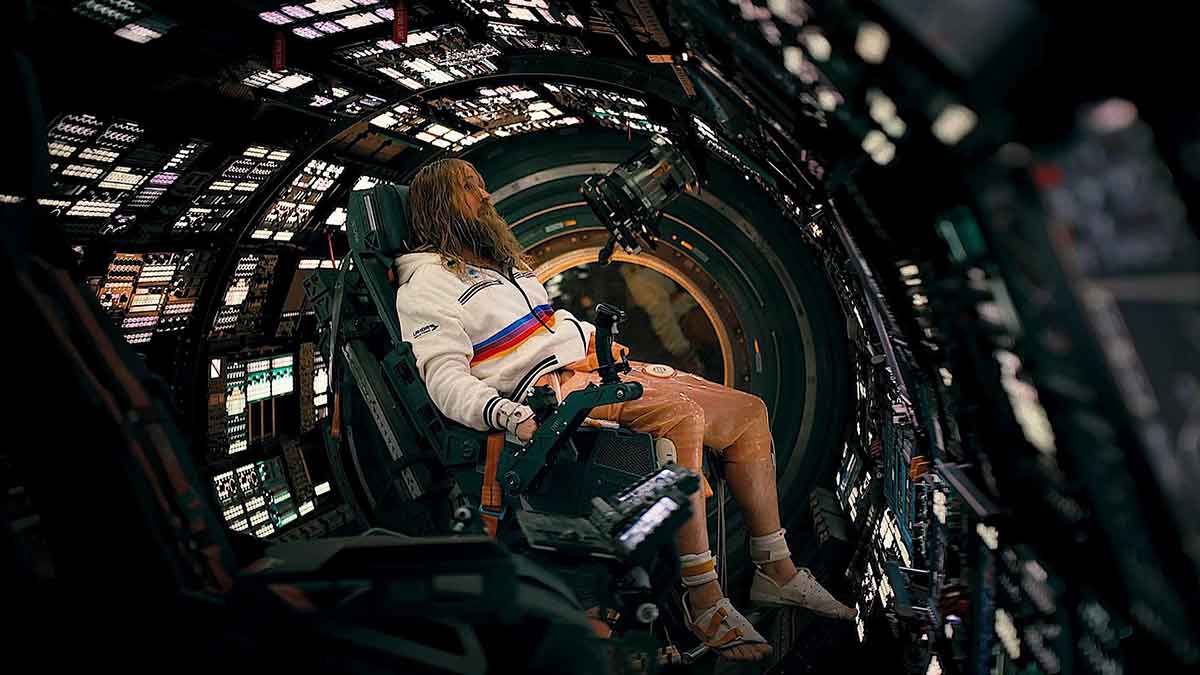
But Mother Mary cannot be restrained to this world, let alone America. She is now making her presence felt in space. The success of Ryan Gosling’s Project Hail Mary—which has become the year’s highest grosser since its release on March 26—seals Mary’s pop-cultural significance this year. The sci-fi thriller, adapted from an eponymous book by Andy Weir, follows Dr Ryland Grace, a high school teacher who is sent to space on the spacecraft Hail Mary to save the planet when it is discovered that earth is threatened by single-celled organisms called astrophage that are absorbing the sun’s energy. In 30 years, it will cause a catastrophic ice age on earth. Astrophage has also infected all nearby stars except one named Tau Ceti, so Grace is sent there to investigate its astrophage resistance.
Once again Mother Mary loses out on her claim to the film’s name. It is named after the American football term ‘Hail Mary’, referring to a prayer uttered as a desperate, last-ditch effort to score a goal when the chances of doing so remain slim. Much like Grace’s one-way mission (there is only enough rocket fuel to get him to Tau Ceti, but not back) whose success is literally a long-shot. The name is more a nod to American colloquialism than Catholicism, although some feel that the prayer (Hail Mary, full of grace) had a part to play in Gosling’s character being named Ryland Grace. Whether that is so or not, the prayer alludes to hope in a time of hopelessness. In a world where the most powerful man has become a meme, days are getting as hot as an episode of Baywatch, and war is becoming the rule than the exception, we could all do with a Hail Mary manoeuvre.
