


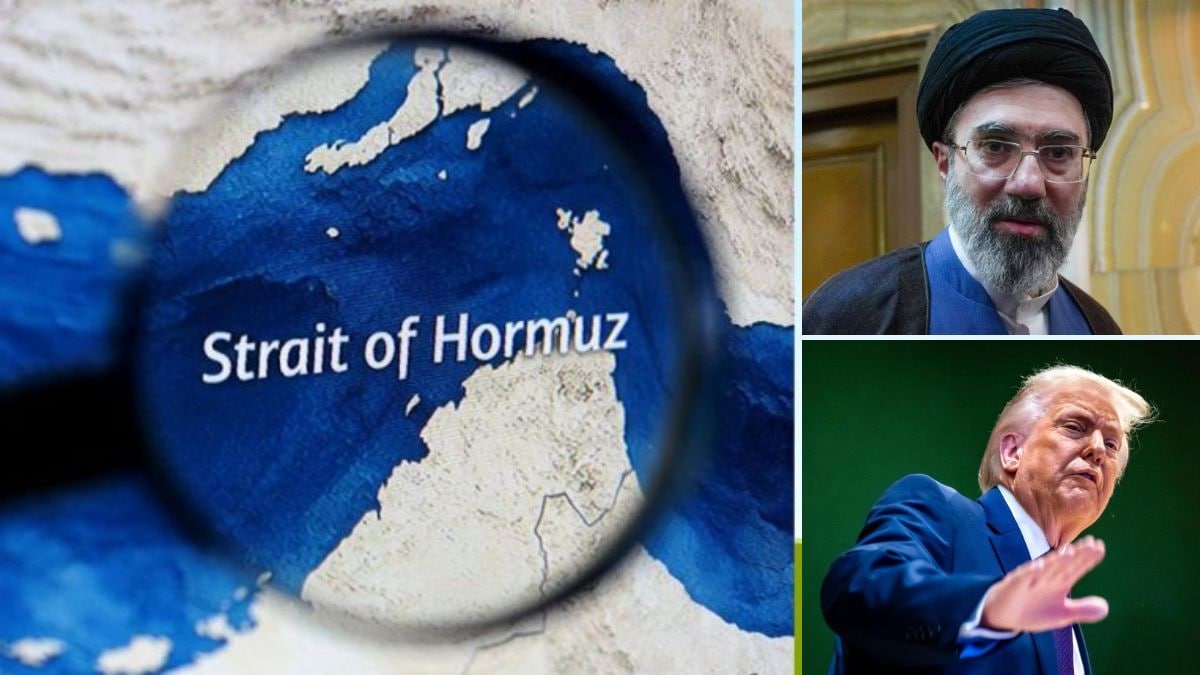
Iranian Foreign Minister Abbas Araghchi on Friday lifted Tehran's closure on the Strait of Hormuz, sparking questions on how it will impact the US Navy blockade of the waterway.
Iran had been responding to US President Donald Trump's declaration of a 10-day ceasefire in the conflict between Israel and Lebanon.
"Passage for all commercial vessels through (the) Strait of Hormuz is declared completely open for the remaining period of ceasefire," Araghchi wrote in an X post on Friday, marking a major turning point in the war between Iran and US-Israel forces, currently in a truce state.
In line with the ceasefire in Lebanon, the passage for all commercial vessels through Strait of Hormuz is declared completely open for the remaining period of ceasefire, on the coordinated route as already announced by Ports and Maritime Organisation of the Islamic Rep. of Iran.
— Seyed Abbas Araghchi (@araghchi) April 17, 2026
While the Central Command of the US military (CENTCOM) has yet to clarify—in detail—the US Navy's stance on Iran's move, Trump has declared that the US Navy blockade would continue in the Strait of Hormuz, while also thanking Tehran.
"IRAN HAS JUST ANNOUNCED THAT THE STRAIT OF IRAN IS FULLY OPEN AND READY FOR FULL PASSAGE," he wrote in a Truth Social post, thanking Iran for the declaration.
However, he was quick to declare that despite Iran's move, the blockade in the strait would continue "UNTIL SUCH TIME AS OUR TRANSACTION WITH IRAN IS 100 PER CENT COMPLETE," he wrote in a follow-up post.
In doing so, Trump has indicated that he now aims to continue using the blockade as leverage over Iran, as he claims that a peace deal between Iran and the US was nearing completion.
What it could mean for maritime operations in the Persian Gulf
If Iran does not retract its earlier move lifting its closure of the Strait of Hormuz because of the US blockade continuing, the maritime situation in the Persian Gulf is expected to ease up.
In that regard, the move has already had an impact on Brent, the global crude benchmark, which fell by 10.73 per cent to $88.73 an ounce, as per an NDTV Profit report.
The risk of vessels transiting via the strait to and from non-Iranian ports is also likely to be lowered, as the terms of the US blockade also do not involve warnings for such vessels, which is expected to ease fears and decongest the waterway.
The move is also likely to help a number of tankers stranded in the Persian Gulf to finally exit the strait, ending what the International Maritime Organization (IMO) had earlier flagged as a humanitarian crisis.
The fragile ceasefire had been paving the way for the evacuation of about 20,000 sailors aboard the roughly 2,000 ships stranded in the Persian Gulf amid the war.
— THE WEEK (@TheWeekLive) April 12, 2026
(us iran war israel, hormuz blockade trump irgc, imo united nations sailors stranded)https://t.co/Wo4yU6j7Wh
According to the UN agency, the blockade would be risking the lives of about 20,000 seafarers aboard 2,000 stranded ships, as of an April 8 estimate.
