


Did Iran agree to open Strait of Hormuz? Trump announces two-week ceasefire; Tehran claims ‘victory’

The negotiations between the two countries are likely to be held in Islamabad on Friday

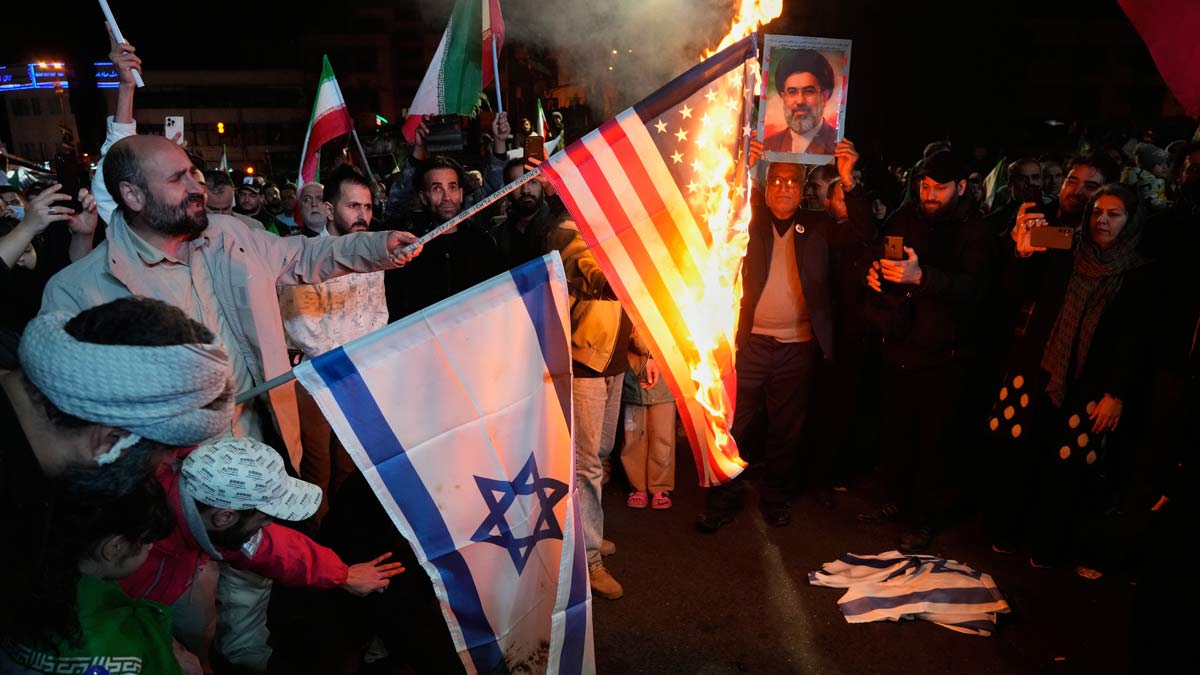
Iranian pro-government demonstrators burn the US and Israeli flags during a protest at the Enqelab-e-Eslami, or Islamic Revolution, Square in Tehran | AP Iranian pro-government demonstrators burn the US and Israeli flags during a protest at the Enqelab-e-Eslami, or Islamic Revolution, Square in Tehran | AP

For latest news and analyses on Middle East, visit: Yello! Middle East

The United States and Iran have agreed to a two-week ceasefire, announced by US President Donald Trump just an hour before a deadline set for Tehran to reach an agreement with Washington was to end.

According to Trump, the decision came after discussions with Pakistan Prime Minister Shehbaz Sharif and Field Marshal Asim Munir. The negotiations between the two countries are likely to be held in Islamabad on April 10.

"Based on conversations with Prime Minister Shehbaz Sharif and Field Marshal Asim Munir, of Pakistan, and wherein they requested that I hold off the destructive force being sent tonight to Iran, subject to the Islamic Republic of Iran agreeing to the COMPLETE, IMMEDIATE, and SAFE OPENING of the Strait of Hormuz," the US President said in a social media post.

"I agree to suspend the bombing and attack of Iran for a period of two weeks," he said, adding that this will be a double-sided ceasefire.

Trump said his decision to agree to a ceasefire was based on the assessment that the US had already “met and exceeded” its military objectives. He added that Washington was “very far along” toward a definitive agreement aimed at long-term peace with Iran and broader stability in the Middle East.

Trump also stated that the US had received a 10-point proposal from Iran and that negotiations would be held to discuss the framework.

Historic victory, says Iran

Meanwhile, Iran’s Supreme National Security Council has declared the development a “historic victory.” According to Iranian state media, the council claimed that Tehran had achieved most of its wartime objectives, including recognition of its rights over the Strait of Hormuz, nuclear enrichment, and the removal of sanctions.

"Iran achieved a historic victory by forcing the criminal US to accept its 10-point plan. The US has accepted Iran's control over the Strait of Hormuz, enrichment rights, and removal of all sanctions. The US has accepted to stop aggression, pay compensation for damages, withdraw it's forced from the region," the Council stated as reported by Iranian state media. 

The council added that Iran had, from the beginning, intended to continue the conflict until its objectives were achieved, including what it described as creating “regret and desperation” in its adversary and eliminating long-term threats to the country.

Talks to be held in Islamabad

Pakistan Prime Minister Shehbaz Sharif has invited delegations from the US and Iran to Islamabad for in-person negotiations on Friday, April 10, aimed at reaching a comprehensive agreement to resolve all disputes.

White House Press Secretary Karoline Leavitt also confirmed that talks are expected to take place in the Pakistani capital. However, she cautioned that “nothing is final until announced by the President or the White House".

Safe passage via Strait of Hormuz

Iranian Foreign Minister Seyed Abbas Araghchi announced on X that Iran would suspend its military operations for two weeks, responding to requests from Pakistani Prime Minister Shehbaz Sharif and the United States, which has proposed a 15-point plan for negotiations.

“If attacks against Iran are halted, our powerful armed forces will cease their defensive operations,” Araghchi stated.

He further stated that, for a period of two weeks, safe passage through the Strait of Hormuz would be facilitated in coordination with Iran's armed forces and subject to technical limitations.