



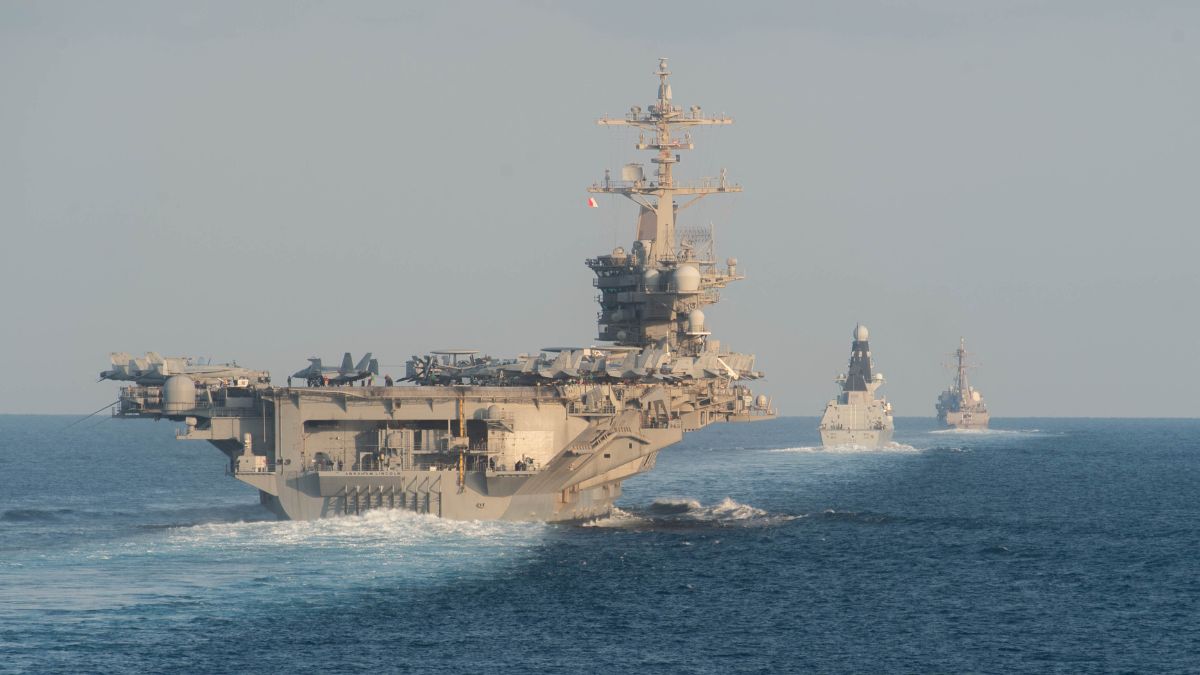
As tensions escalate between Washington and Tehran, speculation about potential military confrontation has intensified. Reports of alleged Iranian threats toward regional states, including Jordan, underscore a broader truth: if the United States strikes Iran, the consequences will not remain confined to the Gulf.
For Asia, this is not a distant Middle Eastern crisis. This scenario has direct implications for energy security, maritime trade, inflation management, and geopolitical alignment.
The key strategic question is whether a U.S.–Iran war would resemble Iraq in 2003.
It would not.
It would be more dispersed, more economically destabilising, and far more intertwined with global great-power competition.
Why this is not Iraq 2003
The 2003 invasion of Iraq was a conventional campaign against a regime isolated by sanctions and lacking a layered regional deterrence structure. Iran today is structurally embedded in the security architecture of the Middle East and increasingly linked to broader anti-Western strategic alignment.
Tehran’s deterrence model rests on four pillars:
- A substantial ballistic and cruise missile arsenal.
- Expanding drone capabilities.
- Cyber warfare infrastructure.
- A network of allied armed actors across Lebanon, Iraq, Syria, and Yemen.
A U.S. strike would likely trigger distributed retaliation rather than a single-front war. This would not be a short shock-and-awe campaign followed by rapid regime collapse. It would be an escalation ladder—horizontal before vertical.
What Washington should expect
If military action proceeds, five strategic consequences are highly probable:
1. Immediate regionalisation
The U.S. bases in Iraq and the Gulf would face pressure. Maritime traffic through the Strait of Hormuz—through which a significant portion of global oil transits—would be vulnerable. Even limited disruption would send markets into volatility.
2. Economic shockwaves across Asia
Asia imports a substantial share of its energy from the Gulf. India, China, Japan, and South Korea would experience immediate price instability. Insurance premiums for shipping would spike. Inflationary pressures would compound domestic economic sensitivities.
In 2003, globalisation was deep. Today, it is hyper-integrated. Disruption spreads faster.
3. Prolonged asymmetric engagement
Iran does not need conventional parity to impose strategic cost. Hybrid responses—such as proxy escalation, cyber disruptions, and maritime harassment—could span months or years. Washington would face an endurance contest, not a decisive battlefield.
4. Strategic overextension
The United States is balancing commitments in Europe and the Indo-Pacific. A major Middle Eastern war would compete for attention and resources. Asian capitals must quietly assess how such a diversion affects long-term U.S. posture in their own region.
5. Internal consolidation in Iran
External strikes often strengthen hardline factions within targeted states. Rather than weakening the regime, military pressure could consolidate it domestically.
The China–Russia Variable
A war with Iran would not occur in a geopolitical vacuum.
According to Professor Rohan Gunaratna, “China and Russia will lose a major partner with the impending US intervention in Iran. With Washington’s plans to change the Ayatollah regime in Tehran, China and Russia would suffer the loss of an ally. Iran provides energy supplies to China and UAVs to Russia to fight in Ukraine. A strategic node in the architecture of anti-Western alignment, replacing the Tehran regime is central for the stability and security of the Middle East and the world.”
This observation highlights two realities.
First, Iran has evolved beyond a regional actor. It is increasingly integrated into broader strategic alignments that include Moscow and Beijing.
Second, any attempt at regime change would reverberate through global power competition, not merely Middle Eastern politics.
China depends heavily on Gulf energy flows, including Iranian supply channels. Russia has relied on Iranian UAV technology in its Ukraine campaign. Tehran, therefore, functions as both an energy node and a defense-industrial contributor within a wider anti-Western alignment.
A U.S.–Iran war would thus intersect with great-power rivalry—potentially reshaping alignments across Eurasia.
Lessons from 2003 — Properly understood
The Iraq War removed a regime but unintentionally altered the regional balance in ways that ultimately expanded Iranian influence. The deeper lesson of 2003 is not that military victory is impossible. It is that second- and third-order effects often exceed initial objectives.
Iran is not Iraq. It is more demographically cohesive, institutionally resilient, and regionally embedded. Targeting it risks triggering systemic ripple effects across energy markets, proxy networks, and global alignments.
Wars rarely remain confined to the logic of their planners.
Why Asia cannot remain passive
Asian governments traditionally avoid direct entanglement in Middle Eastern rivalries. Yet economic interdependence eliminates strategic distance.
If conflict disrupts Gulf energy:
- India’s growth trajectory would face pressure.
- China’s diversification strategy would be tested.
- ASEAN maritime trade routes would absorb secondary shocks.
The appropriate response is not alignment, but preparedness:
- Strategic petroleum reserves.
- Diversified energy sourcing.
- Diplomatic engagement channels with all parties.
- Maritime insurance and supply chain contingency planning.
Asia must think beyond geography and focus on systemic resilience.
The strategic bottom line
A US–Iran war would not be a replay of Baghdad in 2003. It would be multi-theatre, hybrid, economically disruptive, and entangled in great-power competition.
For Washington, the decision is not simply whether it can strike Iran. It is whether it can manage escalation across distributed fronts while preserving global strategic balance.
For Asia, the imperative is pragmatic: prepare for volatility, protect economic interests, and avoid being caught unprepared in a conflict not of its making.
Because if war comes, the shock will not stop at the Gulf.
The author is a security analyst with decades of on-the-ground experience in the Middle East.
