



The United Arab Emirates (UAE) and its relationship with India has been on a fresh high in recent years.
Both nations now have a free trade agreement in place that has already seen trade shooting up, even beyond targets. Both nations have traits that go beyond their shared ties dating back into history—in as much as they are aspirational, ambitious, and eager to go beyond traditional boundaries to make their mark in a changing world.
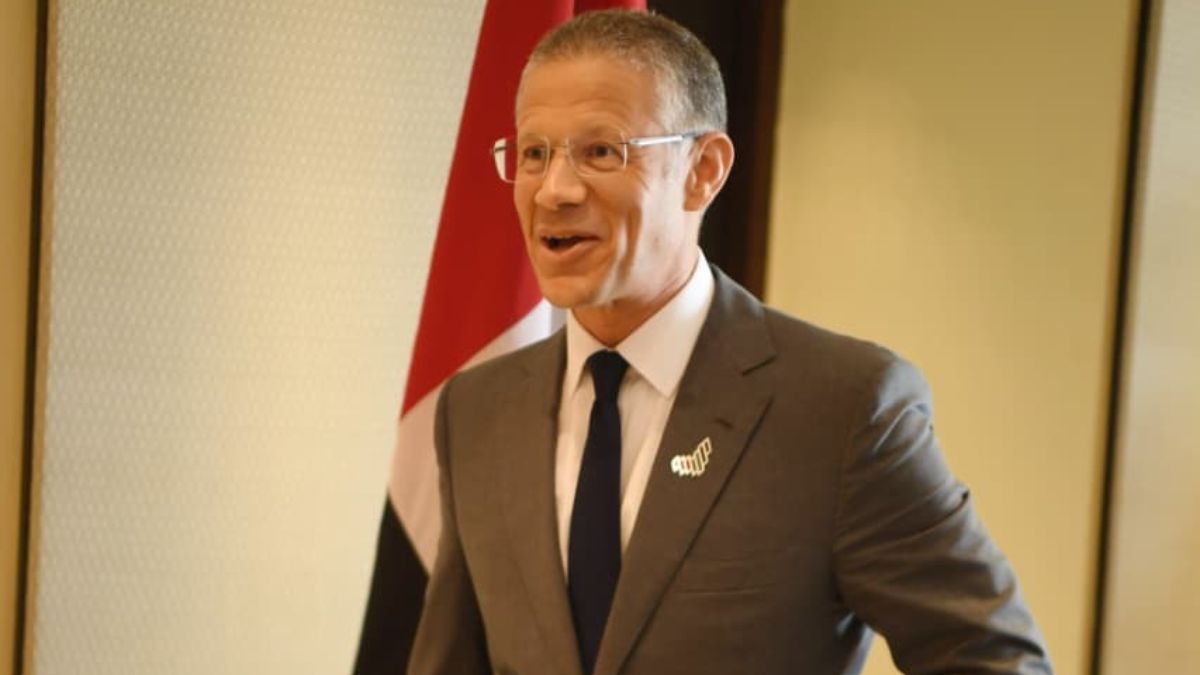
Badr Jafar, UAE’s special envoy for business and philanthropy, exemplifies this perfectly: recognised for combining capital with conscience, his blueprint for a new future involves not just business and trade, but also a whole lot of social capital that cross-cultural, social and scientific collaboration can bring forth.
On a quick visit to India this week, Jafar spoke to THE WEEK on how India and the UAE can take on the challenges of a changing world order with a fresh template. Excerpts:
Q: Governments have realised the strength of soft power. India-UAE soft power has concentrated on people-to-people connect. What are the possibilities that both countries can add on to it?
A: Growing up, everywhere I (went) noticed it was difficult to find branded products and services (not generic products like Hummus!) that came out of Arab countries. And I was curious why it was so for a region of about 500 million people.
Is it because we haven’t got the creative talent? Of course we do. Is it because we don’t have the ambition to do that? Maybe. Is it that we don’t have the correct partnership? Potentially.
The result is that we didn’t.
Take the US. Whether or not you agree with US politics or foreign policy, everyone around the world is exposed to Brand USA at some point or the other. Through food, music, films, through technology, devices, through search engines. And this is incredibly powerful, because what that creates is affinity between the youth of those countries and those exporting it.
Take an example from the UAE. Emirates Airlines. Even people who have only heard about Emirates and not necessarily travelled on it consider it for its reliability, service, about hospitality, all things we associate with the UAE. And they are experiencing it through this brand. If you were to expand that to 50-60—or even 200 such brands—think of the reach in creating those affinities internationally.
Take Korea. K-Pop, Korean skincare regime, TV shows are massive. And these are in a language Indians or Emiratis don’t speak, and yet it has penetrated both countries, and created a huge soft power for Korea.
I think both India and UAE can both learn from that. What we can figure out is each becoming a platform for the other’s products and services to launch to other parts of the world.
The relationship between India and UAE has progressed beyond asking 'can we partner?’ We are now in the implementation phase, creating specific sectors where bilateral trade has gone beyond targets. Indian PM Modi and UAE President Mohammed bin Zayed Al Nahyan have now set it for $200 billion trade by 2032, and we are confident we can reach that target.
But in order to do that, we need to have a strong connection between our business communities: not just sovereign companies and funds, we need to unleash, if you will, the capabilities and capacities of our private sector to understand India as an opportunity, and as a gateway.
Q; In the last couple of decades, the India-UAE relationship has transformed from just Indians going for employment to the Middle East to trade and strong diplomatic ties. And there is the FTA also, how has that changed things?
A: It’s been 4 years since we signed the FTA, the Comprehensive Economic Partnership Agreement (CEPA). The fruits are evident—we have already crossed the $100 billion target that was originally set for 2030. We need to look at the agreement as dynamic and not static, and expand according to the opportunities. Today, it has expanded beyond what it was thought of originally, while signing.
Trade is like the engine of the partnership. But the people are the fuel. It is the people-to-people ties that will fundamentally make this relationship grow stronger and even more strategic in nature as we grow together. And we are seeing that.
In the UAE, it is not difficult to see what India means to us. UAE population is made up of 50 per cent Indian nationals living and working in the UAE. Traditionally, that was blue-collar workers, but it has evolved over the years. Today, close to 40 per cent of the Indian working population in UAE is white collar. You have Indians as CEO of some of our largest companies.
We have a lot of history, and that creates a backbone of trust and a sense of community that is important. That is the foundation for everything that you build on. But we should not take it for granted.
Because going forward—new generation of Indians and Emiratis—if we are not careful, may take that for granted. So we need to make sure that the people-to-people connect is always preserved.
That means not just hard business and investment, but people-to-people connect. Culture is extremely important, education is important, philanthropy is important.
And with India’s scale, there is so much we can do, not just with each other, but globally, especially in places like Africa. There are many examples where we can scale up together.
Q: Your focus areas are philanthropy and social entrepreneurship. How does this work and what can an Emirati business do in India or vice versa?
A: I refer to philanthropy, the forgotten child of the capitalist system. The reality is strategic philanthropy has played an important role in unlocking many solutions, including innovations over the years. You’ve seen it derisking early-stage innovations.
Why is it important for India? Because India is solving many problems at scale—education, healthcare, financial inclusion. As the UAE wants to have more impact, we need to partner with countries (that) have that scale; that know-how. That’s where partnerships can make a lot of difference.
I believe if you are to solve our challenges, particularly systemic ones, it can only be done if you engage entrepreneurs. How? A cross-sectoral initiative between business and philanthropy is what the UAE believes in, and that’s where my job—to help connect the two sectors with our diplomatic corps and government—is proof that we take this seriously.
Q: Are there specific areas you are looking at?
A: Healthcare, education and financial inclusion. But the breadth of the communities we are meeting is beyond that, including environment and conservation. You can’t solve without addressing other interconnected challenges.
Externalities impede your ability to solve many of these challenges. That is why you need an all-of-society approach. Climate change, for example. You can’t just solve for climate change without solving with other issues, like education and health.
Q: Do you think the UAE can look at being an incubating hub for Indian startups even if their core area of operation is in India?
A: Absolutely. We would love to have more Indian entrepreneurs: not just as an opportunity, but as a gateway, to Africa, the Middle East, and Europe. We have a lot of examples already. The opportunity is there.
What we need to be mindful is what the needs of the entrepreneurs are. I already have an engagement with the larger Indian entrepreneurial ecosystem. In the UAE, we need to identify what the opportunities are, the challenges are, and how to solve it for them.
In the UAE, we are here to help. To make that journey as seamless and frictionless as possible. Regulatory framework, access to capital, mentor community, partnership opportunities—we want to provide all of the above; we want to work with Indian entrepreneurship.
Our message is: we are open for business, and we are open to help you scale to other parts of the region and beyond.
Q: How do you think both countries scale their people-to-people connect beyond Indians going to work in the UAE and businesses there looking at India as a market?
A: It’s already happening, but I think we can go deeper. Culture is extremely important. The more cultural exchanges, the better. Education is another. The philanthropic foundations working across culture, providing more access to young artists to express themselves through music, art, theatre etc.
Education is another. We have examples of Indian campuses opening in the UAE. Similarly, we want more Emirati students coming to study in India. A cross-fertilisation of academic content is very important.
And finally, research. Joint research is extremely important. Research is growing, but in UAE, we realise we are behind. More educational and research centres are being established.
Linking innovation research across life sciences, health, and education to manufacturing and advanced industries will help to unlock so much more, and create much stronger people-to-people bonds.
What will then happen is that instead of being consumers of imports, we become creators of innovation for the world. That will be incredibly important to grow the relationship of both our countries as we move forward into the next phase of our relationship.
