



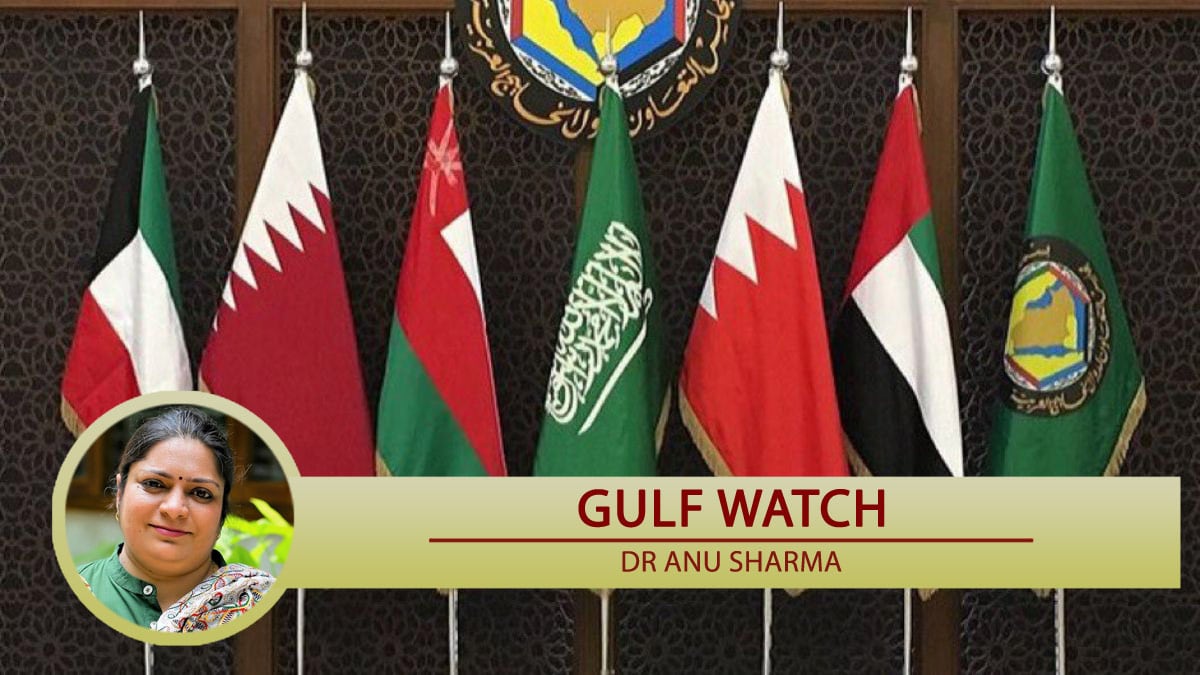
After a hiatus of almost fifteen years, India and the Gulf Cooperation Council (GCC) the Free Trade Agreement (FTA) negotiations are set to be restarted. This indicates a structural shift in how both India and the GCC states visualise each other in an evolving global economic order. On February 5, 2026, India and the GCC signed the Terms of Reference (ToR) in New Delhi to formally initiate the talks, which had been suspended since 2011. Before this, preliminary talks happened in the years, 2006 and 2008, but were deferred.
The GCC states represent one of India’s most important economic corridors. The announcement also fits India’s recent shift in its Gulf trade strategy, which already includes a Comprehensive Economic Partnership Agreement (CEPA) with the United Arab Emirates (UAE) and a newly signed CEPA with Oman. India’s exports to the GCC reached about US$57 billion in the FY 2024–2025, while imports were about US$122 billion, indicating the GCC’s cardinal role in India’s energy, metals, and downstream supply chains. For sure, energy remains central to this trade, with the Gulf fulfilling more than half of India’s crude oil requirements and a substantial portion of its LNG imports. However, what makes this revival of FTA talks significant is that the relationship is no longer limited to hydrocarbons.
The Gulf economies are undergoing profound transformation under sustained diversification programs like Saudi Arabia’s Vision 2030, UAE’s Vision 2071, Qatar’s National Vision 2030, Oman’s Vision 2040, Kuwait’s New Kuwait 2035 and Bahrain’s Economic Vision 2030. These plans aim to reduce dependency on income from oil trade by expanding manufacturing, logistics, renewable energy, tourism, fintech, and digital services. Amidst all this, India is trying to position itself as a global manufacturing hub and a trusted supply-chain alternative amid geopolitical fragmentation. This convergence points to the fact that while the Gulf states seek markets, skilled human resources, and industrial collaboration, India looks for capital inflows, energy stability, and deeper integration into Middle Eastern production networks. The earlier round of FTA negotiations, initiated in the mid-2000s, stalled primarily over market access concerns, tariff structures, and regulatory standards.
In contemporary times, the economic landscape has changed dramatically. India has already concluded comprehensive trade agreements with the UAE and Australia and has expanded negotiations with the UK and the EU. The Gulf states have also initiated deepening of ties with Asian countries, reflecting a pragmatic, trade-first orientation. In this context, reviving the India–GCC FTA fits in India’s geoeconomic calculus. Both sides recognise that supply chains are being reconfigured, and waiting on political certainties is no longer viable.
This reset also comes at a time when global trade fragmentation is increasing. As supply chains are being reconfigured due to geopolitical contestations, sanctions, and strategic decoupling, states are prioritising trusted trade partners and regional corridors. In this context, closer India–GCC economic alignment reflects a pragmatic effort to hedge against uncertainty and secure resilient trade and investment networks. The Gulf states are also exercising a multi-alignment policy by maintaining strategic partnerships with the United States, expanding economic ties with China, and deepening engagement with India. The trade policy has become a balancing tool. The FTA negotiations are also closely linked to connectivity ambitions. The case in point being the India–Middle East–Europe Economic Corridor (IMEC). Even though IMEC is still in early conceptual stages, it reflects a shared vision of trade corridors bypassing the conflict-prone chokepoints. An FTA framework would complement such connectivity projects by harmonising bureaucratic procedures, reducing tariffs, and aligning regulatory standards.
However, there are challenges for the successful completion of this FTA. Agriculture, migration of labour, services liberalisation, and investment protection clauses are likely to be contentious. Gulf countries may seek greater labour flexibility and easier capital mobility, while India will push for market access in services and skilled migration pathways. Balancing these interests will require political will beyond technical negotiations. In all of this, the timing is strategic. As Gulf states recalibrate their regional equations that are evident in rapprochement efforts between rival states and a growing emphasis on economic cooperation, trade has emerged as a stabilising mechanism. For India, strengthening economic interdependence with the GCC states also reduces vulnerability to energy shocks and embeds New Delhi more deeply into regional value chains.
The revival of FTA talks, therefore, reflects a broader reality. Economic diversification, trade corridors, and investment flows are increasingly shaping alignments. In all of this, geoeconomics is not replacing geopolitics—but it is moderating it. If successfully concluded, the India–GCC FTA could mark a decisive shift from a relationship historically defined by oil and remittances to one anchored in industrial collaboration, supply-chain integration, and strategic economic interdependence.
