



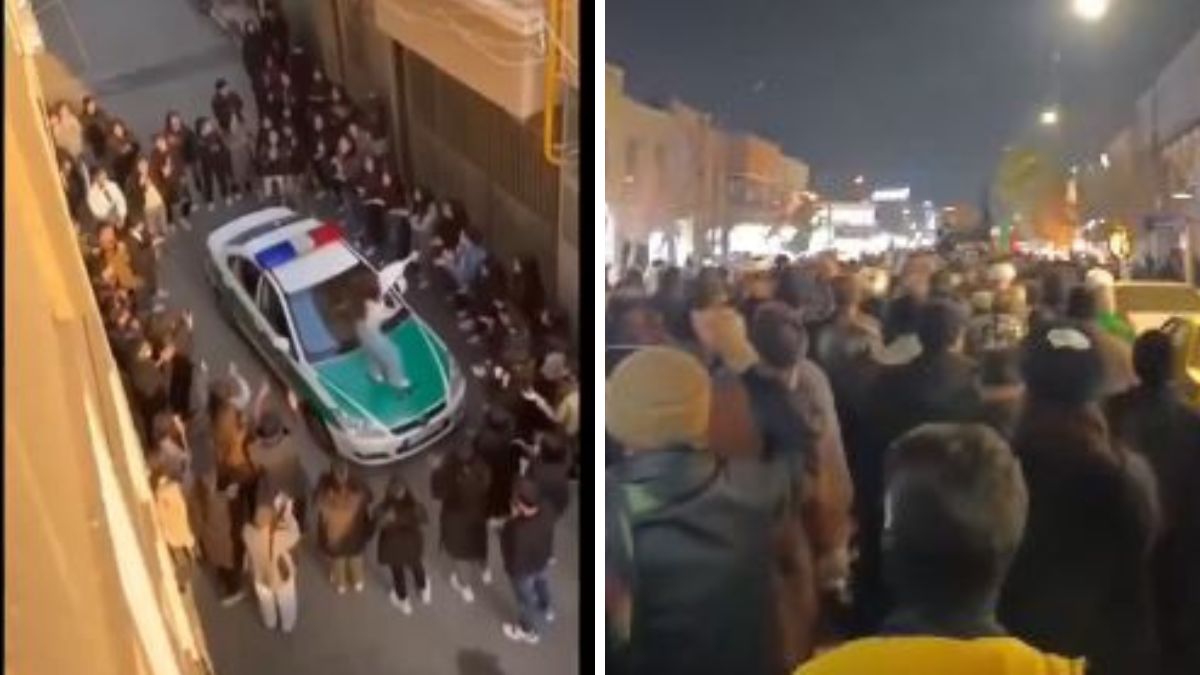
The social media and news outlets have lately been flooded with news and the latest updates from the ongoing protests that have rocked Iran’s Islamic regime for the last two weeks. Chants of “Mullahs must get lost” have become pervasive across Iran following a collapsing currency and shuttered bazaars, which triggered the largest nationwide protests since the ‘Woman, Life, Freedom’ movement in 2022. One of the defining features of the nationwide protests occurred in Qom, often described as the Vatican of Shi’ism. In the published footage, women wearing Islamic clothing are also seen among the protesters, indicating the breadth of dissatisfaction across different layers of society. Chants like “Death to the dictator”, “We will fight, we will die, we will take back Iran,” and “Reza Shah, may your soul rest in peace” signify direct challenges to the ideology of political Shi’ism that governs the Islamic Republic.
To understand why the recent episodes in Qom are significant, one needs to look beyond the number of people on the streets to the city’s demography and symbolic geography. Qom's population is overwhelmingly Shia, with over 99% adhering to the faith, and is highly observant of their religion. More importantly, it is a major global centre for Shia scholarship and pilgrimage, housing significant seminaries and shrines, such as the Fatima Masumeh Shrine. The city attracts millions of religious tourists annually, and serves as a spiritual heartland for Twelver Shia Islam in Iran. The 1979 Islamic Revolution in Iran was sparked in Qom, and Ayatollah Khomeini used the holy city as the launchpad for his Velayat-e-Faqih (Guardianship of the Jurist), including other ideological pillars of the state.
Among the prevailing issues, the demonstrations in Qom, the regime’s traditional base, can be plausibly attributed to the deepening sense of systemic economic injustice between both the non-clerical professional and non-official clerical class and those tied to the seminary system (hawzeh elmieh). While those with advanced degrees in engineering and social sciences are frequently marginalised by a stagnant labour market that pays wages below the legal minimum of 104.4 million rials (US$110) per month, their clerical counterparts benefit from a robust, institutionalised safety net. For the 2024-2025 financial year, the government allocated at least 360 trillion rials (approximately US$600 million) to its propaganda activities, of which 40 trillion rials (approximately US$66.7 million) was allocated to support the Qom Seminary.
This situation is further exacerbated by the scale of the clerical apparatus, which supports thousands of seminarians through tax-exempt stipends (shahrieh) and exclusive financial perks. Moreover, this economic divide has manifested in visible consumption patterns, in which a new social class of clergy and seminary-affiliated staff reportedly earn triple the salaries of skilled professionals and exercise purchasing power through institutional gift cards at state-funded grocery stores.
In addition to this, the economic woes of non-official clergymen and seminary students add further context to the current dynamics in Qom. The statistic that 90% of clerics do not hold government positions highlights a massive internal divide. While the official clergy (those in the judiciary, ministries, or foundations, bonyads) enjoy state salaries and benefits, the vast majority of traditional clergy rely on dwindling religious endowments and private donations. This creates a class struggle within the clergy, where the seminary students and independent preachers feel abandoned by the state they are expected to represent. The vast majority of seminarians subsist on a modest US$50 monthly stipend, which forces them into the informal economy as labourers or even taxi drivers. Similar discontent was observed among young seminary students and certain clerical groups in Qom in 2023, who voiced concerns about deteriorating economic conditions. Moreover, non-official clerics often bear the brunt of public anger directed at the regime without enjoying any of the regime's luxuries and face social ostracisation or verbal abuse due to the state’s failures.
While this does not mean that the Qom clergy have endorsed protests in the city or Iran, the friction between the "political clergy" in Tehran and the traditional "theological hierarchy" of Qom’s hawza cannot be ignored. While Tehran’s authority is enforced through the Supreme Leader and the Revolutionary Guards, Qom’s influence is rooted in the independent scholarly prestige of the marjas. In recent years, public appeals from high-ranking Grand Ayatollahs, such as Naser Makarem Shirazi, Abdullah Javadi-Amoli, and Hossein Nuri Hamadani, for the state to address popular grievances have exposed a significant rift between Qom’s traditional clerical hierarchy and Tehran’s political establishment.
While Qom is obviously not entirely homogeneous in protest against the regime, it represents a significant challenge to the internal stability of the Islamic Republic, potentially signalling a growing rift between traditional Shia religious identity and the state’s political framework. Ultimately, if the regime cannot maintain the loyalty of its spiritual heartland, it faces a crisis of authority that state funding and coercive intervention alone may struggle to resolve.
Mohammed Shoaib Raza is a doctoral candidate at the Centre for West Asian Studies, Jawaharlal Nehru University, New Delhi.
