



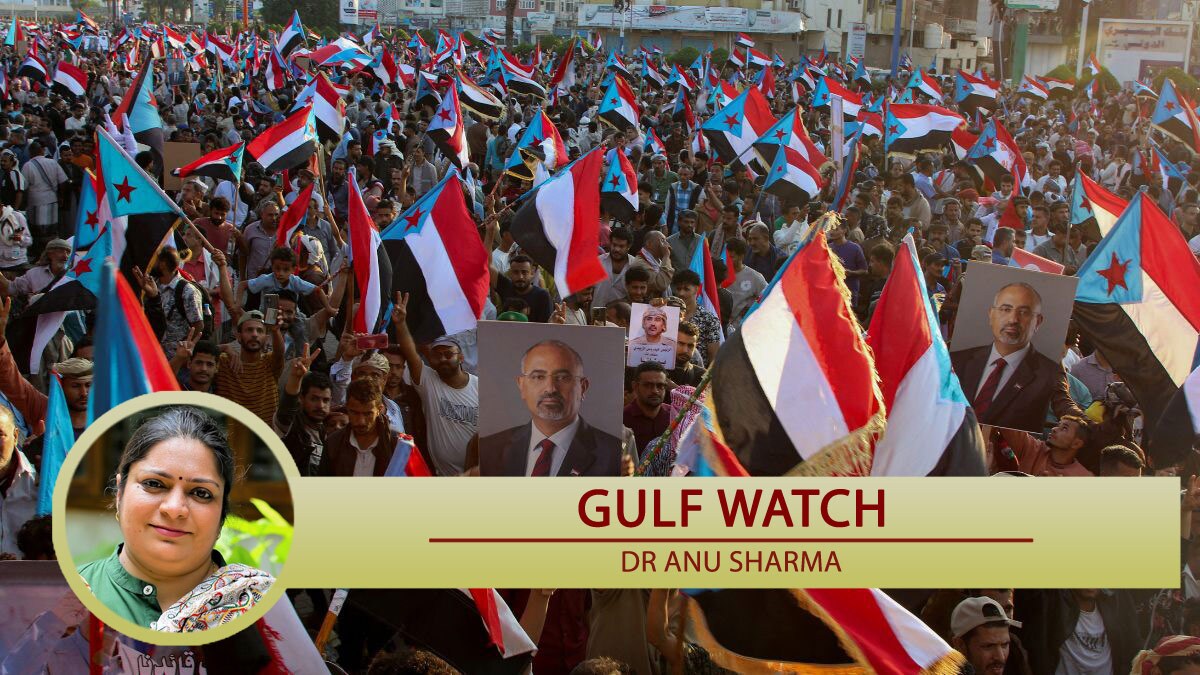
The recent escalation in Yemen marks a critical inflection point not only in the decade-long civil conflict but also in relations among key Gulf actors, particularly Saudi Arabia and the United Arab Emirates (UAE). What began as a unified, Saudi-led intervention against the Houthi movement in Yemen has emerged as an internal dispute, laying bare the divergent strategic visions and rivalries within the cohesive coalition.
The aftermath of the Saudi airstrike on Mukalla port, contentions of UAE arms shipments to the Southern Transitional Council (STC), and the UAE’s contentious decision to withdraw its forces signal a profound reconfiguration of regional alignments, which are definitely going to have serious implications for Yemen as well as the regional political order of the Gulf region. STC is an armed secessionist group in Yemen working against the unification of Yemen.
On 30 December 2025, the Saudi-led coalition launched airstrikes on the southern port city of Mukalla, contending that vessels carrying weapons and military vehicles from the UAE were destined for the STC. Saudi authorities have condemned this move as a violation of coordination protocols and a threat to Yemen’s security. However, the UAE had denied supplying weapons to any faction in Yemen and described the cargo as equipment for its own counterterrorism units. Immediately after the strike, Saudi-backed members of Yemen’s Presidential Leadership Council (PLC) declared a state of emergency and ordered the immediate withdrawal of all Emirati forces. The UAE also announced the pullout of its remaining troops from Yemen. This marks the escalation of what had been a slow variance within the Gulf coalition over Yemen. This withdrawal is significant because, since formally ending its combat role in 2019, the UAE had maintained a limited counterterrorism presence in the country, and its exit now potentially signals a deeper strategic disengagement or recalibration of priorities.
Saudi Arabia and the UAE, long positioned as the twin pillars of the anti-Houthi coalition, have grown increasingly divergent over Yemen. Riyadh’s primary objective has been the restoration of a unified, internationally recognised Yemeni government and the containment of Houthi expansion, which has been conceived within a broader security framework that directly affects its border regions and internal stability.
On the contrary, the UAE’s strategy has increasingly emphasised local power brokers in southern Yemen. This divergence is not new, but recent events have uncovered the faultlines in this coalition. It should be noted that the STC’s assertive moves have increased Saudi anxieties about an emboldened separatist entity potentially extending influence up to the Saudi frontier. Riyadh frames this as a direct threat to its territorial security and Yemen’s unity. Furthermore, the Saudis’ assertion also points to a broader geopolitical calculation wherein external actors with overlapping interests contest influence in Yemen. This recalibration postures echo the patterns in the Gulf region where allied cooperation can be highly transactional and subject to realignment in national interests.
Yemen’s civil war has been catastrophic, with it being the world’s largest humanitarian crisis. Millions have been displaced due to this protracted instability, which has also resulted in external actors playing a role in this conflict since 2015.
The Saudi-UAE rift that is now clearly visible risks undermining prospects for a durable political settlement. For years, Yemen has been the theatre of a regional proxy struggle between regional and external actors and the Houthis rebel group. This fracture in alliance may exacerbate the already complex landscape of the Gulf region. Further, it exposes a broader recalibration of Gulf politics, where economic, strategic and diplomatic interests are undergoing resetting amidst a post-Arab Spring landscape and shifting great power dynamics. Riyadh and Abu Dhabi’s diverging approaches in Yemen reveal how alignments can unravel under pressure. The role of the international actors, including the United States and the United Nations, has condemned escalation and called for restraint. However, external pressures alone cannot resolve internal Yemeni issues.
The emergence of these intra-Gulf tensions over Yemen underscores the fragility of coalition frameworks built without harmonised strategic objectives. The Saudi-UAE crisis in Yemen reveals the competing threat perceptions and the limits of external patronage in shaping regional outcomes. In the current scenario, the challenge is to address the humanitarian crisis and the civil war that Yemen is facing, so that it does not convert into a broader confrontation.
The author is an assistant professor at Amity Institute of Defence and Strategic Studies (AIDSS), Amity University, NOIDA.
