



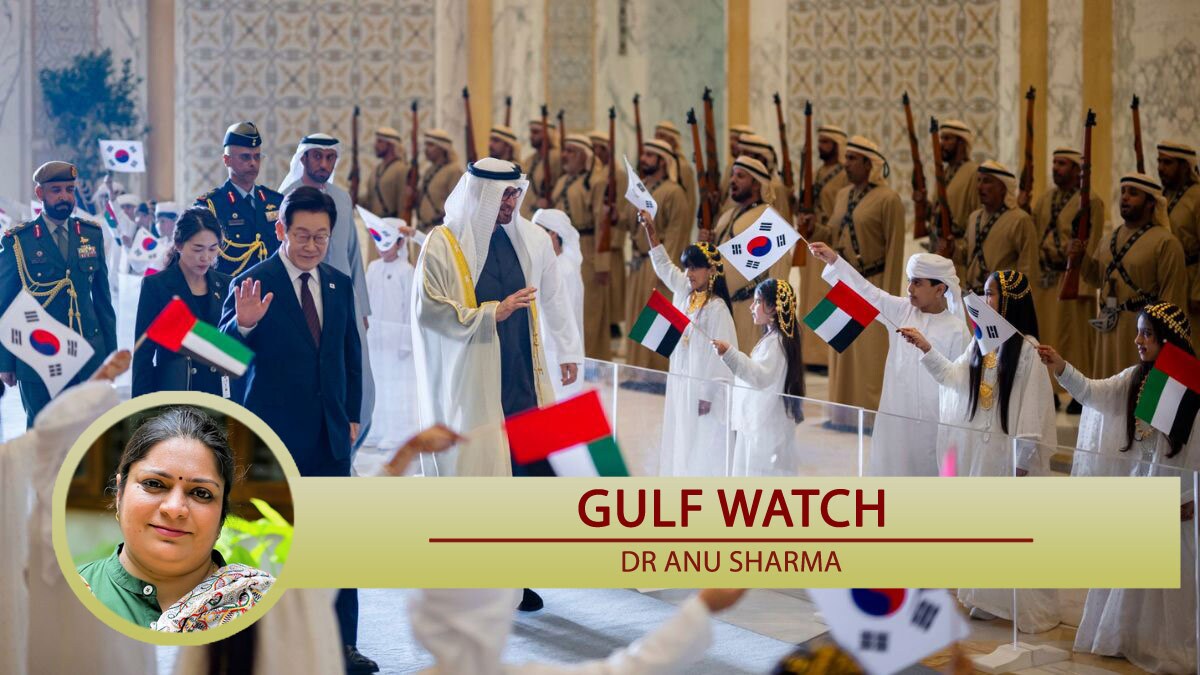
South Korea’s expanding engagement with the Gulf marks a quiet but consequential shift in West Asian geopolitics, reflecting the rise of middle-power diplomacy in an era of strategic flux. What began decades ago as a largely transactional relationship—centred on energy imports and construction contracts—has evolved into a multidimensional partnership encompassing trade, technology, defence cooperation, and strategic coordination. This transformation is not episodic; it reflects structural changes both in Gulf security thinking and in South Korea’s own foreign and security policy, as Seoul seeks to protect global supply chains, diversify strategic partnerships, and project stability beyond Northeast Asia.
At the economic level, the foundations of South Korea–Gulf ties remain robust. The Gulf has long been central to South Korea’s energy security, supplying a significant share of its crude oil and liquefied natural gas imports. However, the relationship has moved decisively beyond hydrocarbons. South Korean firms have become deeply embedded in Gulf development strategies, particularly in infrastructure, construction, smart cities, nuclear energy, and advanced manufacturing.
Flagship projects—such as South Korea’s role in building and operating nuclear reactors in the UAE—symbolise a transition from contractor to long-term strategic stakeholder. The recent signing of a free trade agreement between South Korea and the GCC further institutionalises this shift, signalling a commitment to deeper economic integration, technology transfer, and supply-chain resilience between the two sides.
What distinguishes the contemporary phase of South Korea–Gulf relations, however, is the growing security and defence dimension. Traditionally cautious about military engagement beyond its immediate neighbourhood, South Korea has gradually recalibrated its posture in response to the globalisation of security threats and economic interests. The Gulf, situated at the crossroads of global energy flows and maritime trade routes, has emerged as a key theatre in this recalibration. Naval cooperation, joint exercises, arms sales, and defence-industrial collaboration—particularly with the UAE—reflect a convergence of interests: Gulf states seek diversified security partners beyond traditional Western guarantors, while South Korea aims to protect sea lanes, overseas nationals, and critical economic interests.
This defence cooperation is deliberately calibrated rather than overtly militarised. South Korea does not seek permanent basing or alliance-style commitments in the Gulf. Instead, its approach emphasises capacity-building, interoperability, and technology-driven security cooperation. This aligns well with Gulf preferences for strategic autonomy and diversified partnerships, especially at a time when confidence in singular external security patrons has weakened. The emphasis on naval cooperation, maritime security, and defence technology—rather than ground deployments—allows both sides to enhance security while avoiding entanglement in regional conflicts.
Equally important is the strategic narrative underpinning this partnership. South Korea presents itself not as a hegemonic power or ideological actor, but as a pragmatic, technologically advanced, and politically non-intrusive partner. This resonates strongly in the Gulf, where states are increasingly wary of external actors who tie security cooperation to political conditionality. Seoul’s model—combining economic reliability, technological sophistication, and restrained security engagement—offers an attractive alternative to both traditional Western powers and more assertive emerging actors.
From a Gulf perspective, South Korea fits neatly into a broader strategy of security diversification. As the regional order becomes more multipolar and contested, Gulf states are actively cultivating relationships with a range of middle powers—South Korea, Japan, India, and others—to hedge against uncertainty and reduce overdependence on any single external actor. South Korea’s growing role must be understood within this context: it is not replacing existing security partnerships, but complementing them in ways that enhance flexibility and bargaining power.
The partnership also reflects evolving Gulf threat perceptions. Rather than focusing solely on conventional military threats, Gulf states are increasingly concerned with maritime security, critical infrastructure protection, cyber risks, and supply-chain vulnerabilities. South Korea’s strengths in naval capabilities, advanced manufacturing, digital technologies, and defence innovation align well with these priorities. Cooperation in these areas underscores a shared understanding that future security will be as much about technology and resilience as about traditional force projection.
At the systemic level, South Korea–Gulf cooperation illustrates a broader trend in global politics: the rise of functional security partnerships driven by economic interdependence rather than ideological alignment. Unlike Cold War-era alliances, these partnerships are flexible, issue-specific, and adaptive. They reflect a world in which states seek to maximise autonomy while managing risk through networks rather than blocs. In this sense, South Korea’s engagement in the Gulf is emblematic of how middle powers are reshaping regional security architectures without assuming hegemonic roles.
There are, however, constraints and risks. The Gulf remains a volatile region, and deeper security engagement exposes South Korea to geopolitical tensions it has historically sought to avoid. Balancing relations with rival regional actors, navigating sanctions regimes, and managing great power competition—particularly between the United States and China—will require diplomatic finesse. South Korea’s close alliance with the United States places limits on how far defence cooperation with certain Gulf partners can evolve, particularly where technology transfer and export controls are concerned. Moreover, public opinion in South Korea has traditionally been cautious about overseas military involvement, imposing domestic political constraints on sustained security commitments.
Despite these challenges, the trajectory of South Korea–Gulf relations suggests a durable and strategic convergence. The partnership is no longer defined solely by oil tankers and construction sites, but by shared interests in stability, technological advancement, and strategic flexibility. For the Gulf, South Korea represents a reliable, non-disruptive partner that enhances autonomy in a crowded geopolitical landscape. For South Korea, the Gulf is not only an energy supplier but a strategic arena where economic security, maritime stability, and global influence intersect.
In the coming years, the significance of this relationship is likely to grow as both sides adapt to a more fragmented global order. As traditional security architectures strain under the pressures of great power rivalry, middle-power partnerships such as that between South Korea and the Gulf may play a stabilising role—quietly reinforcing resilience without provoking confrontation. In this sense, South Korea’s engagement in the Gulf is less about power projection and more about strategic presence: a measured, interest-driven approach that reflects the changing grammar of global geopolitics.
