



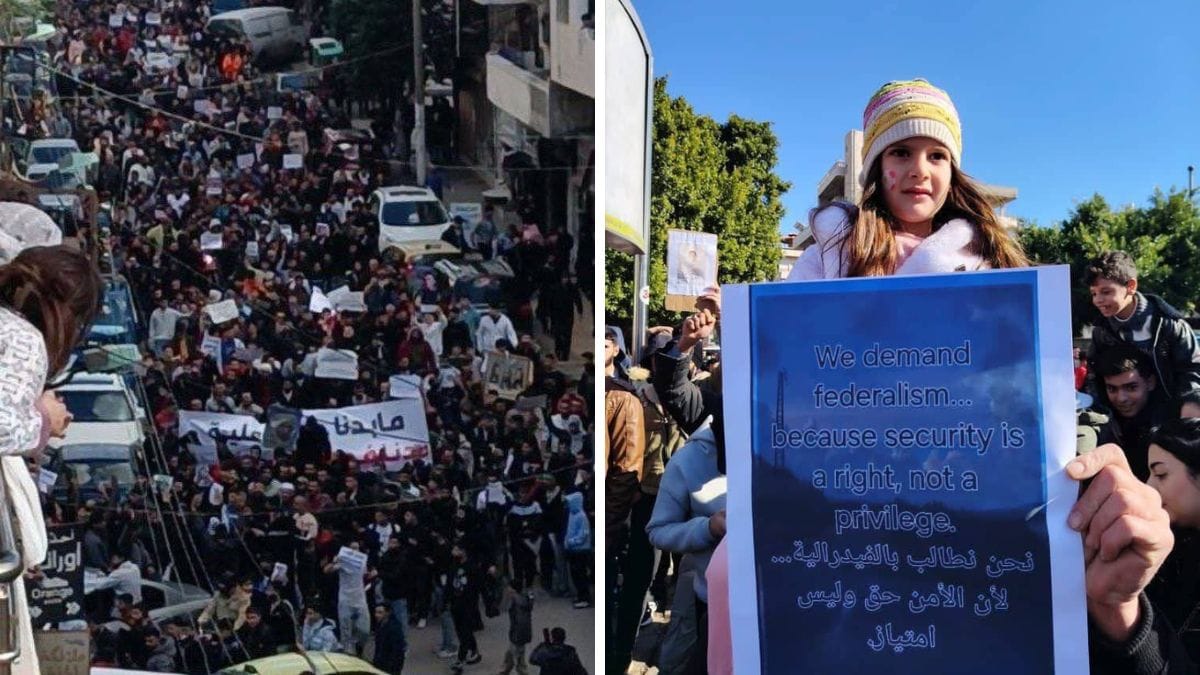
The demands of the Alawites in Syria are precise; rather than crying out for help and longing for Bashar al-Assad's return as their protector once again, they call out for a much more basic but primal demand. As 2025 ends, a powerful chant of "We want federalism" was heard at Azhari Square in Latakia, the heartland of the Alawites. It was a call for the right to survive in their own country.
December 2025 also marks the first anniversary of the astounding fall of the Assad dynasty. It may be a relief for everyone except the Alawites. Alawites, who were the undisputed backbone of the state under Assad, are now having an existential crisis.
On December 26, a Friday prayer in the Ali Bin Abi Talib Mosque in Homs was ripped by an explosion, leaving eight Alawite worshippers dead and many mangled. Labelled as "Nusayri heretics" by Saraya Ansar al-Sunna, a minion of ISIS ideology, the latter states that the purging of the Alawites had just begun towards the establishment of an Islamic state. The terror attack proved to be grim confirmation of their worst fears in the 'New Syria', which is supposed to be better than the Assad regime.
The bombings did not ensue in a vacuum, but were a continuation of the present government's 'De-Ba'athification', a model borrowed from the Iraqi precedent. A part of the process was narrowing the political space by dissolving the Arab Socialist Ba'ath Party in Syria in January 2025. The trauma inflicted by the Assad regime is now inadvertently affecting the Alawites since most of them have been members of the Ba'ath party for their own professional benefits. Many Alawites were removed from their posts to purify the state because of their past associations. In March, pro-Assad remnants in Latakia sparked their revenge killings. To protect themselves, Shahiba, from the old Assad loyalists, have taken up the responsibility to guard their communities. The slow uprooting of the community from the state and the failure to stop radicals from violent attacks indicate a broken social contract and confirm extremists' exploitation of the security vacuum.
To disperse the Alawite protesters chanting for Federalism in Latakia, the security forces used ammunition, which left many protesters injured. Not only are Islamic militias being radicalised, but Alawites have also turned into radical supporters of Federalism. Had the mere utterance of the word "federalism" in the Assad regime, it would have landed many of them in prison. In fact, the previous regime advocated for a more unified rather than a fragmented one. However, a popular name is emerging, Sheikh Ghazal Ghazal of the Supreme Alawite Islamic Council, who lives outside Syria, proposes Federalism, which was considered treason just two years ago.
The proposed federal region would encompass the provinces of Latakia, Tartous, and Hama countryside. President Al-Sharaa's response is unsurprising: he rejected the plan and emphasised that it would lead to the Balkanisation of Syria. As Syria is a multi-ethnic country comprising various minorities like Druze, Kurds, and Christians, this outright rejection reflects that control is more important than securing the country.
Sheikh Ghazal Ghazal has expressed his emotions, capturing the misery of 2025 in his latest message, "Either we are roots on this land that cannot be uprooted, or we cease to exist." His concerns are genuine. Syria's vibrant societal landscape includes Alawites, too; they cannot be uprooted.
Rather than treating every Alawite as a ghost of Assad, the state would have to develop a balanced approach to cater to the needs of all the sects and not just benefit one or repress another. The state should provide security and political freedom irrespective of. The "New Syria" is in the making, although the sun is setting on the Alawites. Will the new year 2026 await reconciliation or a bloodier retreat?
