



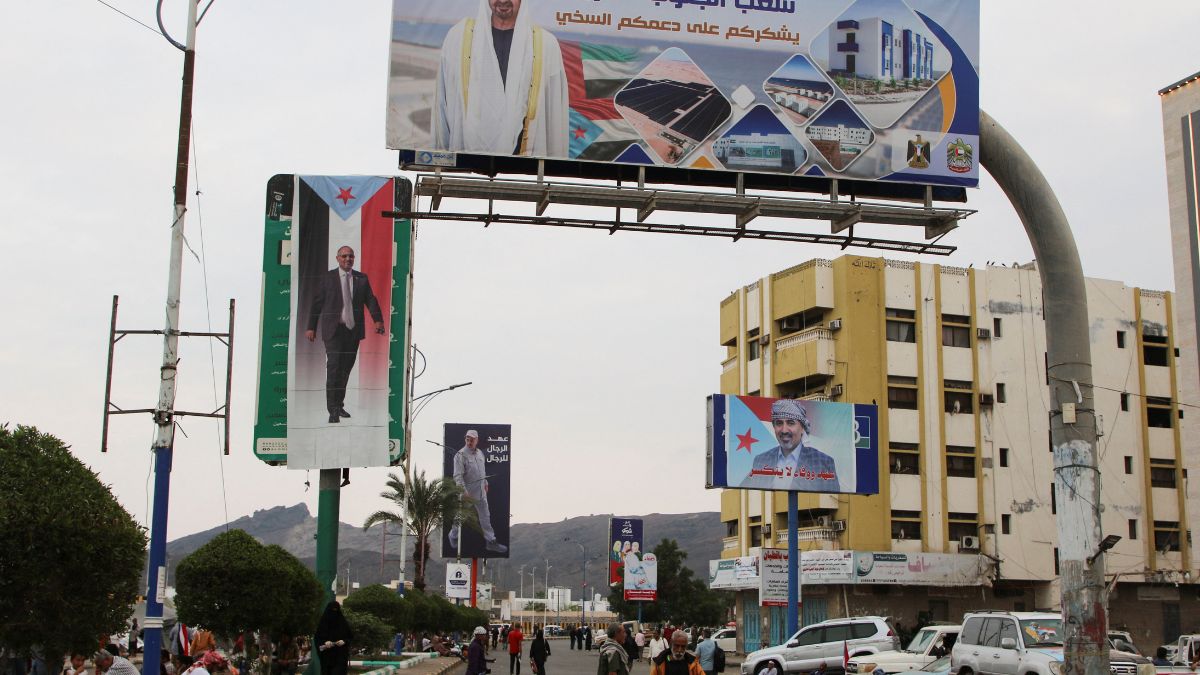
The UAE’s decision to end its counter-terrorism mission in Yemen marks the formal collapse of the anti-Houthi coalition and exposes an open rupture with its traditional Gulf ally, Saudi Arabia. What had long been a simmering rivalry has now erupted into a direct confrontation in southern Yemen.
The immediate catalyst was Saudi Arabia’s air strike on Tuesday on the port of Mukalla in Yemen’s Hadramout governorate. Riyadh described the attack as a “limited military operation” and claimed it was aimed at intercepting illicit arms shipments arriving from the UAE. Saudi officials alleged that vessels had deliberately switched off tracking systems to smuggle combat vehicles and weapons to the separatist Southern Transitional Council (STC), backed by the UAE. Saudi Arabia declared the shipment a “red line” and an “imminent threat” to its national security, signalling that it would no longer tolerate what it sees as the UAE’s covert backing of separatist militias on its southern border.
Shortly after the strike, the UAE announced the withdrawal of its remaining personnel from Yemen. The statement cited “recent developments and their potential implications for the safety and effectiveness of counter-terrorism missions”, language that thinly masked the gravity of the crisis. Although Abu Dhabi insisted the decision was taken of its “own volition”, it followed a blunt ultimatum from Yemen’s Saudi-backed Presidential Leadership Council (PLC), which demanded that Emirati forces leave the country within 24 hours.
Rashad al-Alimi, head of the PLC, accused the UAE of inciting rebellion by “pressuring and directing” the STC to undermine the Yemeni state. He cancelled the joint defence agreement with Abu Dhabi, declared a three-month state of emergency and imposed a 72-hour air and sea blockade aimed at isolating the separatists. While the UAE denied that the cargo contained weapons and maintained that the vehicles were intended for its own forces, the Saudi strike effectively destroyed the foundation of the decade-long alliance.
When the coalition intervened in Yemen a decade ago, the objective was to restore the internationally recognised government by beating back the Houthis backed by Iran. Once that proved to be difficult, their objectives began diverging sharply. While Saudi Arabia wants to keep Yemen united to avoid instability along its porous southern border, the UAE wants influence over critical waterways such as the Bab el-Mandeb Strait and the Gulf of Aden. Abu Dhabi backs the STC precisely for this purpose.
Tensions reached a breaking point when STC forces moved east into the oil-rich governorates of Hadramout and Al-Mahra. For Riyadh, the advance of a separatist force into regions bordering Saudi territory was unacceptable. Saudi officials regard the prospect of a fractured Yemen not as an opportunity for leverage but as a serious security threat. The strike on Mukalla was a clear signal that Riyadh is prepared to dismantle STC supply lines rather than allow a UAE-backed proto-state to take shape along its frontier.
Analysts caution that the UAE’s withdrawal is largely symbolic and unlikely to reverse the fragmentation on the ground. Abu Dhabi withdrew most of its combat troops in 2019 and shifted to a strategy of influence through local proxies, most notably the STC. Removing the remaining “counter-terrorism personnel” does little to weaken the extensive military and administrative structures the separatists have established.
The STC has responded defiantly. Its leaders dismissed the PLC’s expulsion orders as illegal, arguing that “it is unreasonable for the landowner to be asked to leave his own land”. Having seized control of key ports and oil facilities, the STC now functions as a de facto state. Its leadership has refused to withdraw from Hadramout, framing its campaign as a defence of southern populations against what it now openly describes as an enemy government. The STC seems confident that it has sufficient autonomy and resources to sustain a prolonged conflict with Saudi-backed forces, raising the risk of a civil war within a civil war.
The rupture between Saudi Arabia and the UAE recalls the destabilising polarisation of the 2017 Gulf crisis. Riyadh’s public accusation that Abu Dhabi poses a threat to its national security reflects a level of hostility that diplomatic language about “brotherly relations” can no longer conceal.
The primary beneficiaries of this breakdown are the Houthis in the north. It has relieved pressure on them, and they are likely to exploit it to consolidate their control.
The escalation also threatens to deepen the world’s worst humanitarian crisis. The United Nations has warned that disruptions to Mukalla could choke off vital supply routes. As Saudi Arabia enforces blockades to weaken the separatists and the STC entrenches itself to defend territorial gains, Yemen’s civilians remain trapped between former allies turned enemies.
