



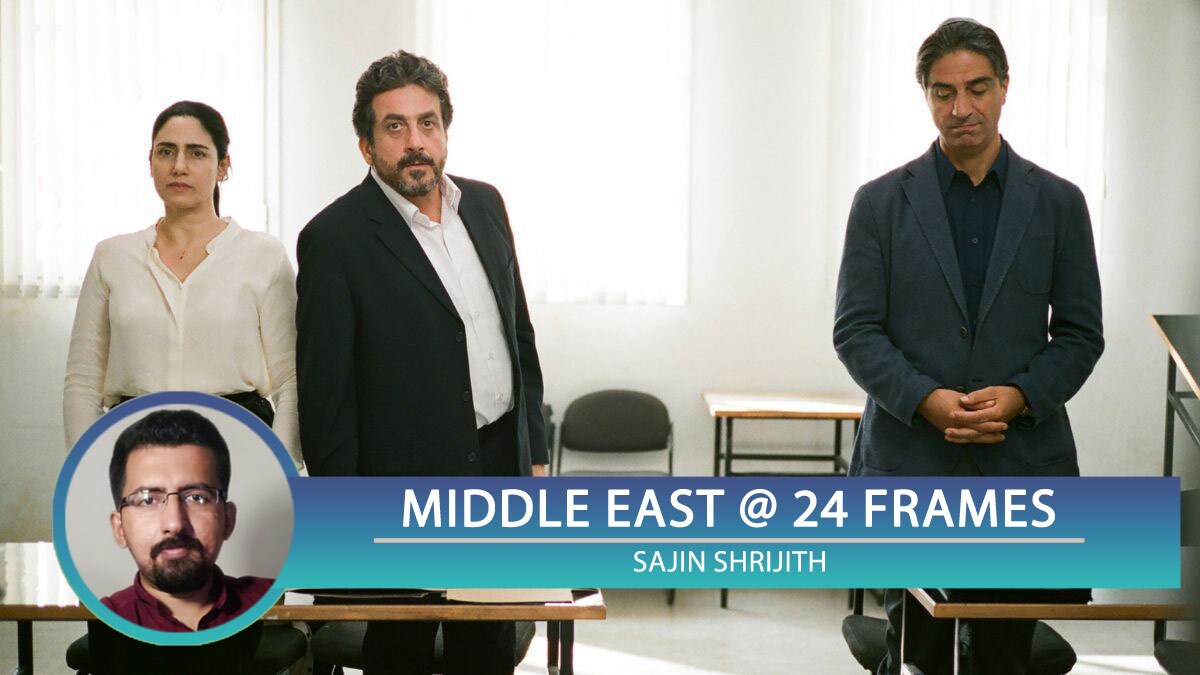
An Israeli middle-aged woman, Viviane Amsalem (Ronit Elkabetz), is trying to break free from her husband of 30 years, Elisha (Simon Abkarian, who played one of the baddies in Casino Royale). She desperately needs a “gett” (divorce), but he is unwilling to grant it to her. As the film opens, we are in the middle of a trial. The woman’s lawyer is pleading her case before the judges. There is something different about the Israeli court system. This is a religious court presided over by three rabbis. The rabbis repeatedly ask him to grant her a divorce, and his answer is always the same: “No.”
What ensues is a hilarious 30 minutes that gradually turns into the serious courtroom drama that it really intended to be. Viviane’s reason is simple: She doesn’t love Elisha anymore. They are simply incompatible. What is so hard to understand about that? But alas, this is not the U.S. The husband fails to show up in court on more than one occasion. Viviane, her lawyer, and the judges are all at their wits’ end. Witnesses are slowly brought in, and at one point, a witness takes the side of both, resulting in yet another humorous situation.
A multitude of thought-provoking arguments are put forward by the lawyers from both sides. Viviane, along with us, is forced to go in and out of the same courtroom for the next five years, and what we see is the husband still being the same stubborn jerk he was when the trial first began. This is about a woman trapped and made to feel increasingly claustrophobic inside an absurd, almost Kafka-esque legal process that is overseen by men with a patriarchal and sexist mindset. Even though the film is set in the same location for the entire length of its duration, it never bores us. I didn’t know what to expect going into the film. One is likely to initially assume it’s a comedy, judging by the comical situations that transpire in the first 30 minutes.
In many ways, it’s reminiscent of 2011’s A Separation, which also dealt with a similar subject. Compellingly acted and thoughtfully directed (by siblings, one of them being the lead actress), Gett: The Trial of Viviane Amsalem is both frustrating and rewarding at the same time. The film cannot be recommended highly enough. It should be made compulsory viewing for any serious cinephile.
Perhaps Ronit Elkabetz would be making more such politically charged films if she were still alive today. A couple of years after the release of Gett, she passed away, aged 51, after a prolonged battle with lung cancer.
In an interview with The Film Experience at the time of the release, Ronit mentioned that she and brother Shlomi Elkabetz had so much material that, at one point, the idea of doing the story in the long-form format fleetingly crossed their minds. "It was never the thing, though, we never wanted to extend this story forever. We were not telling this story; there were so many insights that had to do with Israeli culture and the situation of women, and it had to do with the Mizrahi Jews. We didn’t want to put this in a TV show; we needed something that would stand up for much longer in a solid way. We also always wanted to make a cinema, to watch this story on the big screen. It’s different to watch this in a social context, with 400 people, rather than having a TV show. Our films are very political, and cinema was the right platform," she had shared.
