



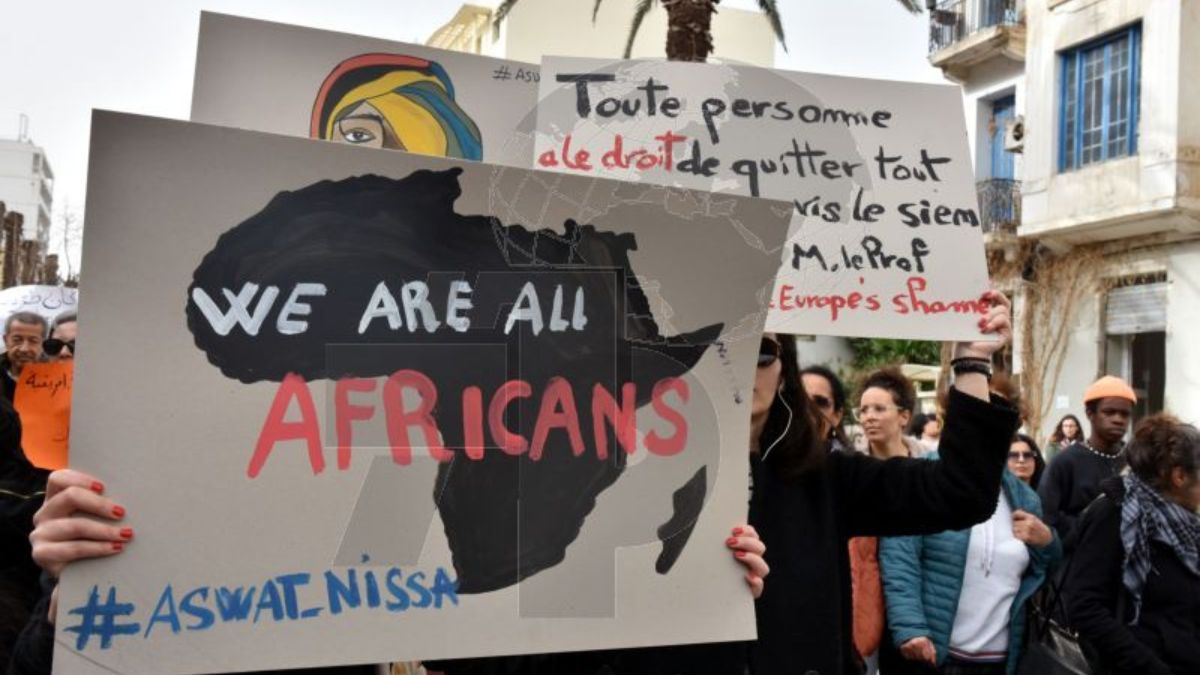
Earlier this month, Tunisia declared that it would not become a transit zone for migrants. In 2025, the country repatriated over 10,000 migrants. Most of these migrants are from sub-Saharan African countries, including Sudan, Somalia, Eritrea, and Cameroon, as well as other West African nations. The sociopolitical course of Tunisia is marked by a concerning rise in state-sponsored racial discrimination, shifting the North African nation from the emerging democracy of the Arab Spring into a stage of hostility specifically aimed at sub-Saharan African migrants.
However, to understand the root of discrimination, one must look beyond racism and analyse the complex mechanisms involved. These include statecraft, economic challenges, and unresolved identity crises that remain within the state. The discrimination against Black African migrants in Tunisia is not accidental; rather, it is a deliberate political strategy.
According to the 2021 national survey, approximately 59,000 migrants have been living in Tunisia for over six months, whether under regular or irregular status. A notable gap exists between the number of registered regular and irregular migrants.
According to the UNHCR, as of 30 September, Tunisia has 7,812 UN-registered refugees and asylum seekers. Most of these are of African origin, including Sudan (3,959), Somalia (451), Eritrea (174), and Cameroon (171). The rest are from Syria (1,861) and unspecified origins (1,196). In contrast, according to the Interior Ministry, as of June 2024, about 23,000 irregular African migrants were in the country. This reveals a significant difference in the numbers.
The discrimination starts with the use of rhetoric by top leaders, which justifies violence and promotes racism. This change peaked in February 2023 when President Kais Saied gave a speech that drastically impacted the safety of Black migrants in the country. By referencing a local version of the ‘Great Replacement’ theory, Saied claimed that ‘hordes’ of irregular migrants were part of a criminal plan to change Tunisia’s demographic makeup and take away its ‘Arab-Islamic’ identity.
Meanwhile, framing the presence of sub-Saharan Africans as a conspiracy against Tunisia, where the state effectively deputised the public to enforce racial borders. Following the president’s speech, a wave of violence erupted across the country, with Black individuals, regardless of their legal status, being attacked on the streets, evicted from their homes by landlords fearing legal repercussions, or dismissed from their jobs. The state’s language provided a moral license for racism, signalling to the populace that the persecution of Blacks was an act of patriotism.
Furthermore, discrimination is enforced geographically through a harsh policy of containment and expulsion that acts as a form of erasure. This is clear in the port city of Sfax, known as the ‘departure point’ for migration to Europe, where tensions are deliberately heightened. During the clashes, the government’s response was not to mediate or provide humanitarian aid, but to carry out mass arbitrary arrests and forced displacements of migrants.
Security forces are documented rounding up hundreds of Black migrants, including pregnant women and children, and forcibly transporting them to militarised buffer zones on the border with Libya and Algeria. Located in the middle of the desert, where migrants are abandoned without food, water, or shelter, and are trapped between countries that refuse to accept them. By physically removing Blacks from urban centres and abandoning them in the periphery, Tunisia attempted to make the problem invisible, treating humans as refuse to be discarded rather than rights-holders to be protected.
However, the main reason for this drive is the rapidly worsening economic situation. The country faces inflation, high unemployment, and ongoing shortages of basic staples such as sugar, coffee, and flour. In this context, the government employs racial discrimination as a diversionary tactic. Black migrants are painted as resource hogs, crime culprits, and sources of instability, allowing the government to redirect the frustrated, hungry population's anger towards a vulnerable population.
Despite being geographically located in Africa, a significant cognitive dissonance exists in the Maghreb regarding its African identity. Historically, the state distinguished between ‘Tunisians’ and ‘Africans,’ with the latter used exclusively for Black sub-Saharan Africans. By rejecting these migrants, Tunisia is asserting its connection to the Arab and Mediterranean worlds while distancing itself from the global south and Black Africa. This reveals a deeply rooted internalised racism that equates whiteness or Arabness with civilisation and Blackness with disorder.
Consequently, this phenomenon is linked to the pressures exerted by the European Union. The externalisation of Europe’s borders has turned Tunisia into a border protector, responsible for preventing migrants from entering the EU. Through various financial initiatives, European leaders have pressured Tunisia to act as a gatekeeper of the Mediterranean. The Tunisian government instrumentalises the migrant crisis, especially by signalling to Europe that it will not be a passive recipient of unwanted populations, and to gain greater leverage in diplomatic negotiations. In this context, Black migrants are discriminated against not only because of local racism but also because of their role as a bargaining chip between Tunisia and the EU.
Finally, it is essential to understand that the problems in Tunisia are complex, with state rhetoric, economic struggles, historical prejudice, and international pressures being some of the main causes that lead to systemic discrimination against Black migrants.
