



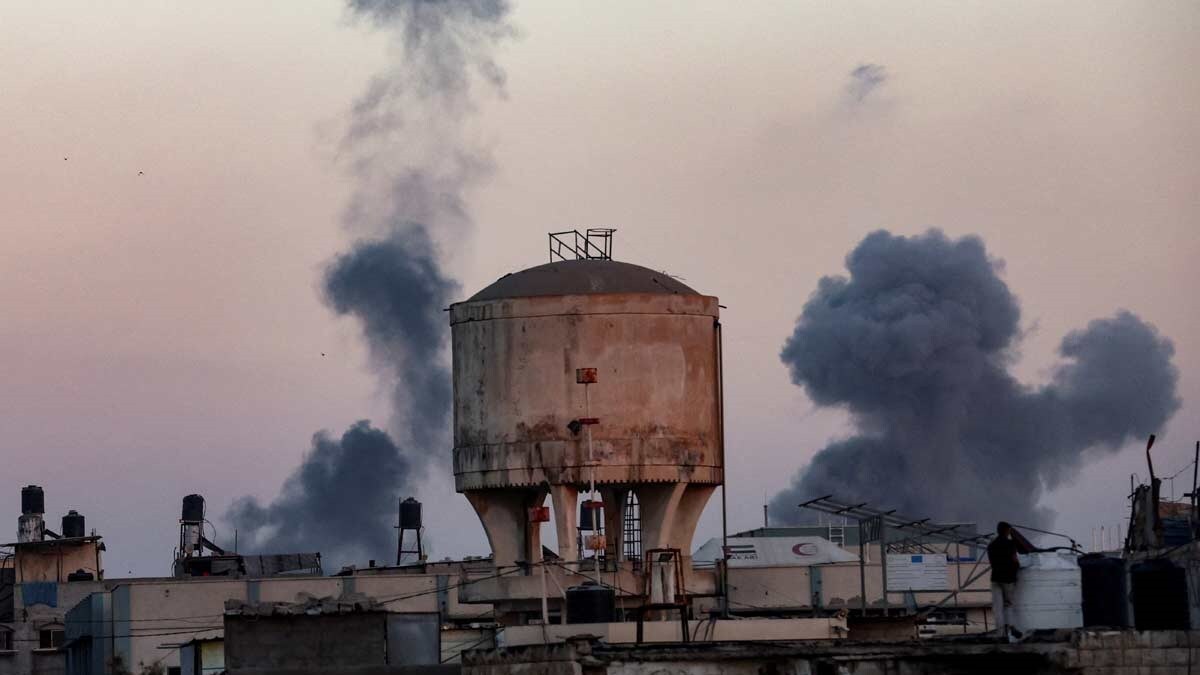
The fragile ceasefire between Israel and Hamas is under serious strain following renewed violence in southern Gaza, with both sides accusing each other of breaching the agreement brokered by US President Donald Trump. The most significant flare-up occurred on Sunday when Israeli forces launched airstrikes on Rafah in southern Gaza after what Israel described as a “blatant violation” of the truce by Hamas militants.
According to the Israeli military, two soldiers were killed during operations in Rafah to dismantle what it called “terrorist infrastructure.” In response to the deaths of Maj Yaniv Kula, 26, and Staff Sgt Itay Yavetz, 21, Israeli aircraft struck tunnel shafts and military sites, later expanding the strikes to the northern town of Beit Lahia. These are the first Israeli military fatalities since the ceasefire took effect on 10 October.
Hamas’s military wing denied knowledge of any attacks in Rafah, claiming it had lost contact with its fighters in the area. It insisted that the group remains committed to the ceasefire, accusing Israel of fabricating justifications to violate the truce and escalate hostilities.
In a statement, senior Hamas official Izzat Al-Rishq said the group had “faithfully implemented” the terms of the agreement and accused Israel of killing civilians, delaying the release of detainees, and blocking humanitarian aid.
The renewed hostilities have halted the transfer of aid into Gaza, further compounding the humanitarian crisis in the territory. Israeli officials, speaking anonymously, said the decision to stop aid shipments was temporary but linked to the security situation. Many in Gaza already face severe shortages of food, water, and medicine, and the ceasefire had provided a brief opportunity to ease the suffering.
Sunday’s violence was not isolated. On Friday, Israeli forces fired on a vehicle in northern Gaza, killing nine people, including four children. The military claimed the vehicle had entered a restricted area and ignored warning shots. Gaza’s rescue services, affiliated with Hamas’s Interior Ministry, described the attack as unjustified, highlighting the confusion many civilians face over ceasefire demarcation lines. Israel said its warnings were clear but acknowledged the challenges civilians face in a devastated landscape with limited access to communication and maps.
As tensions escalate, Israel’s political leadership is under pressure from within. Prime Minister Benjamin Netanyahu is balancing a commitment to the ceasefire with demands from his far-right coalition partners to resume the war. National Security Minister Itamar Ben-Gvir, who opposed the truce from the outset, has called for full-scale combat operations to resume immediately. He also welcomed the suspension of aid deliveries, insisting they should not be resumed.
Despite the violence, both sides have publicly reaffirmed their commitment to the ceasefire. However, statements from Israeli officials suggest a new pattern may be emerging: treating each breach with a military response while attempting to avoid a total collapse of the agreement. Defence Minister Israel Katz said that Hamas “will pay a heavy price” for every violation and warned that responses would grow in intensity if attacks continued.
The ceasefire, agreed in early October in Sharm el-Sheikh, includes provisions for phased hostage exchanges and prisoner releases. Hamas has so far freed 20 living hostages and handed over the bodies of 12 others. A 13th body delivered to Israel was later found not to be a hostage. In return, Israel has released nearly 2,000 Palestinian prisoners and returned over 100 bodies to Gaza. However, Israel feels that Hamas is deliberately delaying the return of the remains of deceased hostages.
Israeli officials have also expressed concern about Hamas continuing to operate from tunnels beneath areas still under Israeli control. The southern Gaza corridor between the so-called yellow line and the Egyptian border is considered particularly volatile, with officials warning it could become a flashpoint for further clashes.
President Trump’s administration has remained closely engaged, with US officials, including envoys Steve Witkoff and Jared Kushner, coordinating with Israeli officials. Trump, speaking from Air Force One, suggested that the incident in Rafah may have been the work of rogue elements within Hamas, not its central leadership. The US has urged Israel to respond proportionately while showing restraint, encouraging the government to focus on isolating Hamas and building alternatives in Gaza.
A senior Egyptian official confirmed that Cairo is engaged in “round-the-clock” diplomacy to prevent a total collapse of the ceasefire. Meanwhile, reports indicate that senior US figures, possibly including Vice President J.D. Vance, are expected to visit Israel soon in a renewed effort to stabilise the situation and push forward the terms of the Sharm el-Sheikh agreement.
