



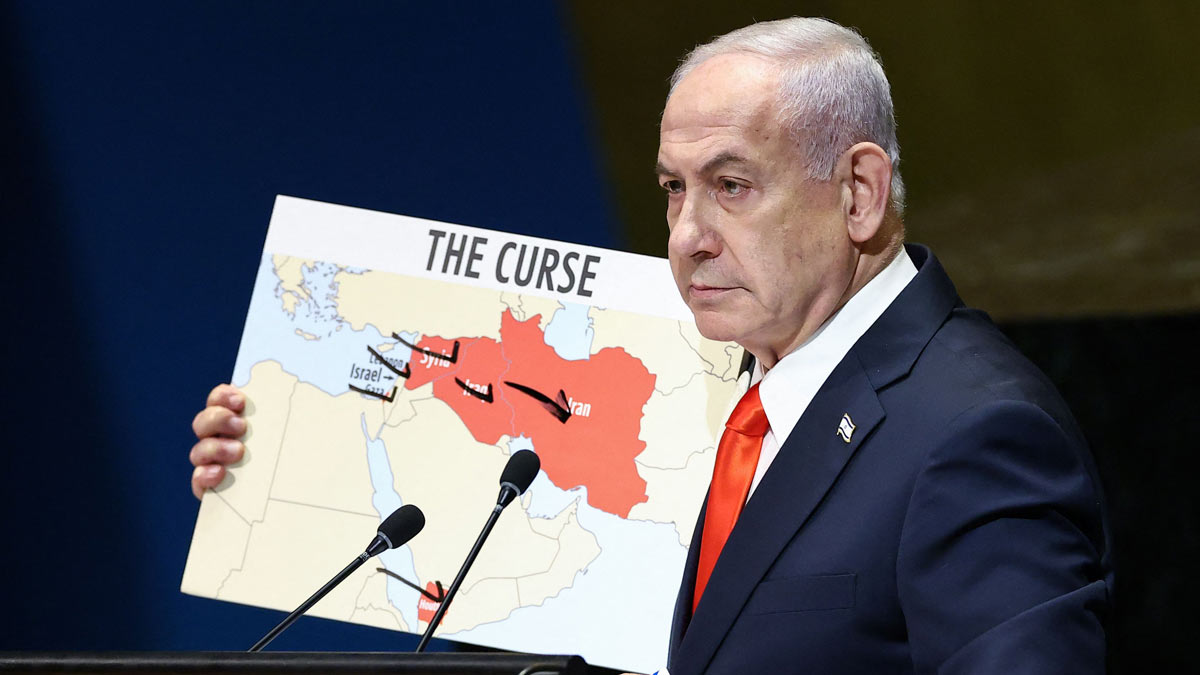
Israeli Prime Minister Benjamin Netanyahu delivered a defiant address at the United Nations General Assembly yesterday, categorically rejecting the creation of a Palestinian state and threatening to continue the military campaign to “finish the job” against Hamas. The speech was as much a defence of Israel’s military campaign as it was a rejection of the widespread criticism his government faces.
As Netanyahu took the podium, dozens of officials and diplomats left the hall in protest. Large sections of the assembly hall were left sparse. The delegations of close allies such as the United States and the United Kingdom were present only at a low level, with senior officials absent. Outside, thousands of demonstrators filled the streets of New York, voicing opposition to Netanyahu’s presence and to the war.
Netanyahu made it clear that Israel would not halt its Gaza campaign and that it would continue to go aggressively after Hamas. The war, he argued, was not a localised dispute but part of what he described as a seven-front battle involving threats from Gaza, Yemen, Iran, Syria, Lebanon and Iraqi militias. To illustrate the scale of what he portrayed as a regional struggle, he displayed a map titled “The Curse”.
Netanyahu vent his ire against Western governments, including the United Kingdom, France, Canada and Australia, for their decision to recognise a Palestinian state. He called the move reckless and misguided, arguing that it was tantamount to rewarding terrorism. He likened it to legitimising al-Qaeda in the aftermath of the 9/11 attacks in the United States. Netanyahu insisted that a Palestinian state would endanger Israel’s security and encourage further violence. He stressed that Israel would never permit such a state to come into existence, a stance he claimed had the overwhelming support of the Israeli public.
He also addressed mounting accusations that Israel’s conduct in Gaza amounts to war crimes. An International Criminal Court arrest warrant has been issued for him on allegations of war crimes, while a UN commission of inquiry recently concluded that Israel had committed genocide in Gaza. Netanyahu dismissed the charges as baseless. He rejected claims that Israel had deliberately starved the population, insisting that the Israeli military had repeatedly urged civilians to evacuate combat zones. He maintained that shortages of food and aid were caused by Hamas, which he accused of diverting supplies.
In one of the more dramatic elements of his appearance, Netanyahu attempted to extend the reach of his speech beyond the walls of the UN. He arranged for his remarks to be broadcast into Gaza using loudspeakers mounted on trucks near the perimeter fence. He also claimed that Israeli intelligence had hacked into Gaza’s mobile phone networks to transmit his words directly to civilians and to Hamas leaders. His intention, he said, was to urge Hamas to surrender and release captives, while reassuring Israeli hostages that they had not been abandoned. The move drew sharp criticism at home. Opposition figures dismissed the loudspeaker broadcasts as childish gimmicks that did nothing to advance Israel’s strategic position.
Despite the cool reception in New York, Netanyahu repeatedly underlined the continuing support of the United States, describing Washington as Israel’s most reliable ally and principal military backer. He praised President Donald Trump’s stance, contrasting it with the decisions of other Western states that have recognised Palestine.
Reactions within Israel were divided. Opposition leader Yair Lapid characterised the UN appearance as tired and repetitive, accusing Netanyahu of offering rhetoric in place of a credible plan for peace or for the release of Israeli captives. He argued that the speech had deepened Israel’s international isolation and damaged its reputation.
Ultimately, Netanyahu’s address amounted to a restatement of his government’s maximalist war aims in Gaza. He presented the conflict as existential, requiring total victory over Hamas and its allies. Yet the images of diplomats filing out of the UN hall and the mass protests outside served as stark reminders of Israel’s growing isolation on the world stage nearly two years into the war.
