



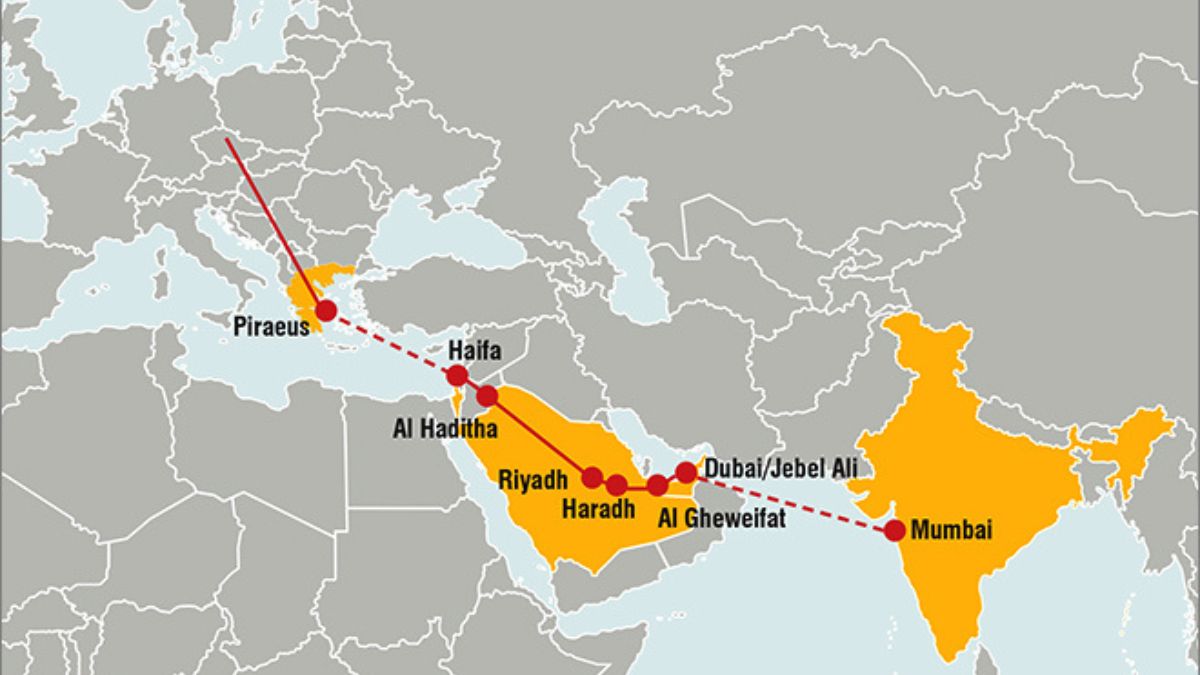
On the surface, the India-Middle East-Europe Economic Corridor (IMEC) may appear to be just another large-scale connectivity initiative in an already crowded field of transnational infrastructure projects and plans. Yet, for India, IMEC is more than just a logistics project. It represents a defining moment of geoeconomic and geopolitical opportunity—one that could reframe New Delhi’s global role as a connector of continents, a supplier of green energy, and a stakeholder in shaping future trade routes.
Announced on the sidelines of the G20 Summit in New Delhi in September 2023, IMEC is finally coming into clearer focus. The time to act is now. India stands at a crucial crossroads. It has the geopolitical goodwill, the economic ambition of a Viksit Bharat @2047, and a rising stature as the world’s 4th largest economy. It also has the political capital to lead a project of this scale and ambition.
However, as the conference discussions underscored, translating this potential into concrete progress will require a sense of urgency, public-private synergy, and deft regional diplomacy. This was highlighted by Shishir Priyadarshi, president, Chintan Research Foundation (CRF) wherein he mentioned the transition of the IMEC from an aspirational vision to an impending strategic imperative.
IMEC is designed to connect India with Europe via the Arabian Peninsula using a multi-modal network of railways, highways, ports, energy pipelines, and digital infrastructure. More than an infrastructure project, IMEC reflects a bold geopolitical bet by India to reshape global trade dynamics, secure energy transitions, and assert leadership in an increasingly multipolar world. The need to prioritise IMEC also lies in assessing International North-South Transport Corridor (INSTC) which was launched with much promise in 2000.
INSTC was envisioned as a direct link from Mumbai to Russia via Iran and the Caspian Sea. While theoretically sound and geographically shorter than current routes, INSTC has suffered from chronic under-implementation. Political uncertainties in Iran, underdeveloped logistics infrastructure, and lack of coordinated investment among member countries have all plagued its progress. However, IMEC, by contrast, begins with several inherent advantages. It is geopolitically aligned with India’s closest strategic and economic partners—the United States, the European Union, the UAE, Saudi Arabia, and Israel. The Abraham Accords and budding normalisation between Israel and Saudi Arabia can further reduce the friction in the corridor’s core geography. In comparison, where INSTC was predominantly reactive—designed to bypass existing routes—IMEC is proactive, visionary, and future-focused. It is engineered to serve not only present trade needs but also the coming era of green energy, digital connectivity, and resilient supply chains.
Strategic timing: India’s window of opportunity
India stands at a rare moment in its global trajectory. Already the world’s fourth-largest economy, it is targeting a transformation into a developed nation by 2047, under the Viksit Bharat vision. IMEC complements this ambition by positioning India as both a connectivity hub and a values-based development leader. Shri Dammu Ravi, Secretary (Economic Relations) in the Ministry of External Affairs at CRF’s IMEC conference mentioned, “IMEC is “critical to India,” wherein he emphasised India’s ability to serve as both the glue and anchor of this transformative endeavour. He echoed a key sentiment that India's economic growth, regional partnerships, and political will make it uniquely capable of orchestrating such a multi-continental project. More than just rhetoric, these statements reflect a readiness—political, economic, and strategic—that India must now convert into concrete progress.
Economic multiplier, green potential
In terms of the plans for IMEC, its design will reduce shipping times between India and Europe by as much as 60 percent and distances by 40 percent compared to current routes that rely on the Suez Canal. The corridor is not limited to physical goods; it is envisioned as a “green and digital bridge”, as articulated by European Commission President Ursula von der Leyen during her March 2025 visit to India. For India, this can prove to be a strategic bonanza. Not only does it promise more efficient trade with Europe, but it also provides a stable, secure, and diversified alternative to chokepoints like the Suez Canal and the Strait of Hormuz. Furthermore, IMEC supports India's ambition to become a global green hydrogen hub. With an allocation of $2.5 billion toward green hydrogen production, and key firms like Adani, L&T, and ReNew Energy are investing heavily in this sector, the ability to transport clean fuel across borders via IMEC’s infrastructure is critical. Pipelines, green ports, and digital smart grids can catalyse India’s role as a net energy exporter in the emerging global decarbonidation market.
IMEC also represents an indirect dividend of regional normalization efforts. The Abraham Accords created new diplomatic space between Israel and the Gulf. IMEC, by incorporating Israel and Saudi Arabia alongside India and Europe, institutionalizes this thaw into economic cooperation. This reflects a convergence of business logic and strategic trust—qualities that the INSTC, involving unstable or adversarial nodes, lacked. Moreover, India’s deepening relations with Israel, the UAE, and Saudi Arabia position it as a trusted interlocutor capable of mediating interests and coordinating investments. Unlike China’s BRI, which is often met with scepticism, India is seen as a neutral, democratic partner offering transparent and sustainable development models. US President Trump, during his February 2025 summit with Prime Minister Modi, described IMEC as “one of the greatest trade routes in all of history” and called for a summit of IMEC signatories to be held later this year. This level of support gives India an additional tailwind to act swiftly and assertively.
Challenges Ahead
That said, the road ahead will not be without its hurdles. The project’s estimated cost of over $600 billion over a 10-year horizon poses significant financial challenges. Innovative financing will be key to spreading the burden and risk. The sheer complexity of coordinating the nations, each with different regulatory regimes and priorities, will require robust institutional mechanisms. Security is another serious concern. Parts of the corridor pass through volatile maritime zones and politically sensitive regions. A joint IMEC security forum that brings together coast guards, cyber agencies, and logistics providers must be envisioned to ensure resilience. The IMEC project is not merely a vision—it is a necessity. It aligns perfectly with India’s economic aspirations, diplomatic relationships, energy goals, and regional credibility. More than any single policy, IMEC represents a test of India’s strategic capacity to lead coalitions, shape global infrastructure norms, and architect the future of commerce across continents. With the political will, economic momentum, and regional alignment now in place, India must act—decisively, quickly, and inclusively. The bridge to a connected future is waiting to be built.
(The author is assistant professor, Amity Institute of Defence and Strategic Studies, Amity University, Noida.)
