



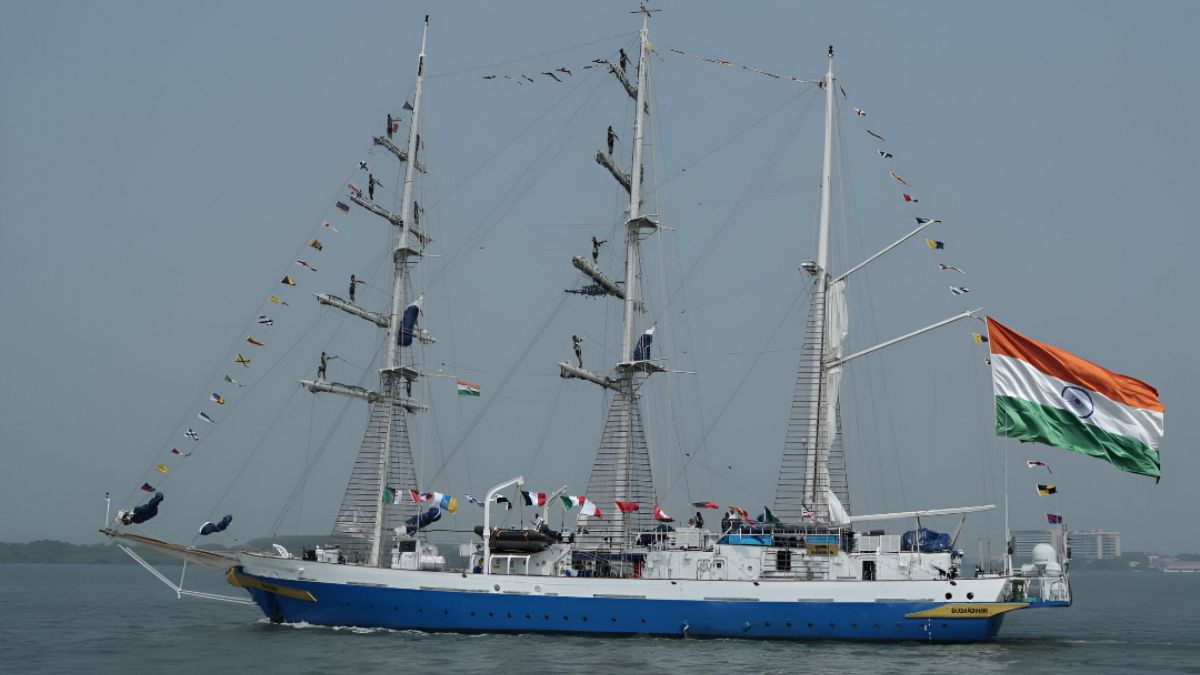
The Indian Navy's sail training ship, the INS Sudarshini (IMO: 1011721) on Tuesday began its ten-month-long sailing expedition from the Naval Base in Kerala's Kochi.
The transoceanic voyage, titled Lokayan 26, will cover more than 22,000 nautical miles, visiting 18 ports in 13 countries.
It is said to be one of the Indian Navy's most extensive sail training deployments in recent times.
The sailing vessel was flagged off by Vice Admiral Sameer Saxena, Flag Officer Commanding-in-Chief of the Southern Naval Command, in addition to senior officers, enthusiastic members of the naval community, schoolchildren, the family members of the ship's crew, and the media.
One of the key highlights of the voyage is the ship making its debut in one of Europe’s premier maritime festivals—the Escale a Sete in France—during the March-April period this year.
On July 2026, the INS Sudarshini is set to join a grand international flotilla—Sail 250 at New York—during the International Parade of Sails amid America's 250th Independence Day celebrations.
"A shining ambassador of India's shipbuilding prowess & maritime heritage," wrote Union Minister for Ports, Shipping and Waterways, Sarbananda Sonowal, in an X post on Wednesday, celebrating the Navy's achievement.
Built indigenously by Goa Shipyard Limited (GSL), this 54-metre-long sailing vessel is equipped with 20 sails, covering a sail area of more than 1,000 square metres.
Notably, its journey starts just a week after the INSV Kaundinya (MMSI: 419002029)—which also belongs to the Indian Navy—reached Oman's Port Sultan Qaboos on January 14, marking an end to an 18-day voyage from Gujarat's Porbandar.
Inspired by depictions of ancient Indian ships in the Ajanta Caves and constructed entirely using traditional stitched-plank techniques, the point behind this 5th-century-style vessel's journey was to retrace the historic maritime routes that connected India with the rest of the world.
