



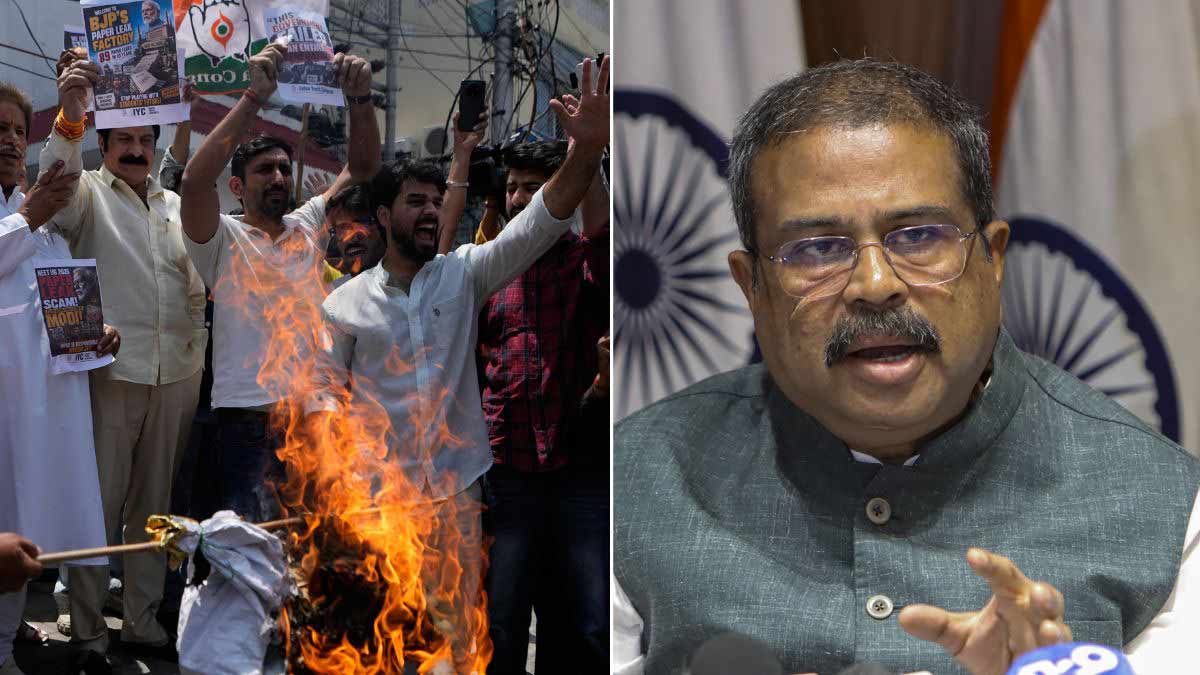
The Union Education Ministry on Friday announced that the cancelled NEET UG 2026 examination will be re-conducted on June 21, following allegations of a paper leak and the circulation of a guess paper that reportedly matched actual questions.
Addressing his first press conference after the cancellation, Union Education Minister Dharmendra Pradhan said the government had adopted a zero-tolerance approach towards examination malpractice and would ensure that no deserving candidate loses an opportunity because of the education mafia.
The National Testing Agency (NTA) had conducted the exam on May 3, but cancelled it days later after confirming that portions of the paper had been compromised. According to the minister, authorities verified within three to four days that the leaked material was authentic.
Union government acknowledges lapses
In a rare admission, Pradhan said there had been a breach somewhere in the chain of command despite reforms introduced after last year’s controversies. He stressed that cancelling the exam was necessary to preserve fairness.
“We will not allow a moneybag to take anybody’s seat away,” he said, adding that the government was engaged in a long fight against organised exam rackets.
The case has now been handed over to the Central Bureau of Investigation (CBI), which will probe how the leak occurred despite new safeguards.
What the Radhakrishnan committee recommended
Following earlier controversies around entrance exams, the government had constituted the Radhakrishnan Committee to overhaul the examination ecosystem. The panel suggested a multi-layered reform framework aimed at plugging systemic vulnerabilities.
The committee recommended a comprehensive overhaul of the examination system, including end-to-end encryption of question papers and their secure digital transmission to centres, along with last-minute generation of papers to minimise the risk of leaks. It also proposed biometric authentication of candidates at entry points and the use of AI-based monitoring systems to detect anomalies and malpractice patterns.
To strengthen accountability, the panel called for decentralised distribution with strict audit trails to track every stage of paper handling, as well as enhanced vetting and responsibility of exam personnel, including centre supervisors.
Crucially, it emphasised a gradual shift to computer-based testing (CBT) for large-scale exams to reduce reliance on physical question papers and curb vulnerabilities.
The committee had also flagged the role of organised cheating networks and called for stronger coordination between central and state agencies.
Government sources said several of the committee’s recommendations were implemented ahead of NEET UG 2026. These included tighter logistics protocols, partial digital tracking of question papers, and stricter centre-level monitoring.
However, several critical gaps appear to have persisted. The examination continued in a paper-based format, leaving scope for physical leaks, while digital safeguards such as full encryption and real-time tracking were not uniformly implemented across the system. The process also remained vulnerable due to multiple human handling points in the chain, creating opportunities for breaches, and the deployment of advanced AI-based surveillance systems to detect anomalies was still at a nascent stage.
Shift to computer-based testing from 2027
In a significant policy shift, Pradhan announced that NEET UG will move to a computer-based format from next year. The transition is aimed at eliminating risks associated with physical question papers and improving security architecture.
Experts have long argued that CBT systems already used in exams like JEE, allow for randomisation of questions, secure delivery, and real-time monitoring, making large-scale leaks far more difficult.
The fresh NEET examination will now be held on June 21, with the government announcing a series of relief measures for candidates to ease the burden of the disruption. The exam fee paid for the cancelled attempt will be fully refunded, and no additional fee will be charged for appearing in the re-examination. Candidates will also be given the option to choose their preferred exam city, with a one-week window provided for making selections and updating related details. Admit cards are scheduled to be released on June 14, and in a bid to reduce last-minute pressure, candidates will be given an additional 15 minutes to fill in details on the OMR sheet. Officials said these steps are aimed at reducing stress and ensuring a smoother examination experience for aspirants.
Students caught in the crossfire
The decision to cancel and re-conduct the exam has triggered anxiety among lakhs of aspirants, many of whom had already undergone months of preparation and stress.
While the government maintains that the move was necessary to protect merit, students and parents have questioned why repeated warnings and committee recommendations failed to prevent yet another breach.
The episode has once again put the spotlight on the NTA’s capacity to conduct high-stakes examinations. With multiple controversies in recent years, the agency faces mounting pressure to restore public trust.
For now, the June 21 re-examination will serve as a critical test, not just for students, but for the credibility of India’s examination system itself.
