



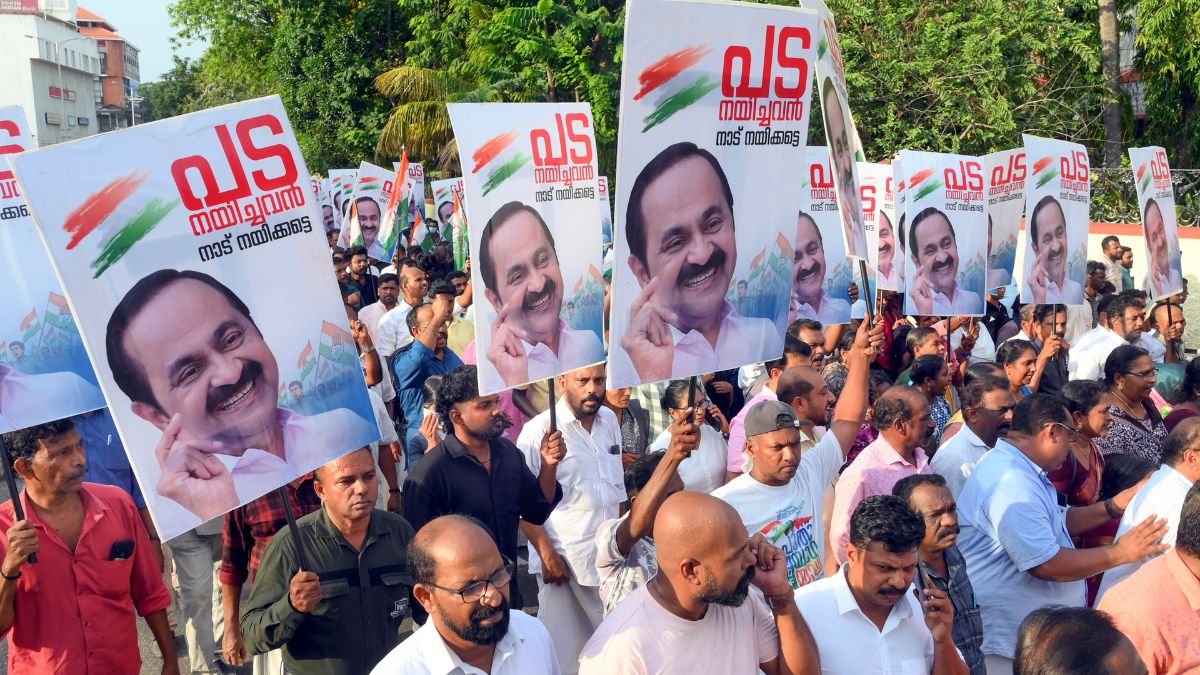
“Vismayam” (surprise) became one of the defining political words in Kerala during the 2026 Assembly election season. Coined repeatedly by Opposition Leader and UDF chairman V.D. Satheesan, the phrase came to embody the electoral verdict that ended Pinarayi Vijayan’s decade-long rule in the state.
Now, as the Congress high command finally hands Satheesan the chief minister’s post after 10 days of intense deliberations, the word appears equally apt for his own political journey—one marked by unexpected turns, repeated setbacks and unlikely comebacks.
Over the years, Satheesan missed out on several important positions, including KSU president, Youth Congress president, KPCC president and even a ministerial berth. Yet in 2021, when the Congress high command broke entrenched factional equations and appointed him Leader of the Opposition–sidestepping the powerful Oommen Chandy-Ramesh Chennithala camp–it came as a surprise to many within the party. Five years later, he has once again overcome the odds to reach the top post in Kerala politics.
Born in Nettoor in Ernakulam district, Satheesan turns 62 this month. Politics entered his life early through student activism at Panangad High School and later at Sacred Heart College, Thevara. He rose steadily through campus politics—as arts club secretary, university union councillor and eventually chairman of the MG University Union.
Although he was repeatedly denied organisational posts in the KSU and Youth Congress, Satheesan persisted. After earning a law degree from the Thiruvananthapuram Law Academy, he once dreamed of building a career in constitutional law at the Supreme Court. But politics pulled him back.
In 1996, the Congress gave him a seat to contest from Paravur, then considered a Left bastion. Relatively unknown in the constituency and given little campaign time, he lost narrowly—by just 1,116 votes—to CPI candidate P. Raju.
The defeat did not push him into retreat. Instead, Satheesan spent the next five years immersed in constituency work—attending weddings and funerals, speaking at local gatherings and forging close ties with UDF workers and residents. The groundwork paid off in 2001, when he won Paravur—a seat he has retained ever since.
Throughout the years of intense factional warfare within the Congress, Satheesan largely stayed away from group politics, focusing instead on legislative performance and constituency engagement. Even during the Left wave led by V.S. Achuthanandan in 2006, he retained Paravur with an increased majority.
Over the next decade, Satheesan emerged as one of the Assembly’s sharpest debaters. His command over policy issues and his ability to challenge ministers made him one of the opposition’s most effective voices. His exchanges with CPIM ministers such as Thomas Isaac during controversies like the lottery issue significantly raised his profile.
Despite expectations that he would become a minister in the Oommen Chandy government after 2011, Satheesan was overlooked—a decision he later admitted caused him deep personal hurt. Yet he continued to take independent positions on environmental issues, tribal land struggles and governance failures, even when his own party was in power.
Even after the UDF’s crushing defeat in 2016, Satheesan retained Paravur by a margin of more than 20,000 votes. In 2021, when he took over as Opposition Leader during the second Pinarayi Vijayan government, the morale of UDF workers was low after successive defeats. But Satheesan led the revival of the UDF, with the front beginning to win by-elections. His predictions on UDF seat tallies and margins in multiple bypolls, the Lok Sabha elections and later the local body polls also proved accurate. In the 2026 Assembly elections, too, he remained the lone Congress leader publicly predicting more than 100 seats for the UDF. He had also forecast the defeat of nearly a dozen ministers in the Pinarayi cabinet. Both predictions came true.
Speaking to THE WEEK after the election results, Satheesan said his election management model was built on a rare blend of data discipline, organisational strength and narrative craft.
At the core of his strategy was bottom-up organisation. Satheesan insisted on strengthening booth committees and grassroots networks first, ensuring voter enrolment was seamless and internal disputes were resolved well before polling day. Social engineering conceived at the top was rigorously executed at the micro level.
Equally distinctive was his approach to coalition politics. After Nilambur, he forged “Team UDF”—a unified framework in which the Congress, the Indian Union Muslim League and other allies campaigned for one another with visible enthusiasm. The idea transformed latent rivalries into a collective spirit, contributing significantly to the alliance’s high strike rate in the Assembly elections. Notably, the support of allies became crucial in Satheeshan’s elevation as the CM.
Notably, Satheesan also sought to redefine what it meant to be a “Congressman” in Kerala. He projected himself as an avid reader—in a state where the Communist Party of India (Marxist) has long associated intellectualism with the Left. He positioned the Congress as a “Nehruvian Left,” tapping into Kerala’s strong centre-left ethos.
At the same time, he created space for a younger generation of Congress leaders—articulate, media-savvy, relatable and often firebrand—to emerge. This cohort moved away from the traditional white-khadi mould, adopting a more casual style and speaking in an accessible everyday idiom, even as many younger CPI(M) leaders retained a more formal, party-line tone.
Satheesan also consciously adopted the idiom of Gen Z and Gen Alpha in an attempt to connect with younger voters. That forward-looking political pitch appears to have resonated strongly with the youth.
Satheesan also took calculated political risks. He has often declared that if the UDF could not return to power with a decisive mandate, he would be willing to withdraw from active politics altogether.
He also openly confronted divisive communal narratives while simultaneously reaching out to even Left-leaning voters. He made bold statements against vote-bank politics as well. In Satheesan’s political style, victory is never accidental; it is engineered through preparation, unity, narrative control and an unwavering focus on both structure and story. That style, ultimately, has now carried him to the chief minister’s office too.
